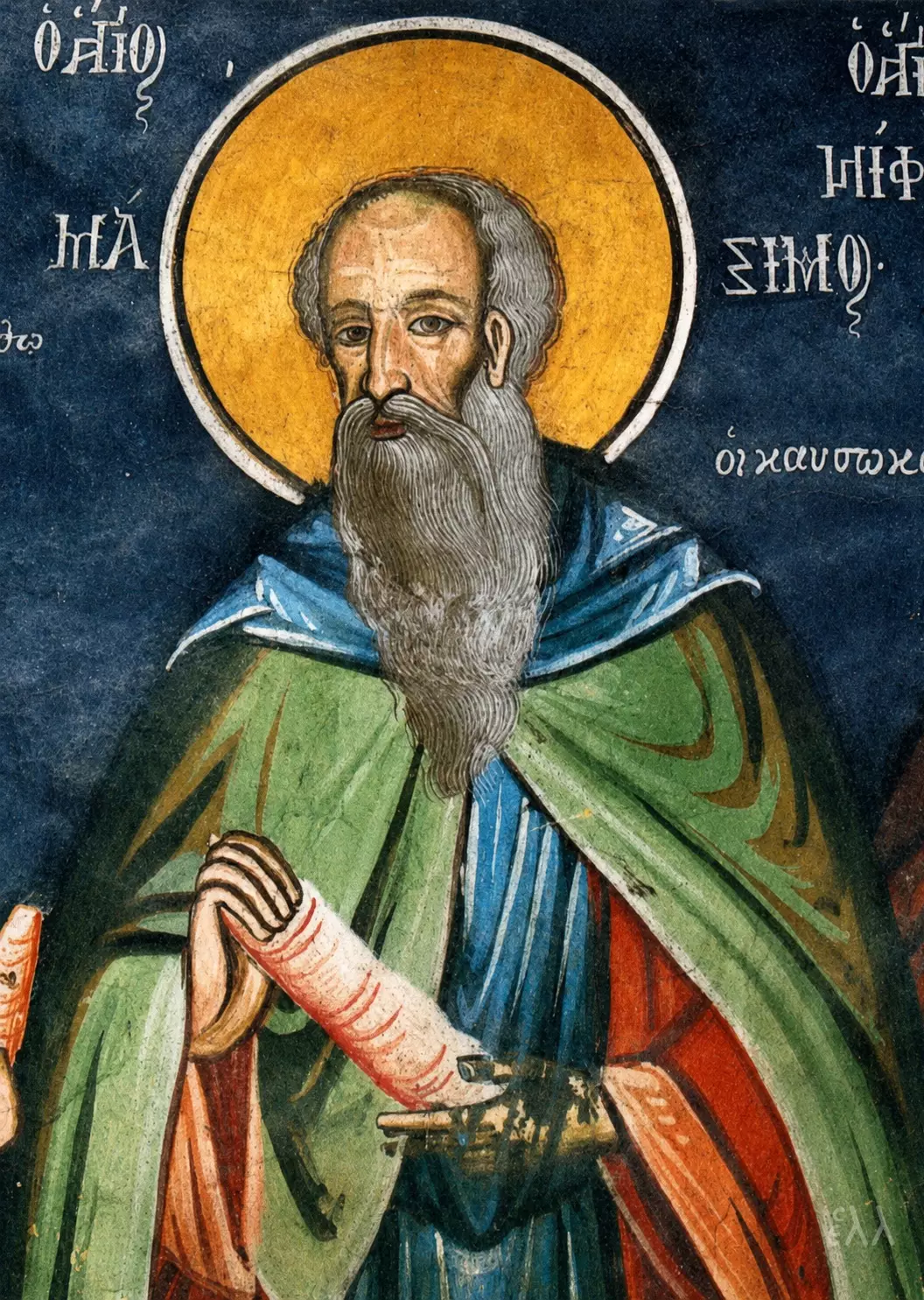
Against the deep blue ground of the kyriakon at Nea Skete on Mount Athos, the eighteenth-century Saint Maximos Kausokalybites wall painting presents the fourteenth-century ascetic as a commanding half-length figure. Maximos belonged to the Athonite eremitic tradition and became known as Kausokalybites, “the hut-burner”, from accounts that he repeatedly abandoned and burned the temporary huts in which he had lived, an extreme expression of detachment from possessions and permanent dwelling. His image stands within the extensive post-Byzantine practice of monumental church painting that continued to structure sacred figures through established iconographic types while permitting considerable regional variation in colour, physiognomy and handling.
The saint occupies almost the entire pictorial field. Around his head extends a broad yellow-ochre halo edged by narrow dark and white contours, its warm surface sharply separated from the blue background. Identifying Greek inscriptions flank the head, integrating textual identification into the painted composition according to a long-established convention of Orthodox monumental art. Grey hair recedes above the high forehead and falls in finely articulated strands beside the temples, while an exceptionally long beard descends across the chest in rhythmic, closely spaced lines.
The Saint Maximos Kausokalybites Wall Painting
Colour carries much of his visual force. A light green mantle spreads broadly across the shoulders, its folds defined by darker contours and ochre-brown accents. Beneath it, a blue garment appears in narrow vertical passages at the centre, joined by a warm red-orange sleeve that introduces a concentrated chromatic contrast. The painter works with clear divisions of local colour, firm outlines and restrained facial modelling, giving him a strongly frontal, hieratic presence.
Across the lower part of the composition, Maximos holds an unfurled scroll whose pale surface is crossed by red lines of writing. One hand gathers its upper edge while the other remains exposed beneath it, the open palm associated within ascetic iconography with purity and the renunciation of worldly life. The face receives greater modelling than the garments: narrow highlights articulate the forehead, nose and cheeks, while the large, steady eyes establish the principal visual focus. Small abrasions and variations in the painted surface remain visible, particularly around the hands, garments and lower edge of the scroll.