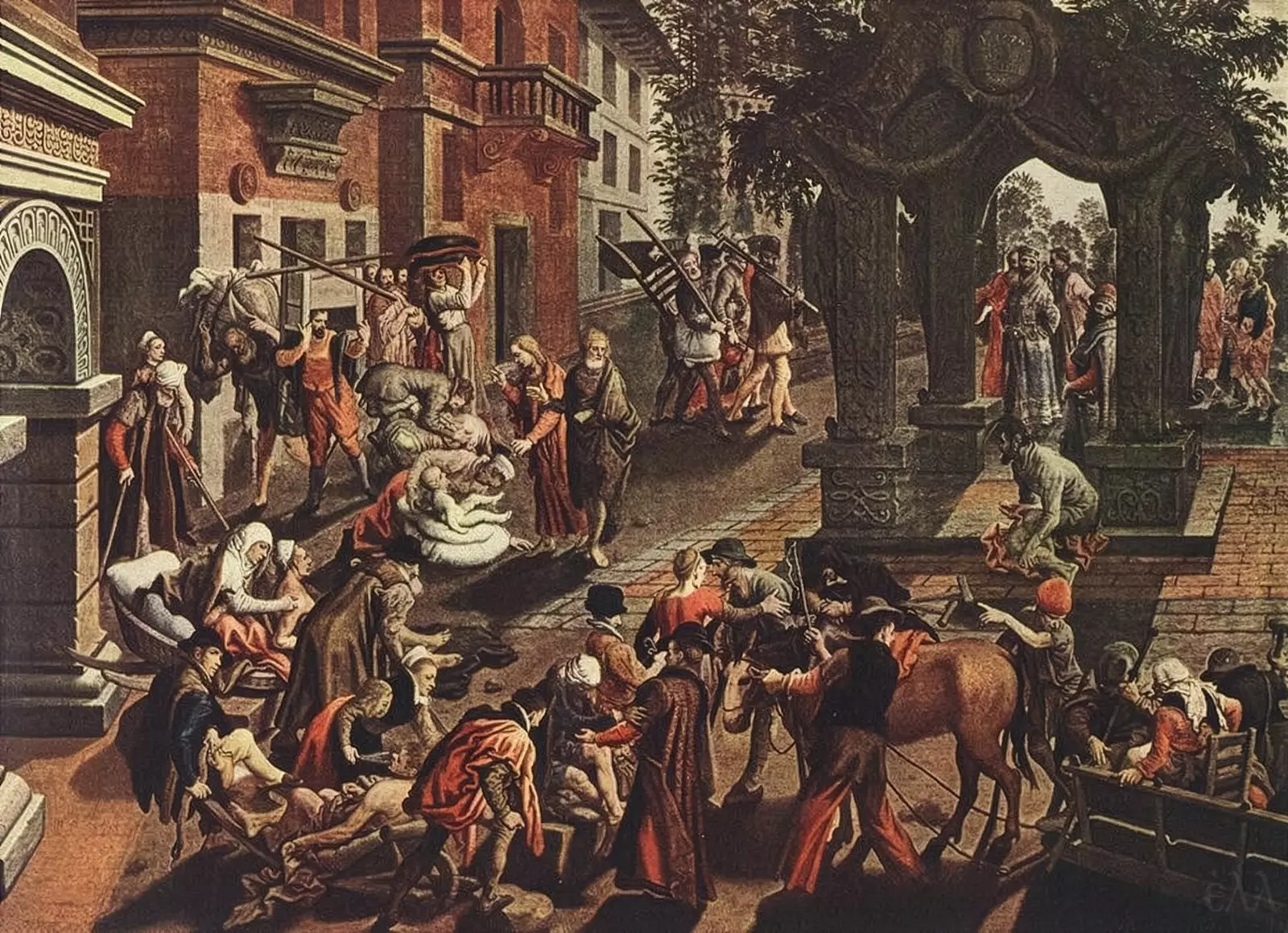
Executed in the final year of his life, Pieter Aertsen Apostles Peter and John (1575) stands as a complex late example of the shifting priorities of sixteenth-century painting in the Low Countries. Measuring 55.5 by 76 centimetres, this densely populated oil-on-panel painting, currently housed in the Hermitage in St Petersburg, represents the biblical healing at the Beautiful Gate (Acts 3:1–10). The scriptural episode recounts the miraculous recovery of a man lame from birth. Aertsen, when he situates this sacred encounter within the wider scene, submerges it in a chaotic, visceral tableau of urban suffering. Widely celebrated for pioneering the monumental genre scene, the artist constructs a visual environment in which everyday affliction physically outweighs the miraculous event. The painting distils the tensions of Northern Renaissance art, balancing acute, almost reportorial observation of the impoverished with the idealised, classical demands of biblical history painting.
Compositional Structure and Spatial Subversion
Aertsen constructs the pictorial space by deliberately frustrating traditional expectations of a central focal point. On the right side of the image, a massive, ornate stone portico dominates the midground and frames the titular apostles. Peter and John stand beneath it before the crippled man, who kneels awkwardly on the pavement with his crutches and support beside him. The apostolic encounter carries the narrative weight of the scene, yet remains compositionally displaced. On the left, the image opens into a plunging street perspective lined with imposing brick and stucco façades, their cornices, pilasters, balconies and carved details drawn from a Renaissance architectural vocabulary. The recession funnels a continuous stream of figures towards the foreground.
Across the lower register crowd the sick, the injured, the impoverished, the exhausted, their bodies forming a dense, interlocking frieze. In the left foreground, attendants bend over prostrate and disabled figures, while a woman wearing a white headdress tends closely to one of the afflicted. In the right foreground, a wooden cart or barrow carries a reclining figure. Towards the centre-right, a donkey occupies the congested space among handlers and pedestrians; beside it, a man in a bright red cap gestures across the scene. The animal, a staple of vernacular painting, introduces mundane commerce and travel into the sacred precinct. Stretchers, crutches, strained muscles, sagging bodies: this accumulation of physical distress anchors the viewer in the harsh material reality that Aertsen makes visible. The foreground is crowded with the afflicted; the deeper space, with movement continuing towards and around the portico.
The Architecture of Healing
A striking feature of the panel is its idiosyncratic architectural setting. The imposing stone canopy under which the apostles stand operates as a theatrical set piece signifying the Beautiful Gate of the Jerusalem Temple. Its heavy columns, ornamented bases, carved surfaces and dark presence bear the marks of an antiquarian architectural fantasy filtered through Mannerist design. Above and around the structure, dense foliage partly merges with its silhouette. By contrast, the large urban façades lining the adjacent street are brighter and more regular, articulated by classical architectural details. The resulting dissonance creates a deliberate temporal uncertainty within the image. The portico evokes a stylised antiquity; the surrounding buildings place the biblical event in an urban world shaped by contemporary Renaissance forms rather than in an archaeologically exact Jerusalem.
Beneath the dark canopy, the apostolic interaction unfolds with restrained dignity. The crippled man, his body bent low and accompanied by crutches, raises himself towards the standing figures. Peter and John remain upright among several attendants and onlookers, their relative stillness separating the sacred encounter from the more agitated activity elsewhere. One apostolic figure occupies the central opening of the portico, another standing close by; the kneeling man below directs the viewer back to the episode described in Acts (Acts 3:1–10). The spatial concentration of these figures provides a visual pause within the larger crowd. The crippled man himself is rendered with close attention to bodily impairment and to the implements on which he depends. Around him, meanwhile, the pavement remains busy with carriers, animals and bodies in motion.
Pieter Aertsen Apostles Peter and John: Mannerism and the Genre Tradition
The deliberate crowding of the composition reflects the complex aesthetic and historical crosscurrents of Flemish Mannerism. Aertsen was born in Amsterdam but spent his most formative professional years in Antwerp, the thriving commercial and artistic centre of the period. There he absorbed Italianate influences associated with Romanist taste while cultivating a distinctly Northern interest in the tactile presence of everyday objects and ordinary people. Returning to Amsterdam later in life, he synthesised these strands. The elongated proportions of several figures, the intertwined poses, the abrupt foreshortenings and the visible muscular tension all accord with a Mannerist visual language. Unidealised faces, exposed feet, coarse garments and the insistent description of bodily strain, however, keep the scene firmly connected to Northern habits of empirical observation.
Aertsen’s approach laid important groundwork for his nephew and pupil, Joachim Beuckelaer, who would further develop monumental market and kitchen scenes. By relegating the primary religious subject to the midground and enlarging the secondary genre activity across the foreground, the painter forces a delayed reading of the image. Through the crowded bodies and practical burdens of the street the viewer reaches the biblical episode only gradually, the visual hierarchy having been intentionally unsettled. The sacred narrative is present from the beginning, yet its discovery depends upon looking past the more immediate spectacle of human need.
The historical context of the 1570s, a period marked by severe religious upheaval and by the aftermath of the Բելդեն փոթորիկ (Iconoclastic Fury) of 1566, profoundly affected artistic production. Aertsen, having lost several major altarpieces to iconoclastic destruction, adapted his pictorial strategies within a volatile climate. Works of this kind could function as religious narratives while also drawing heavily on the conventions of genre painting, placing sacred history inside the observable world of work, illness and poverty. The diseased and crippled figures dominating the foreground therefore operate as narrative participants and, more urgently, as a meditation on charity, poverty and human vulnerability. They recall the visible distress of cities affected by war and economic disruption, translating scripture into an immediate urban visual language.
Materiality, Technique, and Provenance
Executed in oil on a relatively modest wooden panel, the painting rewards close viewing through the density of its small-scale details. Aertsen uses a muted but carefully calibrated chromatic range of earth tones, ochres and deep greys, punctuated by flashes of red and white. These accents pull the eye from figure to figure across the crowded surface and intensify the impression of urban clamour. In the tattered garments, the faces and the strained bodies, the paint handling shifts between controlled description and more fluid passages. The effect is vigorous, especially where fabric, flesh, wood and stone are placed in close proximity. We can almost hear the clatter of carts, the movement of animals and the strained noise of the street against the masonry.
The panel support forms part of the work’s material structure, although the exact preparatory sequence beneath the paint cannot be determined from visual examination alone. What can be seen is the careful tonal construction of the darker passages under the portico, where brown and grey values preserve carved details without flattening the architecture into a single mass. Bright highlights on garments and white head coverings create sharp local contrasts, bringing selected figures forward against the surrounding shadow. Across the panel, small variations in value and saturation separate bodies that would otherwise merge within the crowd; in the portico, darker architecture holds them together.
Now part of the Hermitage collection in St Petersburg, this late work condenses several concerns associated with Aertsen’s mature practice. Within a relatively small panel he combines biblical history, genre observation, architectural fantasy and a dense study of bodily vulnerability. The crippled man at the Beautiful Gate occupies only one part of the pictorial field, while the street remains full of the injured, the dependent, the burdened. Sacred healing and ordinary affliction occupy the same city space, and the composition leaves that coexistence visibly unresolved.
(Թարգմանությունը խմբագրել է Է. Ուիլսոնը):