The vibrant monumental painting of Palaiologan Mistra finds one of its most compelling narratives in The Healing of Peter’s Mother-in-law fresco, currently preserved within the Church of the Panagia Hodegetria. This church, serving as the καθολικὸ of the Brontochion Monastery, stands in the north-eastern part of Mistra’s lower town and was established at the end of the first decade of the 14th century by Abbot Pachomios, a prominent archimandrite and πρωτοσύγκελλος of the Peloponnese. Its architecture—a sophisticated and rare structural model often designated the ‘Mistra type’—is simultaneously innovative, highly complex, and visually imposing. It synthesizes a three-aisled basilica on the ground floor with a five-domed, complex cross-in-square plan on the upper floor, modifying the original design to accommodate galleries demanded by the Mistra leadership.
The church is remarkable also for its ground-floor marble revetment, a luxury rarely encountered during this period even in Constantinople itself. While much of the extensive iconographic program was unfortunately destroyed—the lower zone of standing saints within arched frames has completely perished—the surviving wall paintings in the upper reaches of the church reveal an exceptionally high level of artistry. Reflecting direct links with the artistic production of Constantinople and perhaps resulting from a commission of the Despot Manuel Palaiologos, this cycle exhibits the refined stylistic currents of the capital during the Palaiologan Renaissance.
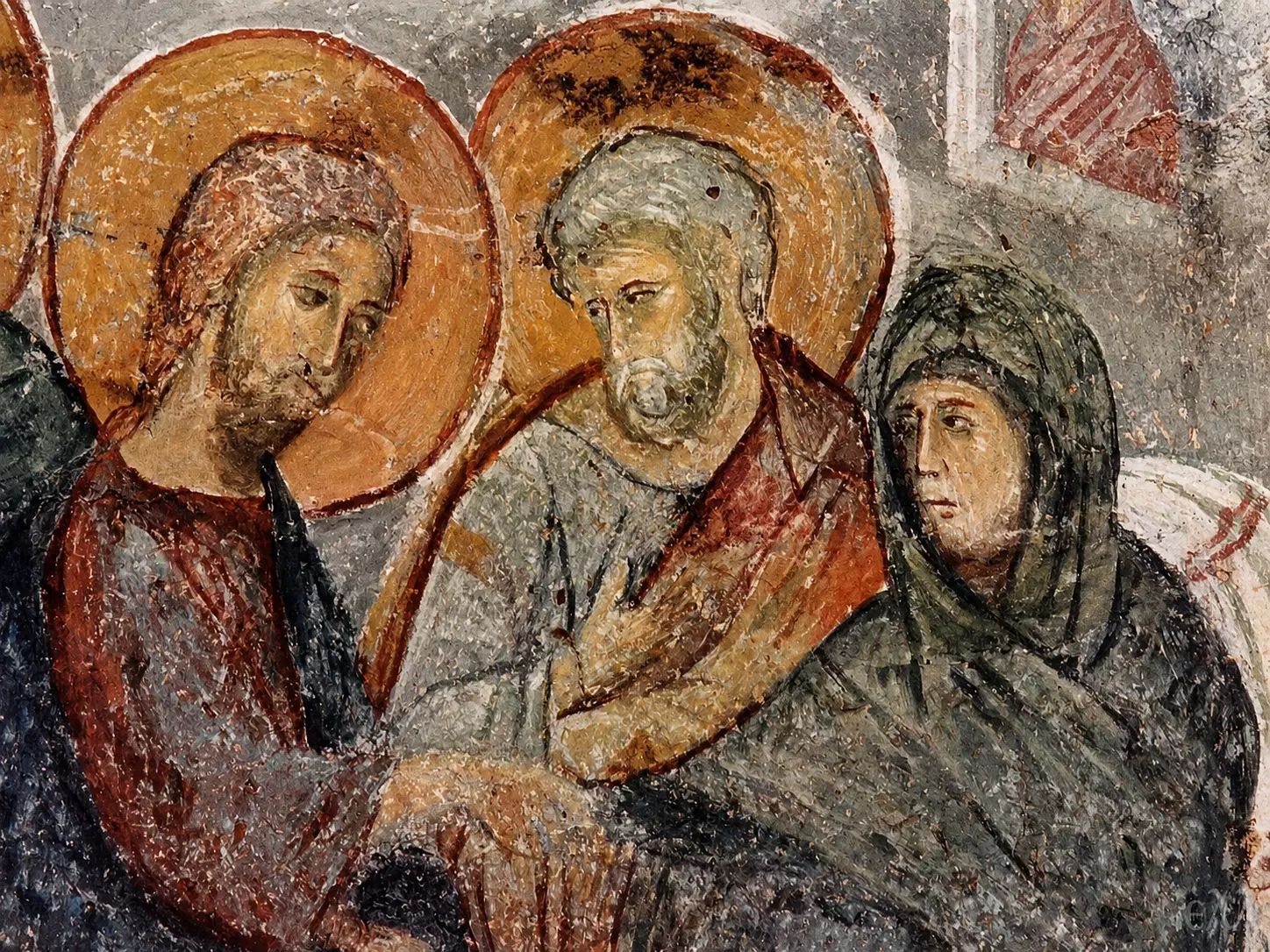
The Healing of Peter’s Mother-in-law fresco at the Hodegetria Church
Compositionally, the narrative scene is structured as a tightly focused, emotionally resonant group on a dark, neutral ground, which effectively isolates the central action and accentuates the gravity of the miracle.
Christ occupies the left portion of the image, and the ailing woman the right.
He appears haloed, his countenance grave and introspective; a deep reddish-purple chiton covers his shoulder and torso, overlaid by a dark mantle. In accordance with the narrative in the Gospels (Matthew 8:14-15, Mark 1:29-31, Luke 4:38-39), where Jesus cures the woman of a severe fever, Christ’s figure extends his right arm, a portion of which is obscured by the figure of Peter, towards the bed. The painter has brilliantly concentrated the dynamic energy of the healing upon the interaction of hands. Christ holds the woman’s delicate wrist, initiating the restoration of health. Centered within the group is Saint Peter, identified by his characteristic grey, curling hair and beard. He stands behind Christ, clad in garments of white or pale grey with touches of a reddish ochre. He gestures with his left hand, pointing towards his mother-in-law, a movement that seems to articulate his personal concern.
On the right side of the image, the ailing mother-in-law is shown enveloped within her dark maphorion, her veiled head resting upon a striped pillow. Her figure lies within a bed adorned with fine red and white striped linens, a rare, precisely observed detail of Late Byzantine material culture. She looks outward with an expression of resignation and emergent relief. Nor is the compositional balance disturbed by this tight grouping, maintained instead through the careful juxtaposition of these three figures—the divine healer, the concerned disciple, and the elderly recipient. Modeling of the faces is accomplished through smooth transitions of earth tones, highlighted by delicate white lines (ψιμύθια), revealing an artistic expertise imparting psychological depth and spiritual grace to the monumental scale. The figures exhibit a relative corporeality and dynamic movement, distinguishing them from the more schematic and static approach of earlier periods. These high-quality wall paintings demonstrate Mistra’s direct connection to the Capital, confirming the presence of masters trained in leading Constantinopolitan workshops. These artists brought that distinct touch of elegance which distinguished metropolitan art even in provincial centers.
A comparative analysis within Mistra reveals that while other cycles, like those of the Peribleptos or Pantanassa, might explore extreme dynamic tension or exaggerated elongation, the paintings of the Hodegetria Monastery retain a certain Komnenian sense of restraint and balance. They infuse the figures with a profound introspection and a nuanced treatment of drapery and volume that clearly belongs to the early 14th century. This fresco cycle offers an essential witness to a specific, high-metropolitan stylistic trend operating at Mistra just before the peak of the Palaiologan manner, presenting monumental grandeur alongside exquisite detail, such as the varied patterns on the bedding and the complex facial expressions.
(De vertaling is bewerkt door Jason Papandreou)