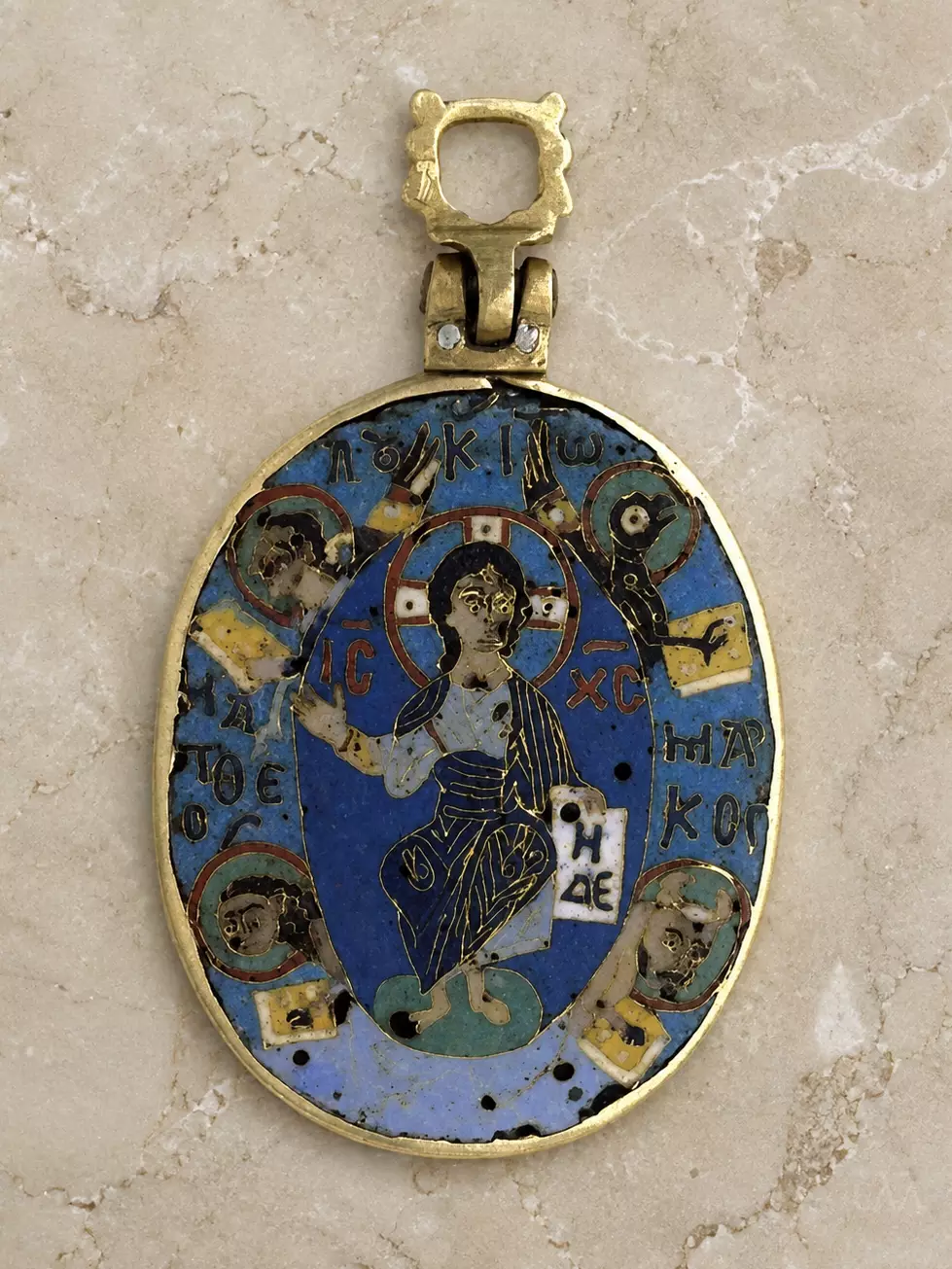
The Christ in Glory Enkolpion preserved at the Holy and Great Monastery of Vatopedi on Mount Athos is a double-sided oval Byzantine pendant dated to the late twelfth or early thirteenth century. Its small scale concentrates precious materials, imagery and inscription within a tightly organized surface. Scholarly discussion identifies the object as approximately 4.1 cm high. One face presents Christ in Glory in cloisonné enamel; the other incorporates a dark green jasper intaglio of the Virgin and Child, an engraved stone that had originally functioned as a seal matrix.
Christ in Glory Enkolpion: Cloisonné Enamel and Iconography
On the enamelled face, the youthful and beardless Christ sits at the centre of a blue oval mandorla whose contour closely answers the shape of the pendant itself. Around him are the symbols of the four Evangelists, compressed into the narrow surrounding field. Fine metal cloisons separate the coloured enamel cells, producing a dense pattern of blue, white, red, green and darker tones. Above the oval body, the suspension fitting makes the pectoral function of the piece immediately legible. Small losses and abrasions interrupt portions of the enamel and lettering across the field, while the central figure remains clearly dominant.
The scroll held by Christ introduces an unusually specific textual element. The surviving letters ΗΔΕ have been identified with the opening of the prophetic declaration “Lo, this is our God; we have waited for him” (Isaiah 25:9). Image and text work together within a remarkably small devotional piece: Christ appears enthroned in glory, framed by the Evangelist symbols, while the prophetic phrase gives scriptural definition to the vision. Strict centralization governs the composition.
Mandorla, seated figure and surrounding emblems remain distinctly ordered even within the restricted field.
The reverse establishes a different material register. At its centre is the green jasper intaglio with the standing Virgin and Child; the Marian sigla were cut in reverse, evidence of the stone’s earlier use as a seal. Around it runs a dodecasyllabic inscription rendered in enamel, referring to carrying the Virgin on the breast and to bodily well-being. An older engraved gem was thus incorporated into a later pectoral ensemble and paired with the enamelled vision of Christ.
Within the Vatopedi treasury, the enkolpion belongs to a broader group of Byzantine pectoral objects executed in varied materials and techniques. The monastery’s collection preserves numerous enkolpia of different forms and periods; in this example, the enamelled image of Christ and the reused jasper seal occupy the two faces of the same compact pendant.