
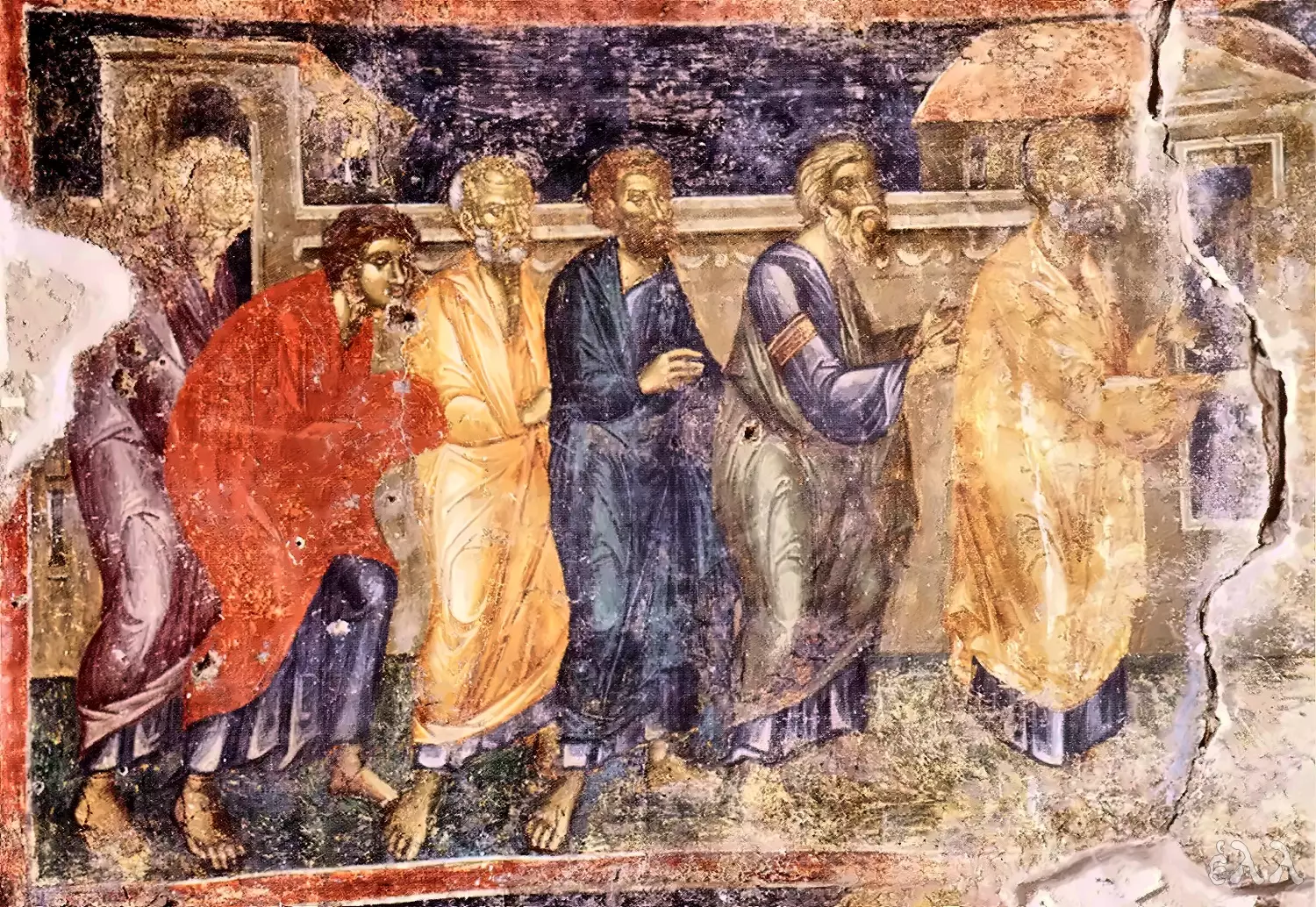
The fresco known as the Valsamonero Communion of the Apostles belongs to the monumental decoration of the katholikon of Valsamonero Monastery, on the southern slopes of Mount Psiloritis in Crete. Dated to the fourteenth century and without a secure attribution to a named painter, it presents one of the subjects most closely associated with Byzantine sanctuary painting: the Apostles approaching to receive the Eucharistic gifts from Christ. The surviving field seen here preserves only part of the larger scheme. Six apostolic figures remain visible, compressed into a procession moving across the wall beneath a deep blue background and a sparse sequence of architectural forms.
Its first impression comes from movement. At the front of the visible group, a figure in a yellow-ochre mantle advances with his body directed forward; immediately behind him, a grey-haired Apostle in blue-grey extends an arm, while another bearded figure in a dark blue garment gathers his hand close to his chest. Farther back, an older man wrapped in warm ochre is followed by a younger, dark-haired figure whose red mantle expands into the largest colour field of the scene. He bends markedly at the waist. The last visible figure, much damaged, occupies the opposite edge of the composition in muted violet. Individual physiognomies, changing inclinations of the heads, overlapping bodies, bare feet, red, ochre, blue — none of it repeats mechanically from one figure to the next.
Valsamonero Communion of the Apostles: procession and pictorial rhythm
The Communion of the Apostles had an especially close relationship with the sanctuary because its subject gives visible form to the Eucharistic rite celebrated within that space. In the established Byzantine iconographic type, Christ distributes the consecrated bread and wine to the Apostles, commonly arranged in two approaching groups. The scene develops the Last Supper into an image shaped by liturgical practice, with Christ appearing as the giver of the Eucharist and the disciples as its recipients. In the surviving Valsamonero section, the administering figure lies outside the preserved field; what remains before us is the response of the Apostles, their approach.
That approach is organised with considerable economy. The painter does not open a deep architectural interior. A low horizontal structure runs behind the figures, above it the dark blue ground, at intervals compact buildings with pitched or curved roofs. These elements establish a setting without competing with the human procession. The figures themselves carry the composition. Their bodies overlap tightly, yet their faces are differentiated by age, beard, hair and profile; the line of heads rises and falls slightly, producing a controlled rhythm along the wall. Drapery folds are linear and emphatic, particularly in the red and ochre garments, while pale highlights pick out shoulders, sleeves and knees. Even in its fragmentary condition the chromatic sequence remains effective: red against ochre, ochre beside near-black blue, then a cooler blue-grey before the luminous garment at the front.
The red-clad Apostle introduces an abrupt internal pause. His pronounced inclination brings his head below those of the men beside him, interrupting the otherwise steady procession and making the movement physically legible. It is a small compositional disturbance, yet a decisive one. The body leans, the mantle spreads, the following figures close in — and depth, rather than being built through an architectural interior, emerges here through overlapping forms, shifting profiles, differences of posture.
Valsamonero belonged to the artistic world of Venetian Crete, a setting in which Byzantine pictorial traditions remained vigorous while painters, patrons and workshops operated within an increasingly complex cultural environment. Later documentary evidence gives this context unusual precision. The Constantinopolitan painter Alexios Apokafkos is recorded as having worked on murals at Valsamonero in 1412, and the same archival study identifies the presence of Constantinopolitan painters on Crete as one channel through which late Palaiologan artistic tendencies reached the island. This evidence cannot establish Apokafkos as the painter of the present fresco. It does, however, demonstrate that contact with Constantinopolitan artistic practice at Valsamonero rested upon documented movements of artists as well as formal affinities.
The state of preservation changes the way the composition is read. Abrasion has softened many facial and drapery details, pale losses interrupt the painted surface at both sides, and a pronounced fissure cuts through the right edge. Yet the central pictorial logic survives. The Apostles remain closely bound to one another by direction, gesture and colour; the architecture stays subordinate; the deep blue field gives the procession a continuous visual ground. Parts of the narrative have disappeared, its rhythm has not.
Within the sanctuary setting, that rhythm carried a further force. A congregation looking towards the bema encountered an image of apostolic participation placed in direct visual relation to the Eucharistic celebration itself. Bodies advancing one after another, solemn, varied, physically present: this is how the Valsamonero fresco translates that relationship. The procession remains its strongest surviving feature — a sequence of figures drawn towards an act that now lies just beyond the surviving edge of the image.