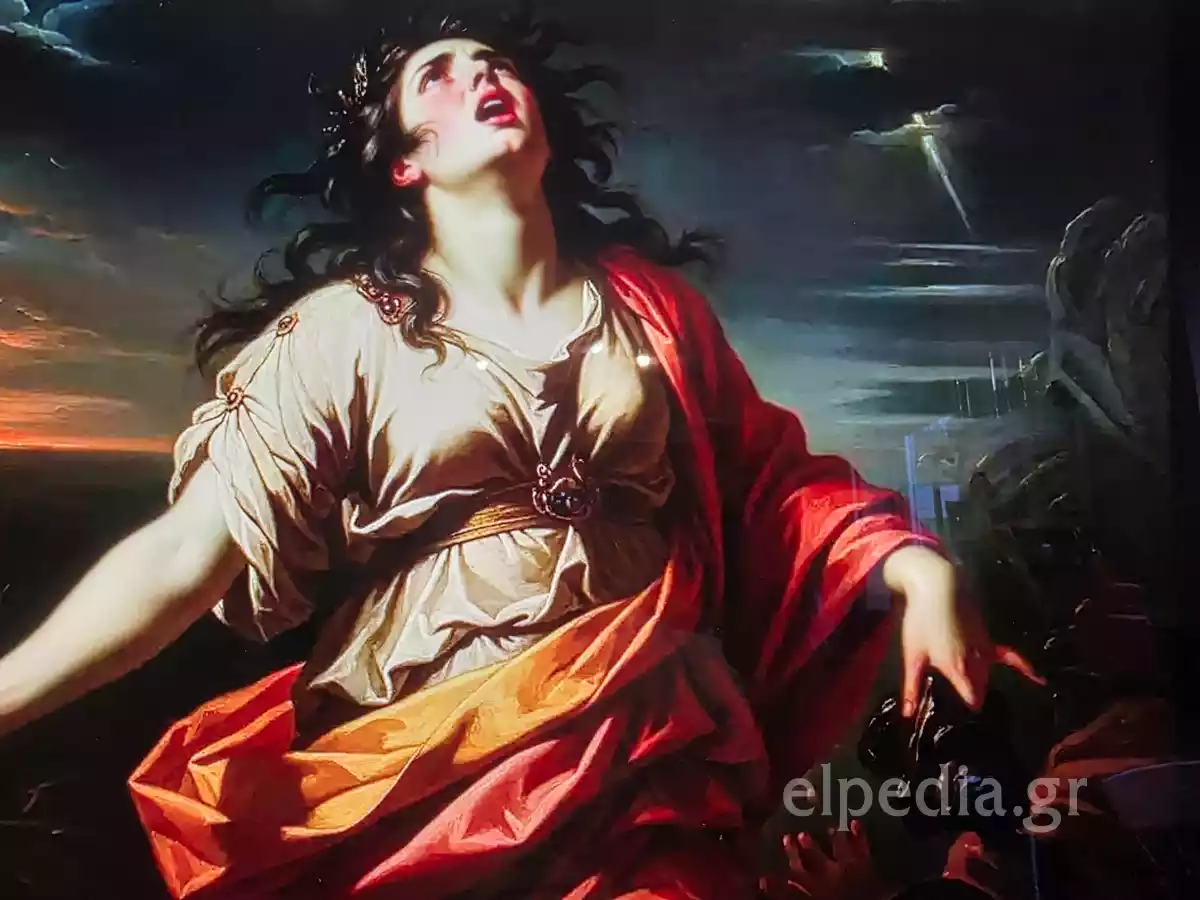
Is there, one might well ask, a greater torment than to possess the absolute, unerring knowledge of what is to come, a future horrific and irrevocable, and yet to be condemned to utter these truths to deaf ears? A voice crying in the wilderness. Such was Cassandra. A princess of Troy, daughter to Priam and Hecuba, a woman graced with a divine gift that was twisted into the most inhuman of curses. Her tale is not merely another facet of the Trojan Cycle; it is a profound, timeless study on the nature of truth itself, on human denial, and on the inescapable fate that is so often woven by our very own hubris. Her figure, at once fragile and yet titanic in her suffering, haunts the world’s literature and thought, posing the eternal question: what is the worth of truth, when no one is prepared to listen? Her path to ruin, a ruin she had foreseen in all its chilling detail, is nothing less than the path of reason itself through a world that chooses blindness, a world that seems, perilously, so much like our own. It is no wonder that such a character, a soul in such profound conflict, would become an essential pillar upon which the edifice of ancient Greek tragedy was built (Kitto), for her struggle was not with an external foe, but with the very condition of human existence.
The Divine Bargain and the Eternal Malediction
How did it all begin? Greek mythology, with its customary brutal poetry, delivers to us the genesis of Cassandra’s tragedy. The god Apollo, the master of light, of music, and also of prophecy, was seized by a violent passion for her, captivated by her unparalleled beauty. He promised her, in exchange for her affections, the highest gift he could bestow: the power to see the future. Cassandra, perhaps from youthful folly, perhaps from a deeper intuition about the perilous nature of the gods, accepted the gift. She received the knowledge. But at the final moment, as the god leaned in to seal their pact with a kiss, she recoiled, refusing him.
The rage of a god is not a human measure. Apollo, wounded, humiliated, could not retract the gift already given—the words of the divine are irrevocable. He could, however, corrupt it. And so, with a single breath, he laid upon her his curse. The malediction was simple in its formulation, yet demonic in its essence: she would retain her prophetic sight, she would see everything, the good and especially the calamitous, but no one, ever, would believe her. Her voice would be mere discordant noise, her words the delirious shrieks of a madwoman. Herein lies the very foundation of her martyrdom. She was not simply a prophetess. She was the personification of disregarded truth. Her existence was transformed into a perpetual, living hell, as she watched with perfect clarity destruction draw near, her loved ones march towards their deaths, her city proceed towards the flames, and she herself was powerless, utterly powerless, to intervene, for her speech had been stripped of all persuasion. Can one even conceive of a greater psychic torture?
The Unheeded Oracles of Troy’s Demise
The prophecies of Cassandra run through the entire epic of the Trojan War like a sombre, repeating melody of doom. Every word she spoke, a warning. Every cry, an alarm bell that fell on deaf ears.
The beginning of the end came with the arrival of Paris from Sparta, bringing with him Helen. While the Trojans celebrated this fateful prize, Cassandra, in the throes of a prophetic frenzy, rushed through the streets, tearing at her hair, screaming that this woman would bring fire, ruin, and death to their glorious city. They treated her with pity, with scorn; they called her insane, hysterical. They had her locked away, lest she bring “shame” upon the palace. And yet, she could already see the Achaean ships cleaving the Aegean waters.
And then, the culmination of her tragic irony: the Trojan Horse. When the colossal wooden effigy appeared at the gates of Troy, a supposed offering to Athena, the Trojans, drunk on the illusion of victory, prepared to haul it inside their walls. Cassandra, along with Laocoön, were the sole voices of reason. She struck the horse’s flanks with an axe, shouting that armed men were hidden within, that this wooden beast concealed their annihilation. “Beware the Greeks, even bearing gifts,” Laocoön would cry, shortly before the gods dispatched serpents to strangle him and his sons—a clear sign, which the Trojans in their blindness interpreted backwards, that the heavens desired the horse within the city. Her prophecy of doom, as a relevant study by Antreas K. Phylaktou highlights, echoes in the tragedies of Euripides, cementing her place at the very core of the mythos (Phylaktou). They ignored her. Once more. And that night, Troy burned.
Her sight, however, did not cease there. Even after the fall, when she was taken as a war prize by Agamemnon, king of Mycenae, she saw his end. She warned him of the fate that awaited him in his homeland, of the bloody bath, of Clytemnestra’s net and Aegisthus’s axe. Agamemnon, the victor of Troy, listened with condescension, as if to the ramblings of a slave driven mad by grief. And the most tragic part? She also saw her own death, beside him, by the same hand. She walked towards her own slaughter with full consciousness, accepting a fate she herself had foretold, but could never alter.
Cassandra is not merely a tragic heroine; she is an eternal archetype. She symbolises the intellectual who foresees disaster but whose voice is drowned out by populism and ignorance. She is the voice of conscience we all prefer to ignore. Her story, steeped in injustice and agony, teaches us—or, at least, it ought to teach us—that the most perilous form of blindness is not of the eyes, but of the judgement. Cassandra’s curse, in the end, was not hers alone; it was the curse of the Trojans, and perhaps, it is our own curse, every time we choose a comfortable lie over an inconvenient truth. Her legacy remains a vibrant, perpetual reminder that the ancient connection between myth and the lyre concealed truths deeply embedded in the human psyche (Phylaktou).
Frequently Asked Questions
Why was Cassandra cursed by Apollo?
According to Greek mythology, Cassandra, a princess of Troy renowned for her beauty, was desired by the god Apollo. He offered her the gift of prophecy in exchange for her love. After she received the divine gift, she rejected the god. Unable to revoke his gift, the enraged Apollo cursed her so that while she would always prophesy the truth, no one would ever believe her, sealing her tragic fate.
What did Cassandra prophesy about the Trojan Horse?
Cassandra’s most crucial prophecy concerned the Trojan Horse. When the Achaeans left the giant wooden horse outside the city walls, she frantically warned her people that it was a trick and contained armed soldiers who would bring about Troy’s destruction. Her warnings were dismissed as madness, and the Trojans brought the horse into the city, leading directly to their defeat, a central event in her story.
How is Cassandra’s death depicted in the myth?

After the sack of Troy, Cassandra was taken as a war prize by Agamemnon, the king of Mycenae. True to her curse, she foresaw both his and her own impending deaths upon their arrival. She prophesied that Agamemnon’s wife, Clytemnestra, would murder them both. Her vision came true when Clytemnestra, seeking revenge, killed Agamemnon in his bath and then murdered Cassandra as well.
What is the ‘Cassandra Complex’ in modern psychology?
The ‘Cassandra Complex’ or ‘Cassandra Syndrome’ is a modern psychological term inspired by her myth. It refers to a situation where a person’s valid warnings or concerns are disbelieved or dismissed by others. This can lead to feelings of immense frustration, isolation, and helplessness for the individual, whose accurate predictions are ignored until it is too late, just like the princess of Troy.
Was anyone else in Troy suspicious of the Greeks’ gift?
Yes, besides Cassandra, the Trojan priest Laocoön also expressed deep suspicion of the Trojan Horse. He famously warned his fellow Trojans to “beware of Greeks bearing gifts” and even struck the horse with his spear. However, the gods, favouring the Greeks, sent two sea serpents to kill Laocoön and his sons. The Trojans misinterpreted this horrific event as a punishment for his sacrilege, further sealing their own doom.
Bibliography


