
The ceramic floor by Masséot Abaquesne from 1557 merges Italian influences with traditional French aesthetics in a unique artistic composition
The 1557 ceramic floor, created by the renowned French potter Masséot Abaquesne (circa 1500-1564), is a rare testament to Renaissance art (Lafont) in northern France. It is housed in the collections of the Louvre Museum, showcasing the complexity of cultural exchanges between Italy and France during the 16th century.
The potter from Cherbourg, who settled in Sotteville-lès-Rouen, emerged as a pioneer of French faience (Erlande-Brandenburg). His technique combined Italian influences with traditional French aesthetics, creating a unique stylistic idiom that would impact northern European ceramics for centuries.
The Theological Aspect of Decorative Narratives
The composition of the floor reveals multiple interpretative possibilities that transcend mere decorative function. Each ceramic tile serves as an independent iconographic unit while simultaneously contributing to a broader symbolic narrative that permeates the entire work.
Iconographic Structure and Spiritual Significance
The central figure in blue garments suggests theological references linked to the tradition of enamelled walls (Cotinat). The deep blue color, traditionally associated with the celestial realm, interacts with green and gold hues that evoke earthly nature and divine grace.
The surrounding decorative motifs develop a complex system of symbolism. Floral elements alternate with geometric patterns, creating a composition that reflects the Renaissance perception of cosmic harmony and divine order.
Technical Innovation and Cultural Synthesis
Abaquesne’s technique incorporates achievements of Italian majolica with traditional French methods. This synthesis reflects the cultural dynamics of the era, where artists sought new expressive possibilities through intercultural exchange. The ceramic floors of the period served as a means of aristocratic self-representation and spiritual expression (Valentiner).
The color palette is chosen with intention that goes beyond aesthetic goals. Each shade carries symbolic weight that engages with the theological and philosophical thought of the Renaissance. Blue dominates not merely as a color choice but as a bearer of spiritual meanings that refer to the heavenly sphere.
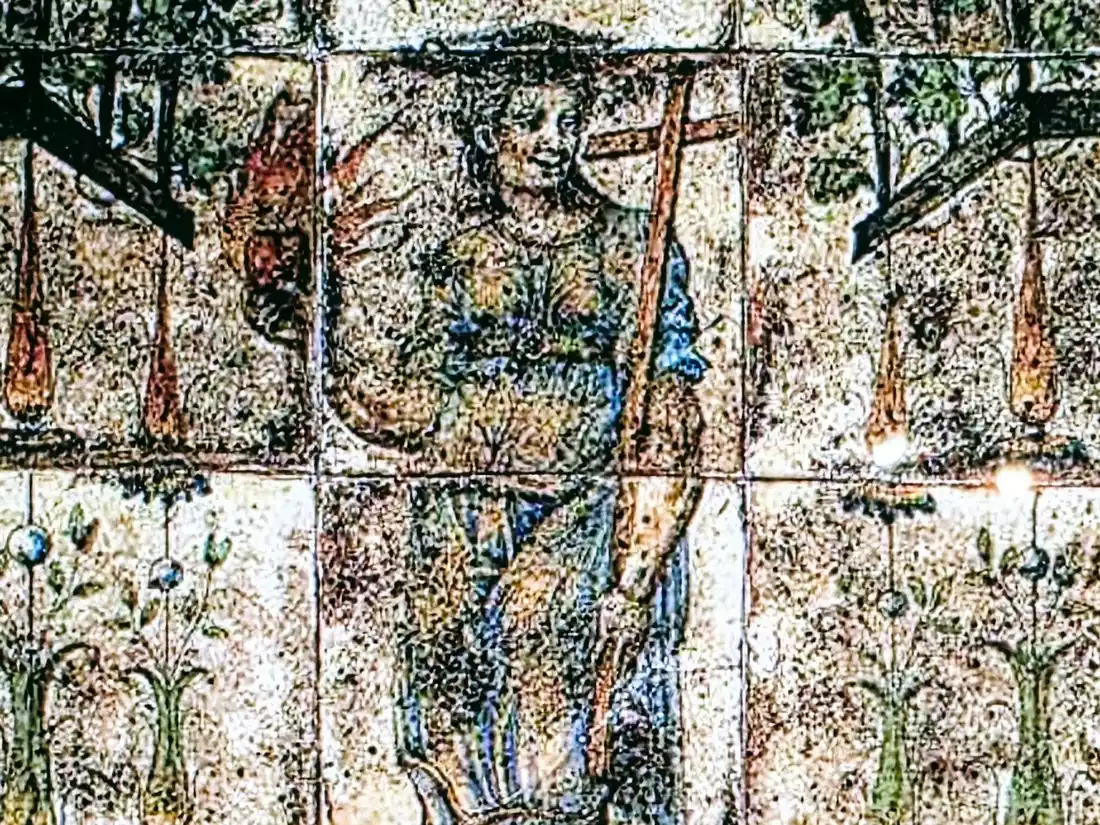
The central figure in blue garments reveals theological references linked to Renaissance spirituality and French faience
Cultural Heritage and Contemporary Interpretation
The work of Masséot Abaquesne transcends its temporal boundaries. It serves as a bridge connecting medieval tradition with Renaissance innovation while also foreshadowing future developments in decorative art. The French ceramic tradition it establishes continues to influence European artistic production today (McNab).
Studying the work reveals how art functions as a vessel of cultural memory and spiritual expression. It is not merely a decorative object but a complex communication system that conveys theological, philosophical, and cultural values from generation to generation. Its preservation in the Louvre ensures the continuity of this cultural transmission, offering contemporary viewers the opportunity to engage with Renaissance spirituality.
Ultimately, the 1557 ceramic floor testifies to the power of art to synthesize diverse cultural traditions into new meanings. Masséot Abaquesne did not limit himself to simple imitation of Italian models but created a French artistic idiom that retains its originality to this day.
Bibliography
Chabanne, D., Aucouturier, M., Bouquillon, A. ‘Ceramics with metallic lustre decoration. A detailed study of Islamic productions from the 9th century until the Renaissance’, Matériaux & Techniques, 2012.
Cotinat, L. ‘Deux albarels des ateliers de Masséot Abaquesne au feu des enchères’, Revue d’Histoire de la Pharmacie, 71(257), 1983.
Damiano, F., Abaquesne, M. ‘”Handelar’s Black Choir” from Château to Mansion’, The Metropolitan Museum Journal, 44, 2009.
Erlande-Brandenburg, A. ‘Les pavements émaillés de Masseot Abaquesne’, Bulletin Monumental, 136(1), 1978.
Lafont, O. ‘L’inauguration à Rouen de l’exposition «Masséot Abaquesne; l’éclat de la faïence de la Renaissance»’, Revue d’Histoire de la Pharmacie, 104(393), 2017.
McNab, J. Seventeenth-Century French Ceramic Art, 1987.
Norton, C. ‘Medieval tin-glazed painted tiles in North-West Europe’, Medieval Archaeology, 28(1), 1984.
Valentiner, W.R. ‘French Faïence’, Bulletin of the Metropolitan Museum of Art, 8(12), 1910.


