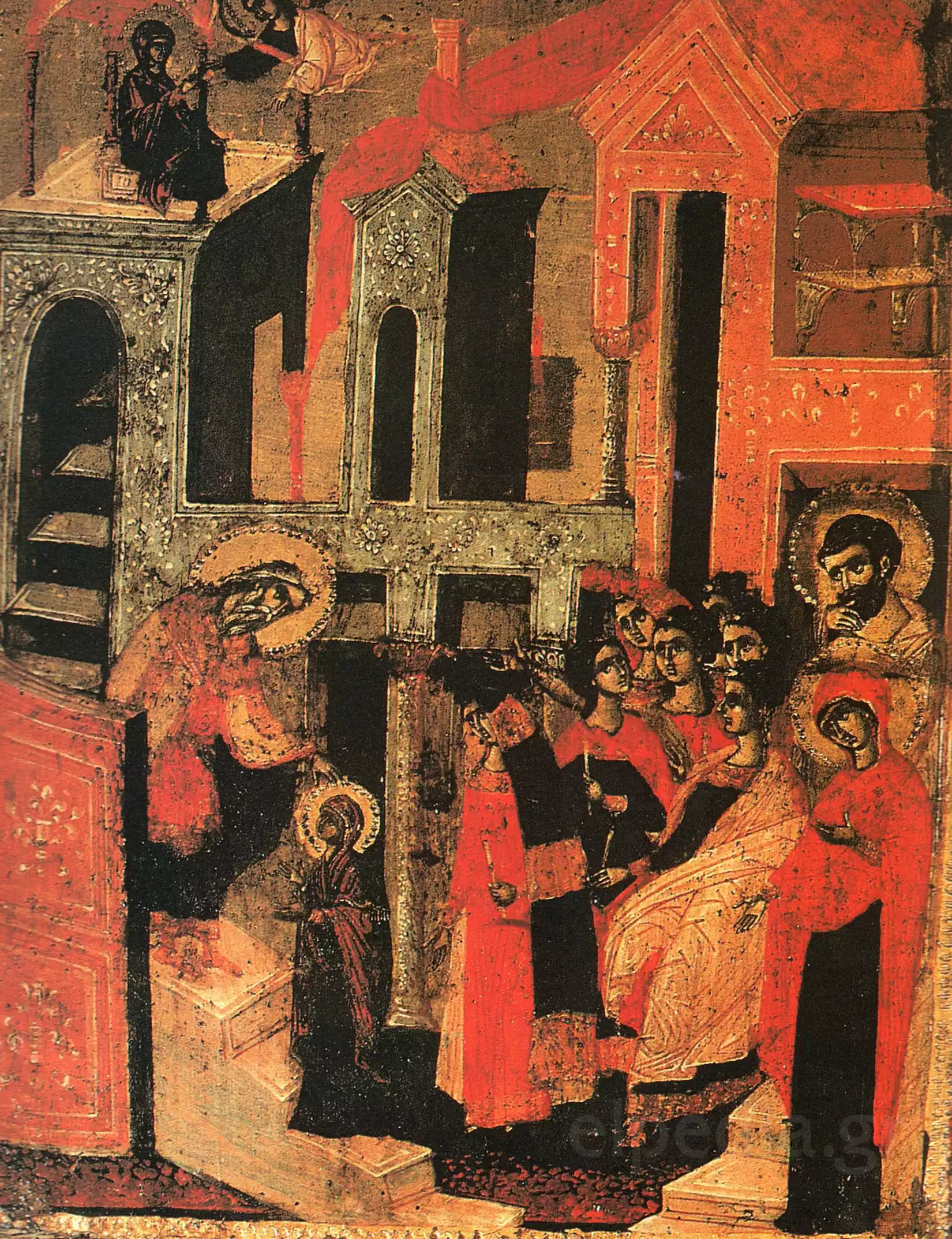
The masterpiece by Davide Selenicasi, Entry of the Theotokos, from the Church of Saint Nicholas in Korçë, exemplifying high post-Byzantine art and theology.
We often stand before an image, feeling the awkwardness of the modern person who has lost the keys to understanding, perhaps even the very sense of it. We look, but do we truly see? This particular composition, created by Davide Selenicasi in the 18th century, is not merely a relic preserved in the Museum of Art and Architecture in Tirana, detached from its natural context, the Church of Saint Nicholas in Korçë. It is a cry of silence. Or rather, an invitation to a world we have forgotten.
The depiction of the Entry is not limited to the historical recording of an event. Who cares about history today if it does not touch the core of existence? Here we encounter a pivotal moment of transformation. The little girl entering the Holy of Holies. What a paradox… How can the finite contain the infinite? The artist, working in an era when Byzantine art was already influenced by the West, manages to preserve the mystery through form. It is not merely painting. It is theology expressed in colors. And what about us? We remain spectators of an action that demands participants, often trapped in a barren aesthetic pleasure that ignores the pulse of the depicted truth.
The Dynamics of Movement and the Stillness of the Sacred
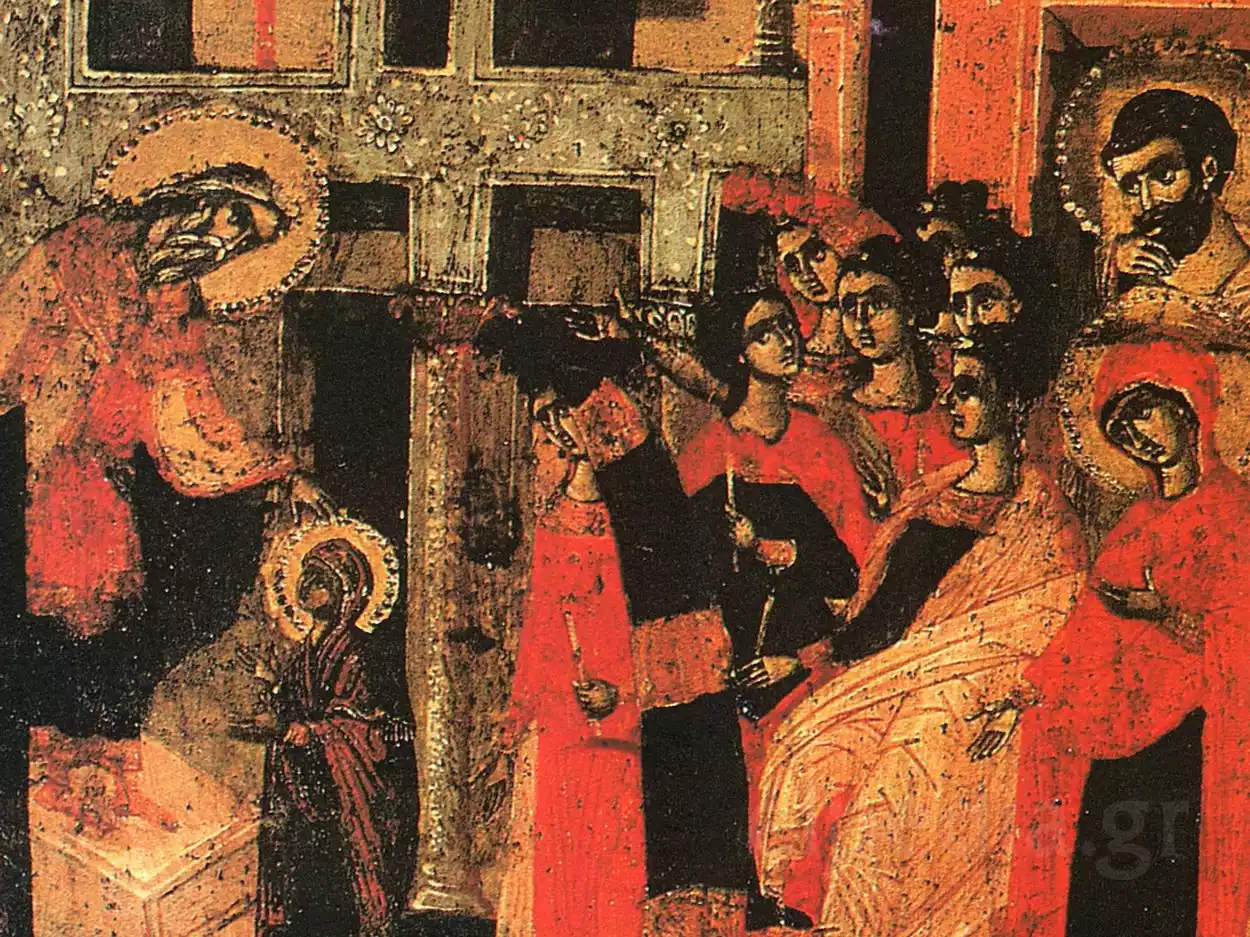
Our gaze inevitably falls on the center of the composition. But is it truly the center? Or does gravity shift to where logic ceases? Zacharias welcomes the Theotokos. His figure, imposing and priestly, seems to bend under the weight of the moment. This is not just a meeting of two figures. It is the encounter of the Old with the New Testament. Selenicasi, with his distinctive 18th-century style, is unafraid to give volume to the bodies, making them “stand” on the earth while simultaneously destined for heaven.
Observe the architectural depths. Buildings, columns, a setting reminiscent of a theatrical stage – and why not? After all, the Divine Liturgy is the divine drama. These buildings are not merely decorative. They define the space of the sacred, the space of the “forbidden.” Yet, is this forbidden space violated? No, it opens up. Little Mary advances. How many of us dare to move forward like that? Without turning back? Her movement is decisive, even though her body is rendered with the tenderness of childhood. There is a contradiction here that is bone-crushing. The child who is simultaneously the Land of the Uncontainable.
The iconographic tradition, which the painter respects yet renews, depicts the radiant virgins following. Look at them. Is it a procession of joy or a mournful procession? Perhaps both. For every dedication is a death and a resurrection. The candles burn. Their light is not natural; it does not come from a setting sun. It is the light of hope. Nowadays, we have filled churches with electric lights, losing the flicker of the flame, which signifies the instability and hope of the human soul. The artist knew this. The folds in the garments of the virgins, with their vivid colors – reds, greens, ochres – create a rhythm. A visual music.
Color as Experience Rather than Decoration
And we arrive at color. In the 18th century, the palette changes, becoming perhaps more earthy, more “Baroque,” as art experts would say, yet the essence remains Byzantine. The mantle of the Theotokos. Dark, almost black or deep crimson? It stands out from the crowd. It is the mark of choice but also of pain. For grace brings pain. It is not a saccharine feeling of religious bliss, as we “pious” Sunday Christians often think. It is fire.
Selenicasi uses light not to illuminate faces but to reveal them. The faces do not possess the strict stillness of earlier centuries; they have a sweetness, a human quality. Is it a “crack” in the strictness? Perhaps. Or is it the era’s need to see the human within the holy? Zacharias, adorned in richly embroidered vestments, is not merely an official. He is the representative of a law that steps aside for Grace to pass. The golden background, where it exists, is not wealth. It is the absence of space. It is the “everywhere” and “nowhere” of God.
I sometimes wonder, when we see such images in museums, stripped of the scent of incense and the sound of hymns, what do we understand? Do we see technical perfection? Yes, Selenicasi was a master. He knew how to handle the brush. But if we stop there, we have lost everything. This art was not created to please the eye but to lead to repentance. To show us that entering the temple is not a local movement but an existential change.
The Theotokos ascends the steps. One, two, three… Each step is a distancing from decay. And us? Where do we stand? Usually, we look from afar, commenting on the “beautiful art,” unable to take even a step upward. We are comfortable with the horizontal dimension. The vertical disorients us.
The detail of the angel feeding the Virgin Mary, high up in a second level of the composition, often goes unnoticed. Yet, there lies the entire mystery of the Divine Eucharist. Heaven nourishes the earth. Literally. In today’s age of material abundance and spiritual starvation, this image of the angel with the “bread” seems almost provocative. What do we ultimately lack? Not bread. We lack meaning.
The painter from Korçë, during the Ottoman rule, paints freedom. For what else is dedication to God but the absolute freedom from necessity? His lines, sometimes strict and sometimes curved, follow this dialectic. Nothing is random. Even the position of the feet, the tilt of the head, all serve a purpose: the revelation of the unseen.
It is truly tragic. To have such theology before you and to pass it by in search of “style.” As if you are thirsty and instead of drinking water, you analyze its chemical composition. This image demands silence to speak. It requires us to become, even for a moment, a temple. Can we? Difficult. Very difficult. But perhaps, by looking again and again at Selenicasi’s work, we might see that small crack in time through which light enters.


