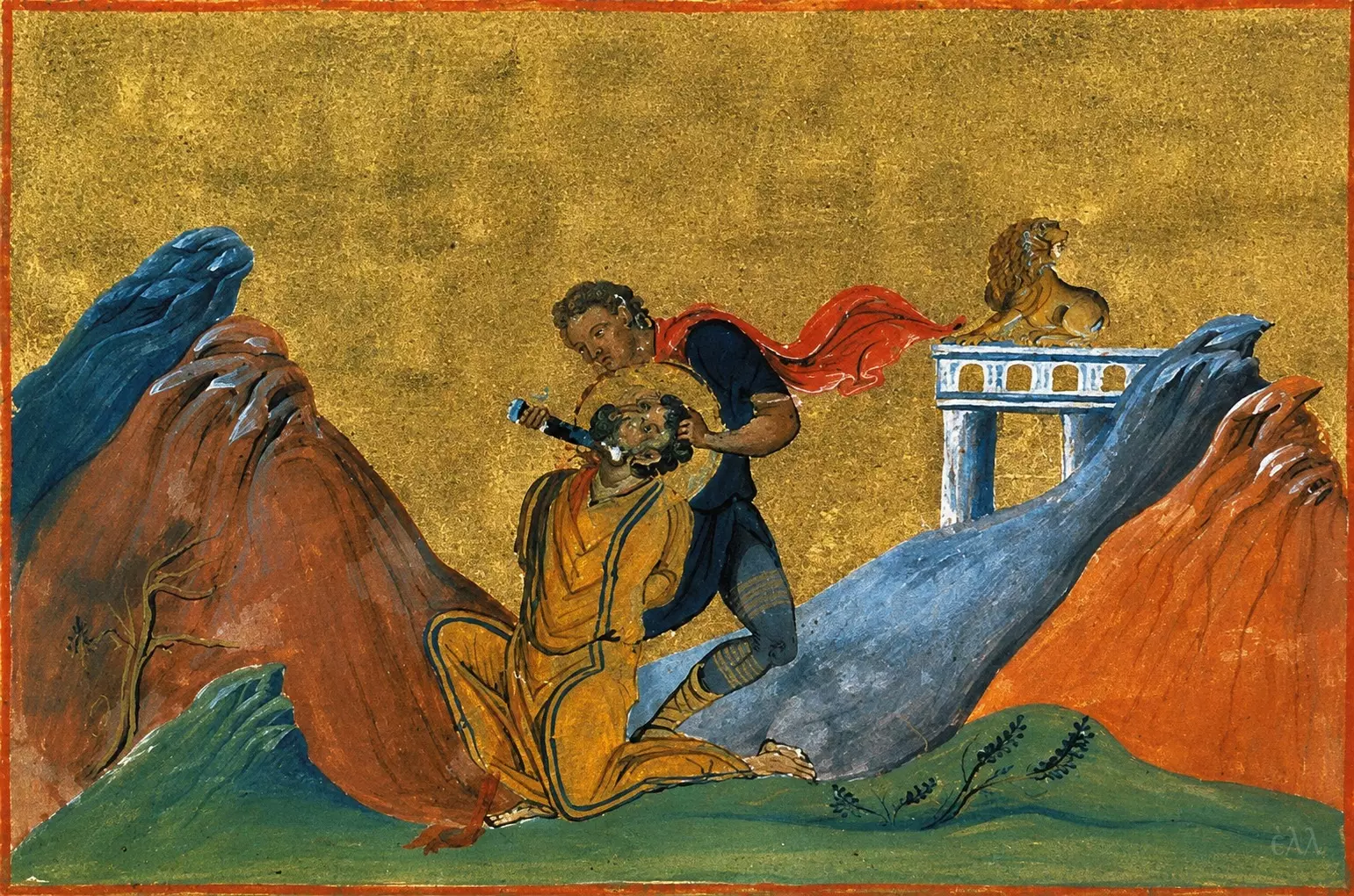
The Martyrdom of the Apostle James belongs to the illuminated manuscript traditionally known as the II Basil Menologiyası, produced in Constantinople for Emperor Basil II and generally dated to the closing decades of the tenth century. More precisely, the codex is a richly illuminated synaxarion, pairing short commemorative texts with hundreds of narrative miniatures for the first half of the liturgical year. James the Greater, son of Zebedee and brother of John (Matthew 4:21), is shown at the final moment of his life. Against an uninterrupted gold ground, the apostle kneels on a narrow band of green earth while an executioner, leaning across him from behind, brings a short blade to his neck. James wears an ochre-gold garment defined by dark linear borders; the executioner’s deep blue tunic and red mantle create the strongest chromatic contrast in the scene.
Rocky masses rise at either side and direct attention towards the two figures, leaving the gold field almost empty. One element interrupts that austerity: a small white architectural structure crowned by a seated lion. Landscape, architecture, figure: each is compressed into a pictorial sign and given specific narrative work. The object is best described through manuscript-illumination terminology—a narrative miniature with a gold ground and landscape setting—without importing the vocabulary of panel icons or wall painting.
The Martyrdom of the Apostle James as Byzantine Narrative
The composition is built around an oblique descent. The executioner bends forward from above; his red mantle follows the movement in a long, animated curve, while the apostle’s body sinks towards the ground in the opposite direction. Between them, the circular halo forms a stabilising disc. Drapery folds are stated by firm contours and narrow internal lines, while the faces retain tonal definition and physical presence. Compact, tense, immediately legible: a single action carries almost the entire narrative.
What Acts 12:1–2 records with striking brevity is that Herod put James, the brother of John, to death by the sword (Acts 12:1–2). Nestor does not construct a court, a prison or a larger sequence around the event. He isolates its decisive instant. Historical space is abbreviated; the principal action, clarified; secondary detail, admitted sparingly. For the manuscript’s texts and calendar, Charles Kuper’s 2025 modern edition and translation provides the first complete English version in a modern edition.
The gold ground also changes the status of the landscape. These rocks do not open onto a continuous natural horizon; they stand as shaped masses against the luminous field. Blue-grey, red-brown and ochre slopes establish a chromatic rhythm that continues into the green foreground. Such features belong to the sophisticated court culture conventionally associated with the “Macedonian Renaissance”, although the label remains debated in Byzantine art history. Classical inheritance may be sensed in the bodily movement, the handling of the mantle and the interest in recession, yet the miniature’s visual logic remains governed by concentrated sacred narrative and a deliberate economy of means.
Especially conspicuous is the lion. Perched on the small structure in the upper part of the scene, it is rendered as a sculptural object rather than as a living participant. It may simply mark a monumental or civic environment; without an identifying inscription or a secure iconographic parallel, a narrower symbolic reading would be speculative. Precisely because the detail resists easy explanation, it carries unusual visual weight. Amid a composition stripped of unnecessary incident, the tiny monument remains distinct against the gold field.
The illuminator, identified as Nestor, is one of eight painters whose names were recorded in association with the manuscript’s miniatures. That survival is exceptional and has made the codex fundamental to discussions of Byzantine workshop organisation and individual hands. Central to the subject remains Ihor Ševčenko’s classic study. The attribution gives this image unusual documentary precision: an imperial manuscript, a named illuminator, a miniature in which individual authorship can still, at least in part, be traced.
(Tərcümə N. Jones tərəfindən redaktə edilmişdir.)