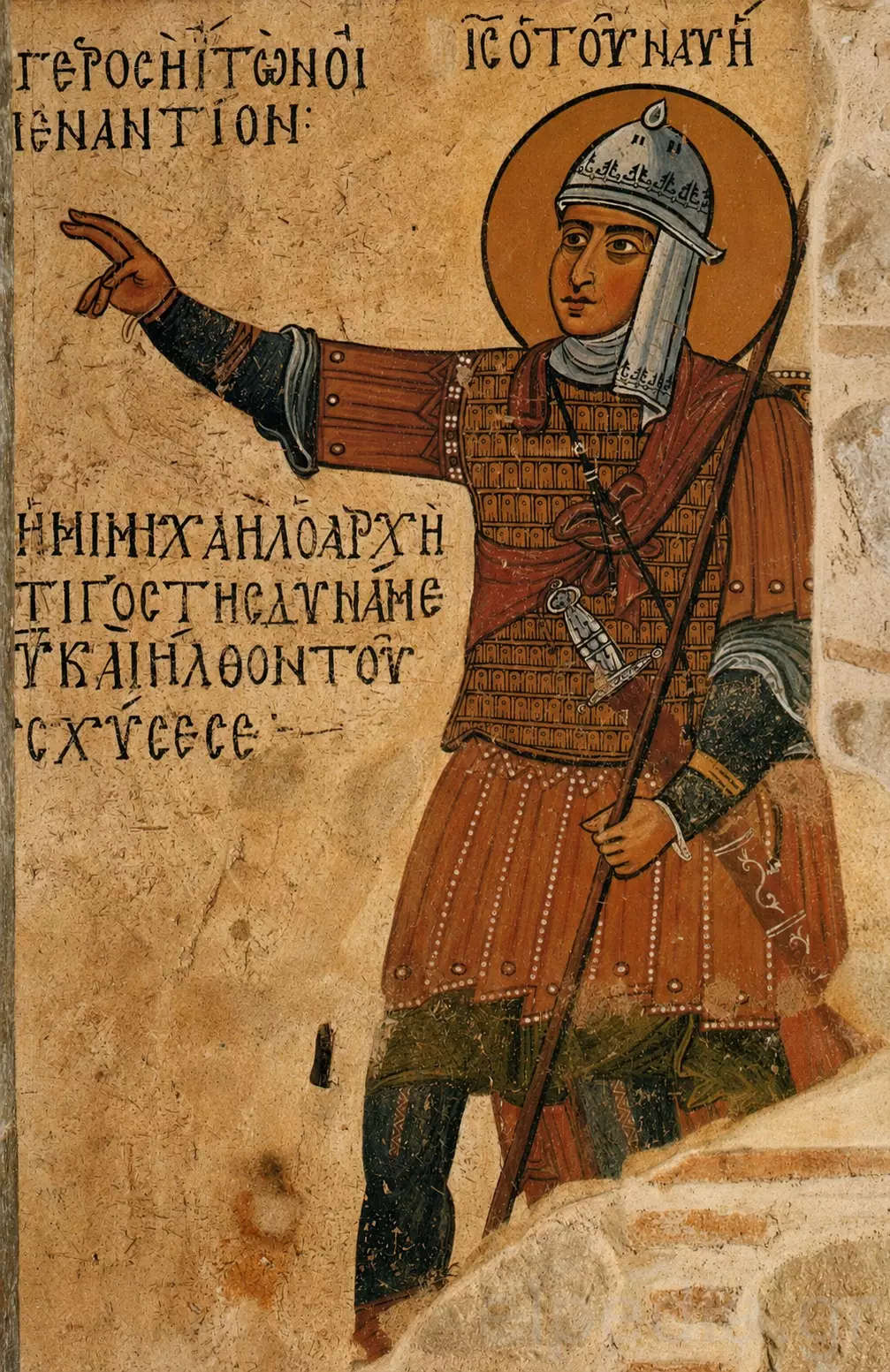
Beneath the heavy marble revetments that for centuries lined the eastern wall of the northern cross-arm inside the katholikon of Hosios Loukas in Phocis, a remarkable piece of tenth-century monumental painting remained entirely hidden. Uncovered during meticulous restoration work in 1964, the Joshua fresco at Hosios Loukas constitutes the oldest surviving mural at the sprawling monastic complex. The painting originally adorned an exterior surface at the southern edge of a bipartite narthex belonging to an older, smaller church dedicated to the Virgin, which was subsequently absorbed into the massive octagonal katholikon around 1011. Depicted in a moment of intense visionary dialogue, the armed youth with a radiant halo is identified as Joshua, the successor of Moses, at the moment of his encounter with the commander of the Lord’s host, traditionally understood in this context as the Archangel Michael, shortly before the biblical siege of Jericho (Joshua 5:13–15; 6:1–20). Monastic tradition strongly associates this specific iconographic choice with a historical prophecy uttered by the founder, Saint Luke of Steiris, who foretold the Byzantine liberation of Crete from Arab forces in 961. Serving as a sophisticated ideological statement of the Middle Byzantine period, the work was executed by an anonymous painter whose refined technique displays strong affinities with Constantinopolitan court art. The preservation of the plaster layer behind the masonry provides an uncommonly pristine glimpse into the artistic vocabulary that preceded the widespread mosaic programmes of the following century.
The Joshua Fresco at Hosios Loukas: Composition and Context
Presenting a compelling synthesis of classical naturalism and hieratic abstraction, the full-length figure of the Israelite general dominates the composition. Joshua points emphatically with his right hand towards the unseen celestial interlocutor, while his left hand firmly supports a long, vertical spear. Clad in the elaborate, stylised armour typical of Byzantine military imagery, Joshua wears a meticulously delineated lamellar cuirass over a heavily pleated, earth-red tunic. A finely detailed sword rests at his waist, suspended by a knotted crimson sash, while defensive arm guards complete the martial assemblage. The military equipment, rendered with considerable specificity, reflects the appearance of heavy infantry gear associated with the Macedonian period, transforming the Old Testament leader into a recognisably contemporary Byzantine warrior.
The structural organisation of the composition, its rigid frontality momentarily broken by the dynamic, communicative gesture of the extended arm, reflects the confident spatial awareness of a master artist. Accompanying the figure, black majuscule inscriptions on the ochre background explicitly identify the protagonist and cite the scriptural encounter with the commander of the Lord’s host (Joshua 5:13–15). The mural functions essentially as a dynamic commemorative declaration of divine favour and military triumph, aligning biblical conquest with the empire’s contemporary geopolitical struggles in the Mediterranean. In tight, rhythmic patterns fold the linear passages of drapery, which display clear morphological affinities with the ornate marble templon carvings found within the adjacent, slightly later architectural spaces of the monastery.
Physiognomy and Constantinopolitan Refinement
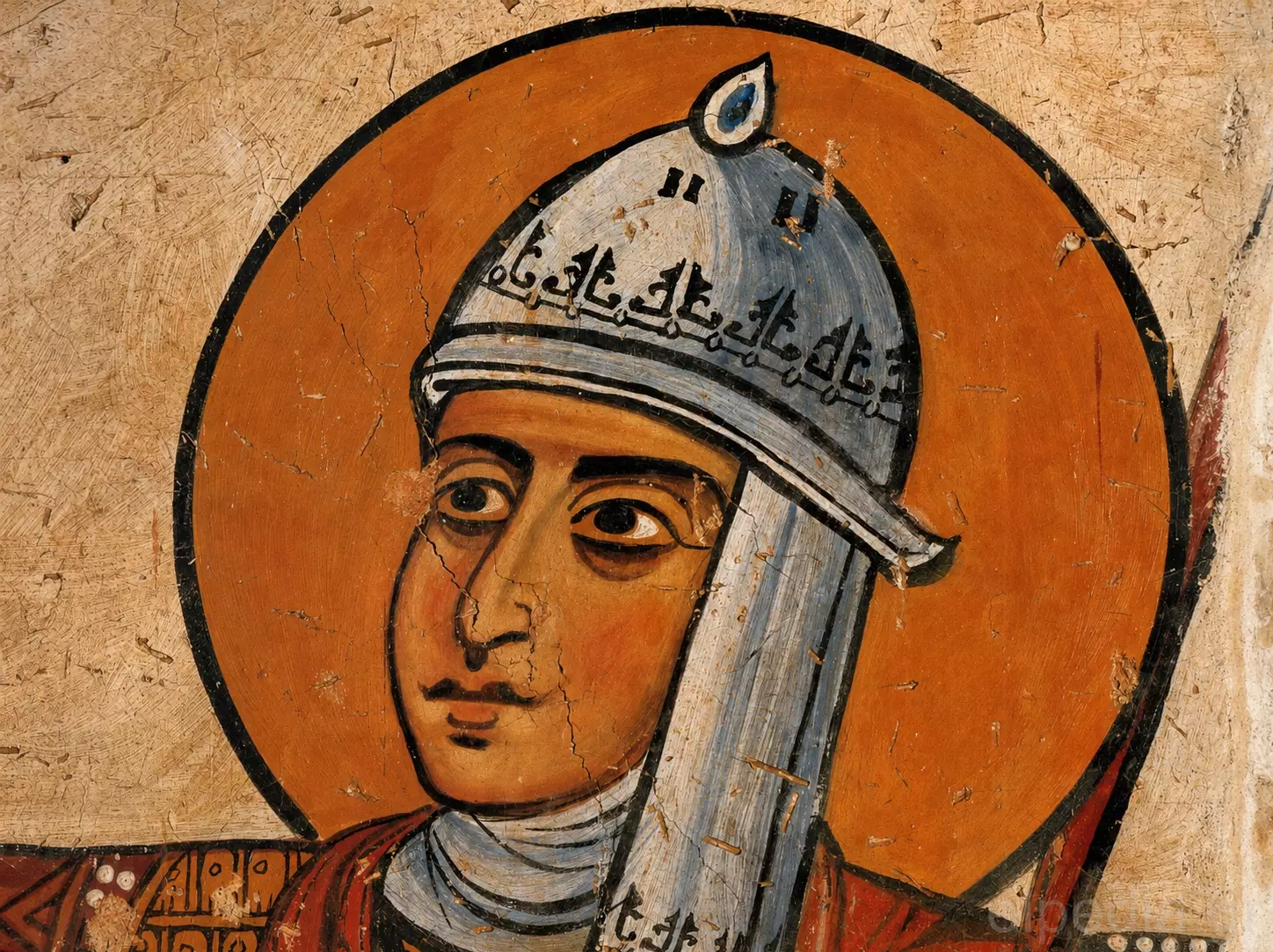
The facial modelling of the young commander reveals an extraordinary delicacy of execution and is consistent with the refined stylistic currents associated with the Macedonian Renaissance. Joshua gazes outward with deep-set, almond-shaped eyes beneath strongly arched eyebrows, his expression fixed in a state of solemn contemplation. Upon his head rests a striking silver-blue conical helmet, bordered by an intricate band of dark, geometric pseudo-Kufic ornament and surmounted by a central, teardrop-shaped jewel. The inclusion of Islamic-inspired decorative motifs on the armour subtly acknowledges the cultural exchanges and military conflicts defining the era. Through sweeping, translucent glazes and crisp white highlights, the painter gives the headpiece its metallic sheen, setting its cool surface against the warm, saturated earth tones of the halo.
The artist constructs the flesh tones, the traditional carnation, using a luminous, softly blended base, carefully modulating the volume through subtle olive shadows along the jawline and the narrow, straight nose. A protective cloth, painted in cascading folds of pale blue and white, falls from the helmet to shield the neck, imparting a tangible element of historical realism to the idealised portrait. This psychological penetration, achieved through an equilibrium of linear precision and volumetric modelling, is consistent with the sophisticated language of Constantinopolitan court art during the late tenth century. Anchoring the military character of the figure in a state of profound stillness, the painter applied the final linear highlights directly over the dry intonaco, a technical choice that has remarkably survived the subsequent centuries of architectural concealment.
(Oversættelsen blev redigeret af E. Wilson.)