

The complete scene of the Annunciation to Anna from the Armenian Hymnal of 1591. The composition is divided into two parts, showcasing the dialogue between the figures.
A rare 16th-century manuscript, an Armenian Hymnal, provides us with a unique visual testimony. It is a historical artifact. Currently housed in the Armenian Museum of France in Paris, this 1591 work is not merely a collection of religious hymns but a vibrant cultural document, a canvas where faith, artistic expression, and the historical context of the time intertwine seamlessly, offering contemporary scholars valuable insights into Armenian identity. The miniature we are examining, known as the “Annunciation to Anna,” depicts a scene from apocryphal tradition. A story of hope. The very nature of hymnody, as both an oral and written tradition, presents an exciting field of study (Altman). Instead of viewing this image as a mere worship object, we will analyze it as a historical document. What does it reveal about the artist, their community, and their era? Every brushstroke, every color choice, every line carefully etched onto the parchment tells a story that transcends the boundaries of religious iconography, linking the evolution of psalmody to hymnographic books with the social and artistic conditions of the time (Kujumdzieva). The composition features two figures, Joachim and a messenger, in a moment of divine intervention that will forever alter their fate.
The Figure of the Prophet-Messenger
On the left stands a youthful figure. He wears a striking red cloak that dominates the palette of the composition, immediately drawing the eye. His hand is raised. A gesture of speech, blessing, or announcement. The style, while echoing Byzantine iconography with its strict lines and use of gold background, reveals a distinct local sensitivity, an expressiveness that may stem from a long tradition of Armenian art, which assimilated foreign influences without ever losing its core character, making the study of early medieval Armenian art particularly fascinating (Palladino). The face, with its large, expressive eyes and the delicate black line defining the features, exudes an almost otherworldly calm. Is he an angel or a prophet? In the upper left corner, a winged figure emerges from the heavens, affirming the divine origin of the message, yet the central figure, with the red covering on his head, appears more like an earthly messenger, blurring the lines between the celestial and the terrestrial. Beside him, a stylized plant with two birds adds a symbolic layer, likely alluding to fertility and the new life about to be announced, elements often found in similar hymn manuscripts that served as both practical and symbolic texts (Forrest et al.).

The Reflective Joachim
On the right, the atmosphere shifts. Joachim, Anna’s husband, is depicted as an elderly man with a white beard and a contemplative gaze. His figure is silent. Enclosed within a strict architectural frame resembling a portal or niche, he emanates a sense of isolation and introspection, a visual metaphor for his sorrow and his time spent in the wilderness, as described in the apocryphal narrative. His garments, in shades of blue and gray, create a stark color contrast with the messenger’s red cloak, highlighting the differing emotional states of the two figures. His hands are crossed over his chest in a gesture of acceptance or prayer. Why does the artist portray him this way? Perhaps to emphasize his faith despite the trial, a virtue highly valued in texts found in hymn manuscripts and psalms (Warson). His face, though simple in design, is filled with passion, with his gaze slightly upward, as if listening to an inner voice. The golden halo, common to both figures, elevates them to a sphere of sanctity, yet the human expression remains at the forefront. The fact that we possess such a well-preserved work is extremely significant, as often only fragments of manuscripts survive from such collections, making each page invaluable (Gwǝḥila). This dual composition, with its dynamic contrast between action and contemplation, youth and old age, serves as an intricate visual narrative, a window into the artistic and spiritual life of the Armenian community in the 16th century, a time when methodist hymnody had yet to be formed, but the tradition of hymn manuscripts was in full bloom (Volland).

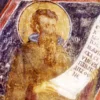
Close-up of Joachim’s face. His expression is filled with contemplation and sorrow, fitting the narrative of the Armenian Hymnal of 1591.
The Dialogue of the Figures and the Golden Aura
The two figures are not alone. They stand within a world crafted from color, gold, and symbolic lines, a world that the artist has meticulously constructed. The composition, while seemingly simple in its paratactic structure, reveals a profound theological and narrative intention, as the miniaturist divides the space into two distinct fields – the left, dominated by the stylized plant motif and the heavenly messenger, and the right, where Joachim is trapped within a strict architectural structure. A divided world. What does this separation signify? It likely symbolizes the encounter of divine word with human isolation, the miracle intruding upon finite reality. There is no eye contact between them. A silent dialogue occurs. The dynamic gesture of the messenger crosses the imaginary boundary and addresses the contemplative Joachim, creating an invisible bridge of energy that connects the two sides of the image, a technique that transforms the static image into a scene filled with latent action and spiritual tension, perhaps reflecting the very nature of hymnody, where the word bridges the human with the divine (Warson). And above all, the gold. The radiant, golden background is not merely a luxurious, decorative choice; it is a deliberate artistic statement that removes the scene from historical time and specific place, placing it in a dimension of eternity and divine presence, a practice deeply rooted in the iconographic tradition of Eastern Christianity. The very material value of the gold leaf underscores the significance of the manuscript and the message it conveyed. Every element serves the narrative. From the angel’s gesture to Joachim’s contemplative gaze, and from the striking color contrast to the silent glow of gold, this miniature from the Armenian Hymnal of 1591 serves as a masterful example of how art can transform a simple religious story into a complex historical and cultural document, offering invaluable insights into the aesthetics and spirituality of an entire era.
Bibliography
- Altman, R., ‘Hymnody, Graphotactics, and “Cædmon’s Hymn”‘, Philological Review, 2008.
- Forrest, B. K., Lamport, M. A., and Whaley, V. M., Hymns and Hymnody, Volume 1: From Asia Minor to Western Europe, 2020.
- Gwǝḥila, M., ‘A Fragment of an Ancient Hymnody Manuscript from Mägdäla Č̣ärqos (Wällo)’, Aethiopica, 2014.
- Kujumdzieva, S., ‘The Тropologion: Sources and Identifications of a Hymnographic Book’, Българско музикознание, 2012.
- Palladino, A., ‘From Desperate Solidarity to Dispassionate Eye. Shifting French Perspectives on Early Medieval Armenian Art (ca 1894–1929)’, in Re-Thinking Late Antique Armenia: Historiography, Archaeology, and Identity (Brepols, 2023).
- Volland, L. L., ‘…centuries of Methodist hymnody: an historical overview of the development of the American Methodist hymnal with special attention to hymnody in the 1780…’, (PhD diss., ProQuest, 1995).
- Warson, G. R., ‘From psalmody to hymnody: the establishment of printed hymnbooks within hymn singing communities’, (E-thesis, White Rose University Consortium, 2001).


