
Depiction of the one-eyed Cyclops Polyphemus from the Odyssey on an ancient Greek vase, dating around 650 BC – a significant example of mythological iconography.
Oil jars are among the most remarkable artifacts of ancient Greek pottery, reflecting both artistic evolution and the commercial exchanges of the Greek world. During the Proto-Geometric and Proto-Archaic periods, the Greeks’ contact with Eastern cultures through trade brought about a profound transformation in pottery art. The importation of valuable items from Asia Minor, Syria, and Egypt introduced new decorative elements and styles that gradually became integrated into the Greek ceramic tradition. Particularly in jars intended for the storage and transport of oil, one of the most precious commodities of antiquity, the changes were striking. The shift from strict geometric patterns to more Proto-Geometric pottery featuring realistic depictions of human figures, animals, and mythological creatures marked the beginning of a new era in the history of Greek art. The intricately decorated oil jars serve as valuable testimonies of this transitional period, reflecting the fruitful dialogue between East and West that significantly shaped Greek culture.

Proto-Attic jar from the 7th century BC, featuring characteristic representations of sphinxes and dancers – an important example of ancient Greek pottery (Louvre).
Eastern Influences in Ancient Greek Pottery
Introduction of New Patterns through Trade
The increasing commercial activity during the 8th-7th centuries BC brought the Greeks into close contact with Eastern cultures. Imported items from Phoenicia, Syria, Egypt, and Mesopotamia served as carriers of new iconographic themes and decorative patterns. Particularly, metal and ivory objects conveyed a rich iconographic vocabulary that included realistic representations of animals, humans, and fantastical creatures in various compositions. This acquaintance with the Orientalizing period of art was a crucial factor in transforming Greek pottery.
Transition from Geometric to Realistic
The transition from the strict geometric style to a more realistic depiction was not abrupt but gradual. Greek potters began to incorporate new elements into their existing repertoire, creating a unique synthesis. The oil jars from this period are characteristic examples of this transition, often combining traditional geometric patterns with new realistic representations. (Search for more information with the term: archaic Greek pottery)
Eastern influences extended beyond themes to include techniques of representation. Greek potters adopted new methods for rendering details in the human body, animals, and plant motifs. The introduction of silhouette and profile view was a significant innovation that added greater realism and vitality to the representations on oil jars.
Symbolic Themes in Oil Jars
Particularly interesting are the symbolic themes that frequently appear on oil jars. Sphinxes, griffins, and lions were not merely decorative elements but carried deeper symbolism regarding strength, protection, and power. These motifs, introduced from the East, acquired new interpretations and meanings within the Greek context, thus contributing to the creation of a rich iconographic tradition.
The adoption of Eastern elements significantly influenced the commercial value of oil jars. Richly decorated vessels with exotic themes and techniques gained greater prestige and demand in Mediterranean markets. Merchants and affluent buyers sought increasingly elaborate decorated jars, prompting potters to pursue further artistic innovations and evolution.

Aryballos (small oil jar) from terracotta, early Corinthian period (620-590 BC). The depiction of a bull facing a goat reflects the Corinthians’ love for animal forms. Metropolitan Museum of Art, New York.
Corinthian Oil Jars: Innovation and Leadership
The Black-Figure Technique
Corinth, with its strong commercial position at the crossroads of the Mediterranean, led the adoption and evolution of new artistic currents from the East. Corinthian potters, lacking a long tradition in human representation, showed remarkable receptiveness to external influences. Their most significant contribution was the invention of the black-figure technique, a method that would redefine archaic pottery as a whole. This technique involved painting dark silhouettes on the light background of the clay, with details subsequently incised into the dark glaze.
Animal and Mythological Motifs
In Corinthian oil jars, artists developed a particular preference for animal and mythological representations. Predatory animals like lions and fantastical creatures such as griffins and sphinxes were depicted with impressive vitality and dynamism. These motifs, which initially appeared on miniature vessels, soon spread to larger oil jars, creating striking friezes with repeating patterns. The new realistic approach allowed for the depiction of movements and postures in a way that far surpassed conventional geometric representations. (Search for more information with the term: Corinthian oil jar friezes)
The success of Corinthian oil jars was immense in the ancient Greek world. Corinth, as a dominant commercial power in the 7th century BC, had an extensive network of colonies and trading posts that facilitated the widespread dissemination of its works. Corinthian oil jars, with their exotic decoration and high technical quality, became sought-after goods in Mediterranean markets, influencing local pottery traditions from Italy to Asia Minor. According to John Freely, this spread of ceramics was crucial for the evolution of art throughout the Mediterranean (Freely).

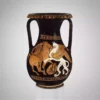
Oil jars in the shape of a griffin-eagle painted in Cycladic style, dating around 675 BC, depicting a lion with its prey as symbols of power and royal authority in ancient Greece.
Attic Oil Jars: Tradition and Evolution
Preservation of Monumental Style
In contrast to Corinth, Athens adopted a more conservative approach to integrating Eastern influences. Athenian potters, having already developed a strong tradition of monumental painting during the Geometric period, did not completely abandon their traditional style. Instead, they gradually adapted new elements into their existing artistic vocabulary. Early proto-Attic oil jars retained the large scale and monumentality of the geometric period, enriched, however, with new techniques and themes. The archaic immediacy of the compositions remained, but was enhanced by an increasing attention to detail and expressiveness. Studies on ancient pottery art highlight that this dialectical relationship between tradition and innovation is one of the most interesting characteristics of Attic ceramics (Jully).
Experimentation with Color
A particularly significant contribution of Athenian potters to the evolution of oil jars was their experimentation with color. In contrast to the Corinthian preference for black silhouette, Athenian artists developed a more complex color approach. They favored outline and linear representation, often adding additional colors such as white, red, and brown to emphasize details and create depth. Particularly striking are the multicolored oil jars from Attica, where figures are rendered with remarkable detail and vitality. This technique allowed for a more complex and expressive depiction of forms, adding an extra level of narrative power to the representations. (Search for more information with the term: multicolored Attic oil jars)
Attic oil jars are also distinguished by the deep symbolic dimension of their depictions. The mythological scenes that often adorn these vessels are not mere decorative compositions but carry multi-layered meanings regarding social, religious, and political life. For instance, the representations of sphinxes and dancers on the proto-Attic jar from 690 BC housed in the Louvre combine exotic elements with traditional themes, reflecting the complexity of Athenian society during a period of transformation.
At the same time, oil jars in the shape of griffin-eagles, depicting lions hunting their prey, serve as powerful symbols of strength and royal authority. As noted by Nikos Koutsoumpos in his study of the Orientalizing period, these symbols, although borrowed from the East, acquire a distinctly Greek interpretation and function within the context of the emerging city-state. The animal motifs are not merely decorative elements but express deeper perceptions of cosmic order, power, and the relationship between humans and the divine.

Amphoriskos (oil jar) of the Fikellura type from Eastern Greece, of Milesian origin (550-525 BC). The waterbirds reflect the symbolic and aesthetic approach of Milesian potters.
The influence of Eastern elements on ancient Greek oil jars is a brilliant example of how cultural exchange can ignite artistic revolutions. During the Proto-Geometric and Proto-Archaic periods, Greek potters did not limit themselves to simple imitation of foreign models but creatively assimilated them, enriching their tradition. Due to their significant practical and symbolic value, oil jars became a privileged field for this artistic renaissance. The different approaches developed in production centers, such as Corinth and Athens, reflect the unique social and cultural conditions of each region. This fertile dialectic between tradition and innovation laid the foundations for the flourishing of classical Greek art, leaving a legacy that continues to inspire us.


