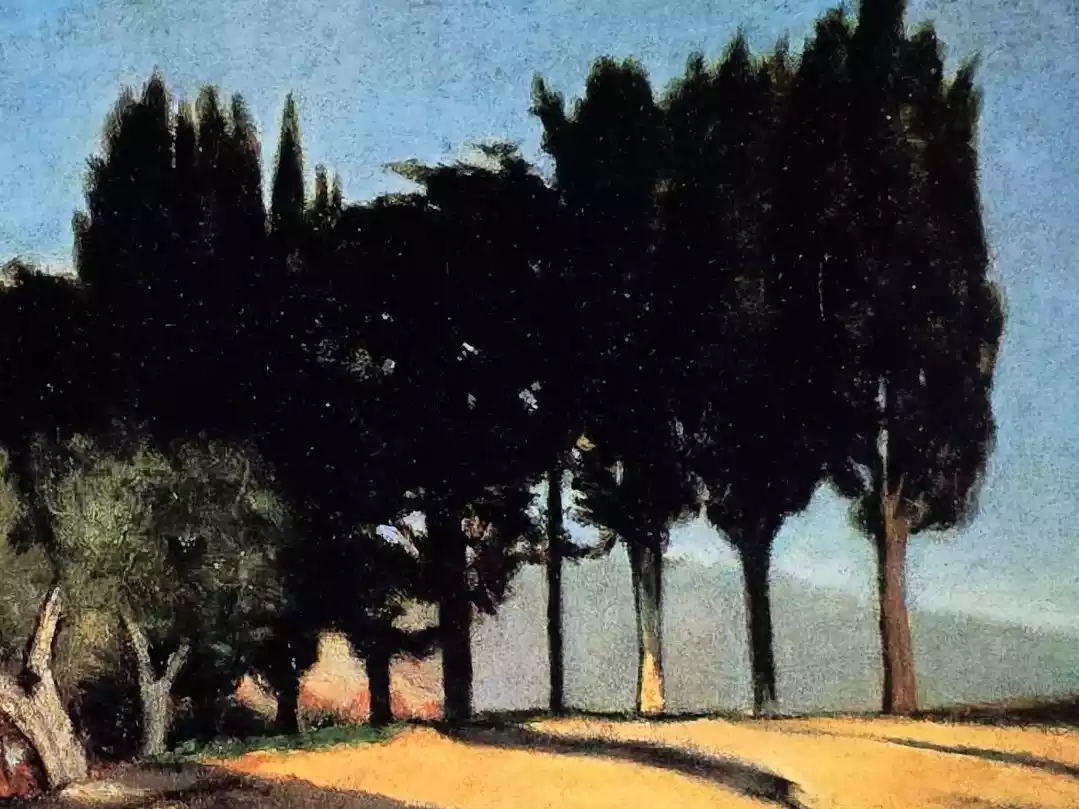
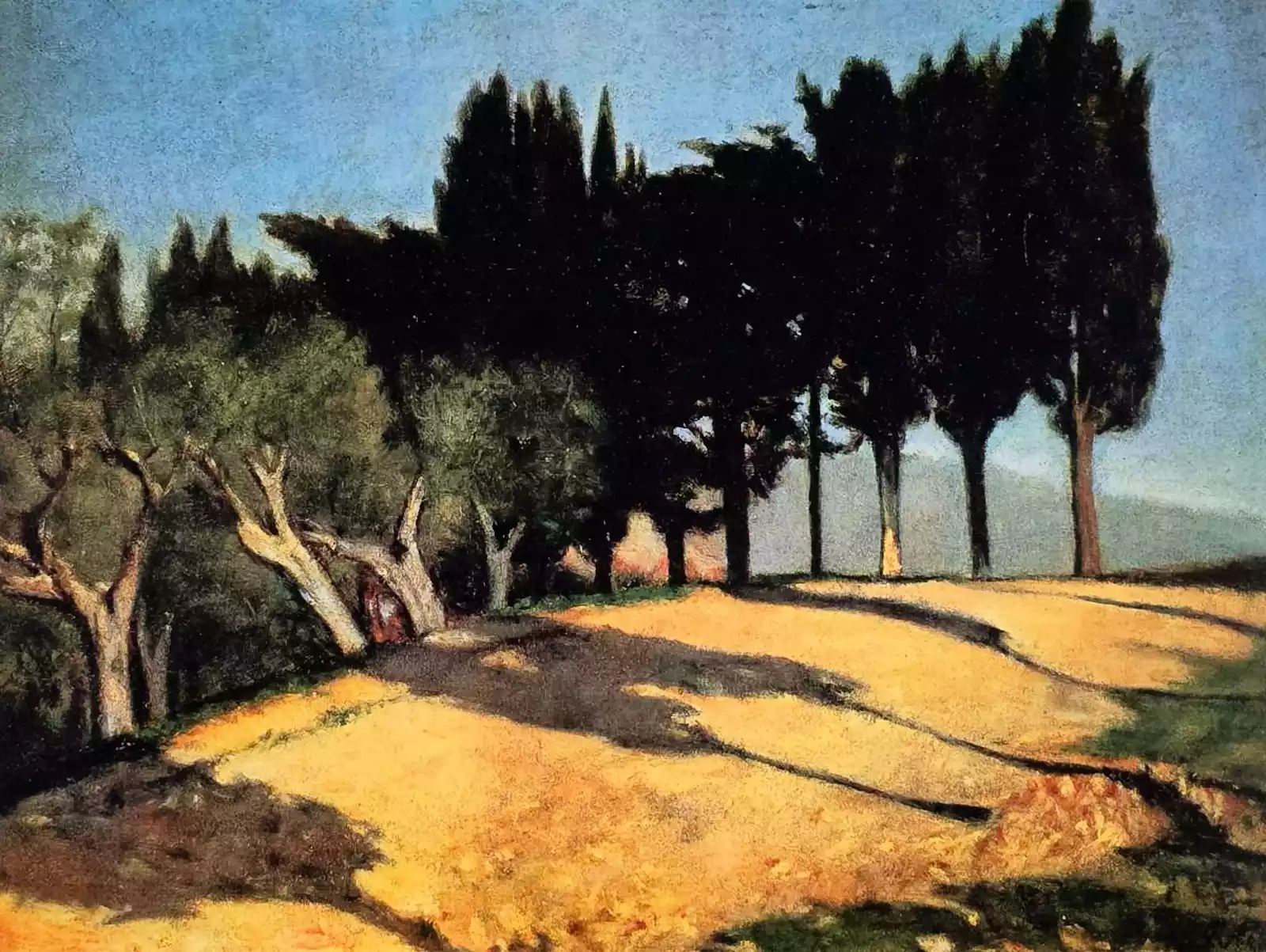
Giuseppe Abbati, “Country Road with Cypresses” (c. 1860). A masterpiece of the Macchiaioli movement, highlighting the contrast between light and shadow.
There are moments when a small painting, measuring just 28 by 37 centimeters, speaks volumes more than a large canvas. Such is the case with Giuseppe Abbati’s work, created around 1860, shortly before his death (he lived from 1836 to 1868). Titled “Country Road with Cypresses,” it is now housed in Florence at the Palazzo Pitti, painted in oil on linen. While many see cypress trees and olive trees, I perceive the shadow. I see the shadow as a form, a heavy substance resting on the ground, transcending mere absence of light. Those painters known as the Macchiaioli sought this—the “stain” (macchia). Abbati, perhaps more than any other, discovered the truth in the contrast between light and darkness, which goes beyond simple form.
The Dominance of Cypress Trees and the Earth as Fire
What is the virtue of this painting? It begins with the cypress trees. Here they stand. They are like sentinels, lined up, rigid. They are pitch-black columns, almost formless, opposing the azure sky, surpassing the appearance of mere trees. Abbati paints only the solid mass, their power to obscure light, moving beyond the depiction of leaves or branches. There is something martial about them—perhaps a reflection of Italy as it was forming at that time (around 1860)? But that is another discussion. Beside them, the olive trees, crooked and translucent, still show signs of life—while the cypress trees seem dead or rather, they stand above life, as absolute ideas of darkness.

The Fiery Road and the Stains
Below lies the road. It is golden, almost fiery, as if the very earth is ablaze under the Tuscan sun, transcending the image of a simple path. And upon this fiery surface, there are the shadows. They are cyan, crimson, deep, entities with their own form, fragments of the sky that have fallen to the ground, far exceeding mere grayness or faintness. Here, Abbati pushes the “stain” (macchia) to its limits: the road becomes a battlefield where light and shadow—these two forces—clash, and the shadow, the heavy shadow, seems to prevail, imposing its rhythm upon the earth and the road that bends and the brilliant light between them—and all of this is nothing more than patches of color placed side by side, before our minds rush to label them as “tree” or “soil.” This truth is almost painful. It demands visual reality as it is, transcending the pursuit of beauty. And that is precisely what it accomplished.