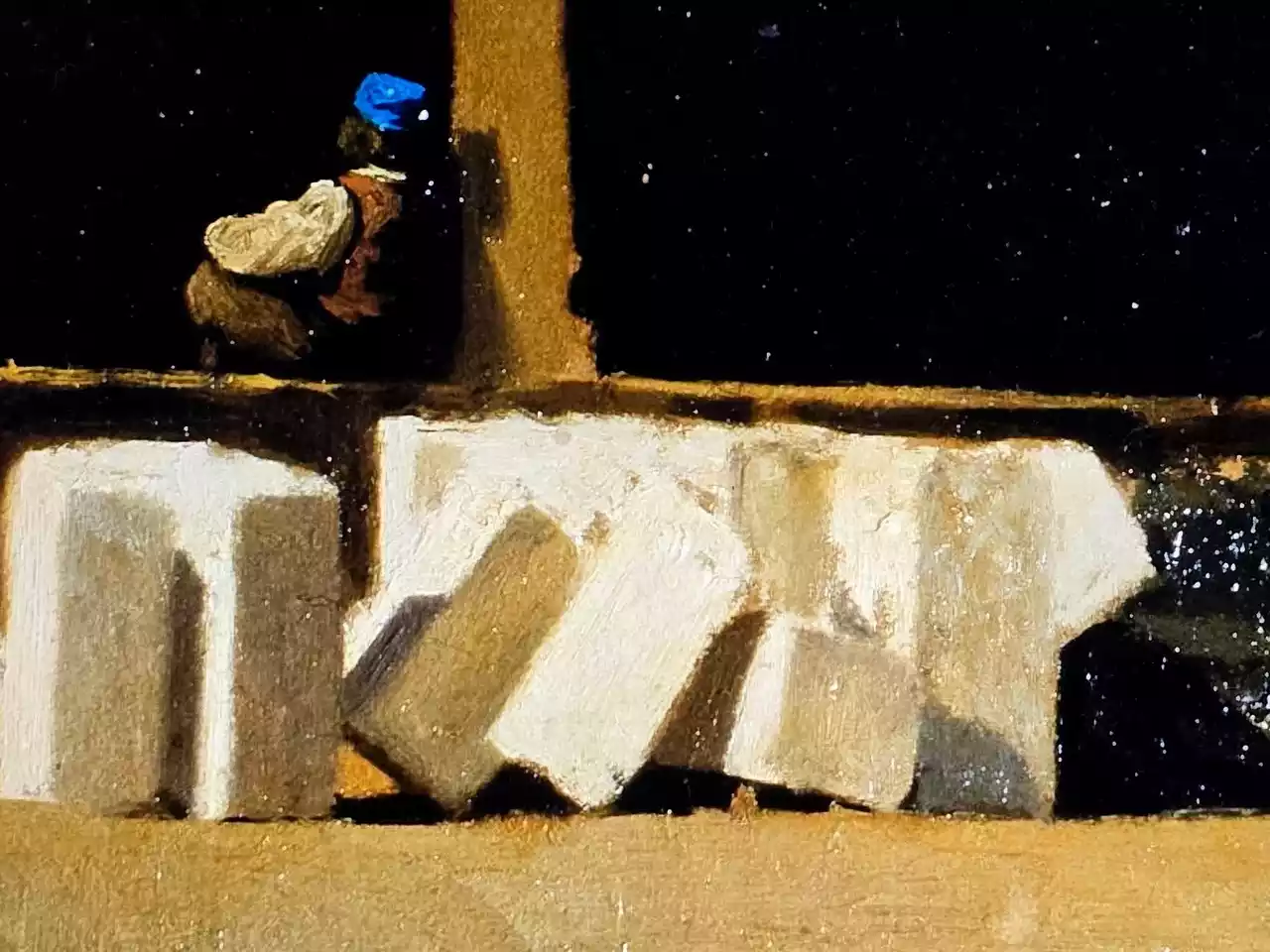
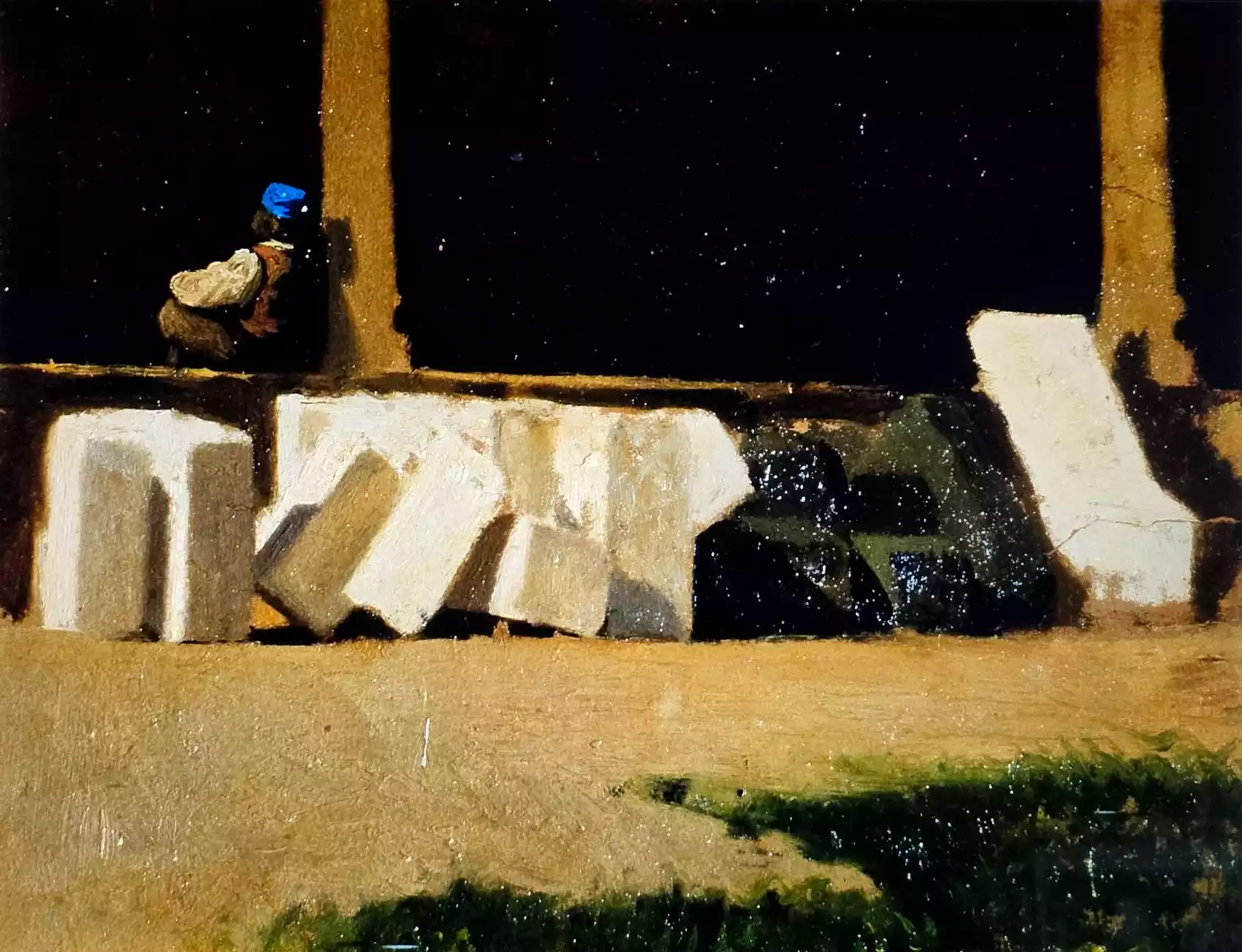
Giuseppe Abbati, “The Cloister of Santa Croce” (1861-62). This work demonstrates the boldness of the Macchiaioli in their use of extreme contrasts (chiaroscuro).
Often we look, but we do not truly see. In Florence, at the so-called Palazzo Pitti, there is a small painting—small in size, measuring 19 by 25 centimeters, oil on paper—created by Giuseppe Abbati. It dates back to 1861 or 1862. It is titled “The Cloister of Santa Croce.” And what do we see? A small figure with a blue cap? Or the white stones blazing in the sunlight? To me, it seems like neither. What we see is darkness. A deep, black mass that swallows everything—both the figure and the columns. This painting is about emptiness, transcending the subject of stones and people. The art of the Macchiaioli, to which Abbati belonged, often revolved around the contrast of light and shadow, but here it reaches its most violent expression.
The Tyranny of Darkness
How can one paint nothingness? Most painters depict shadow as an absence of light, as a diminishment. However, Abbati takes a different approach.
The Blazing Stones
Abbati, one of the so-called Macchiaioli, chases after light. But here, the light is violent, surpassing any notion of softness or divinity. It is fierce. Do you see those white stones? They are plaster, transcending the mere sense of stone, as it appears. The sun strikes so fiercely that the very shapes dissolve. The gaze loses itself beyond the precise angles and textures. You see “blotches” (as they themselves referred to their work) of whiteness. There is something raw, almost audacious, in this light—and this light carries weight, just like the stones it illuminates. They are solid, masses of light shattered upon the ground.

The Blue Stain and the Great Chaos
Then comes the figure. Or rather, the stain. There in the corner, a small figure sits, its head blue—who knows? Perhaps a soldier? Maybe an Italian monk? Its identity is secondary. Abbati has nearly erased him, making him part of the wall. He serves merely as a pretext for the blue color, contrasting against the vast darkness that unfolds behind him.
And this darkness is everything. It is a substance that transcends mere absence of light. It is essence. A black wall, shapeless, infinite, devouring the cloister, the columns, the figure, almost half the painting. The Macchiaioli say that reality is composed of light and shadow, of blotches, but here the shadow prevails. It prevails completely. This painting is a study of how darkness can be solid, how it can have weight and consume matter, transcending the subject of the cloister in Florence. The ground below, this pale zone, simply exists. It remains inert.