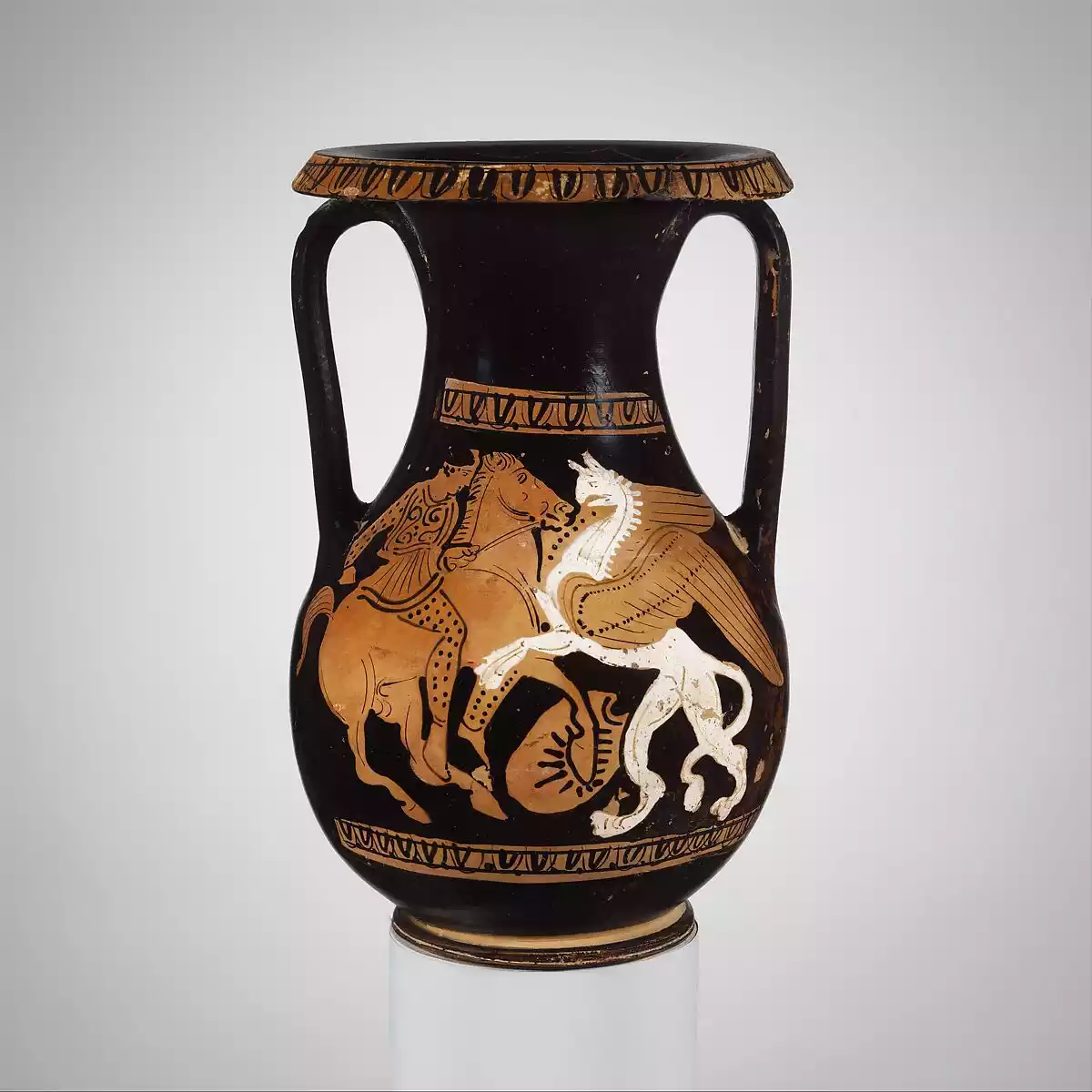
Terracotta pelike, 3rd quarter of the 4th century BC, attributed to Group G. It is part of the collection at the Metropolitan Museum of Art (The Met), New York.
The Griffin, this enigmatic creature with the body of a lion and the head and wings of an eagle, stands as one of the most imposing figures ever conceived by human imagination. It is more than just a monster; it symbolizes ultimate power, merging the royal authority of the lion, the ruler of the earth, with the divine sovereignty of the eagle, the supreme lord of the skies. Its story does not begin in the mountains of Greece but rather traces back to the depths of ancient Near Eastern civilizations, where myth and reality often coexisted. Studying its journey from early depictions in Egypt and Mesopotamia to its incorporation into Greek art and literature reveals a fascinating path of cultural exchanges, where this creature transformed, acquiring new meanings and functions, reflecting the beliefs and perceptions of each culture that embraced it. This analysis will approach the Griffin not as a religious object but as a historical and artistic artifact, a marker of the interconnectedness of ancient civilizations (McClanan).
The Eastern Origins and the Greek Narrative
The presence of the Griffin is felt long before the Greeks integrated it into their own mythological pantheon. Indeed, the earliest known representations of it can be found in the art of Elam and Mesopotamia as early as the 4th millennium BC, as well as in Egyptian seals and frescoes, where it often appeared as a guardian of sacred places or protector of the pharaohs, a clear indication of its connection to power and the divine. Its form, as supported by the relevant Egyptian and West Semitic traditions, was already established as a hybrid of eagle and lion, embodying a powerful and often threatening force of nature that humanity was compelled to respect (Wyatt). These winged beings were not mere decorations; they served as apotropaic symbols, capable of warding off evil and ensuring order, a concept that would travel with their image throughout the eastern Mediterranean. But how did this Eastern creature reach the shores of the Aegean? The answer lies in the trade routes and cultural contacts that intensified during the early Iron Age. Through Phoenician merchants and the artistic workshops of Syria and Anatolia, the Griffin, along with other mythical creatures like sphinxes and sirens, was introduced to the Greek world during the so-called Orientalizing period, in the 8th and 7th centuries BC, enriching local art and mythology.
The Greeks, with their unparalleled ability to assimilate foreign elements and imbue them with new, original meanings, did not merely adopt the image of the Griffin. They gave it a distinct identity and a leading role in one of the most captivating tales of geographical mythology. The historian Herodotus, in the 5th century BC, is the first to detail the myth of the Griffins as guardians of gold. According to his account, based on earlier epics such as the “Arimaspea” by Aristeas of Proconnesus, the Griffins inhabited the remote, mountainous regions of northern Asia, likely in the Ural or Altai mountains, in a land rich in gold deposits, which they fiercely protected. There, at the edges of the known world, these powerful creatures had to confront the one-eyed Arimaspians, a mythical people who constantly sought to steal their precious treasure. This narrative, combining elements of fantasy, geography, and morality (the greed that is punished), solidified the image of the Griffin in the Greek consciousness as the ultimate guardian. Interestingly, modern geomythological approaches link this myth to possible real mining activities in Central Asia and, notably, to the discovery of fossils of the dinosaur Protoceratops in the Gobi Desert, as the beak, quadrupedal stance, and bony frill of this creature bear striking similarities to ancient descriptions and depictions of Griffins (Mariolacos). Perhaps the ancient nomadic Scythians, upon seeing these strange fossils emerge from the earth, interpreted them as the bones of the mythical creatures guarding the treasures of the underworld. This captivating theory adds an unexpected, almost paleontological dimension to the myth. The story’s resonance was immense, transforming the Griffin into an exceptionally popular subject in archaic Greek art, where it became a common motif with rich symbolism (Mesbah & Shadrokh).
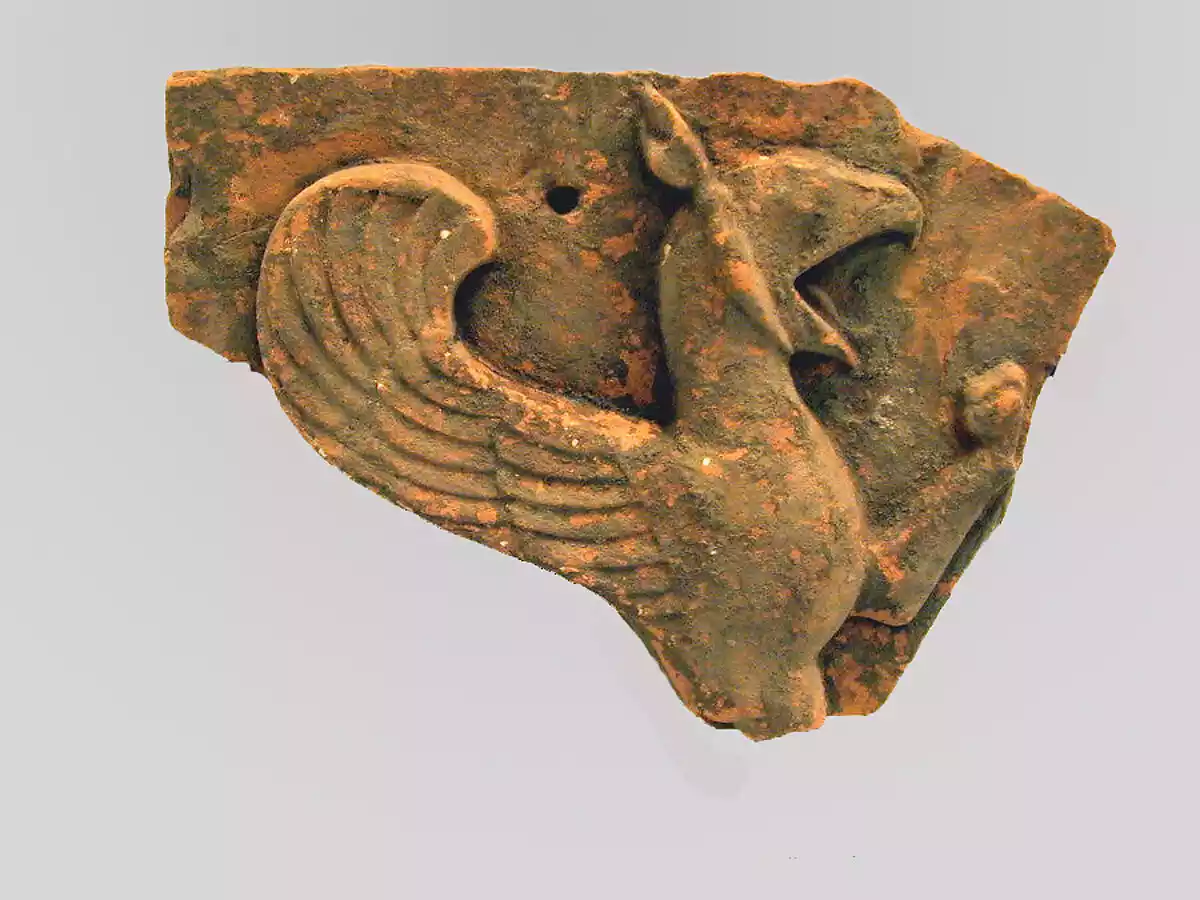
Intricate archaic relief in terracotta featuring a griffin, representative of 6th-century BC pottery, located at The Metropolitan Museum of Art.
Artistic Representation and Timeless Legacy
The adoption of the Griffin by Greek art was immediate and enthusiastic. From the early 7th century BC, its form began to appear with remarkable frequency across a wide range of artistic media, demonstrating its rapid integration into the visual vocabulary of the time. Where do we find it? We see it adorning the lips and handles of massive bronze cauldrons, such as those dedicated to great sanctuaries like Olympia and Delphi, where its busts, with their hooked beaks and large, upright ears, served both decorative and apotropaic functions. This connection, as highlighted by archaeological findings, was particularly strong in both archaic Greece and the nomadic cultures of Central Asia, suggesting a shared symbolic core (Lymer). Furthermore, Griffins became protagonists in vase painting, depicted either individually, in a vigilant stance, or in scenes of fierce battle against the Arimaspians, as well as accompanying deities like Apollo and Dionysus, emphasizing their divine aspect (Vlachou).
However, the legacy of the Griffin did not end in antiquity. Its strong symbolic charge, combining vigilance, power, and divine justice, secured it a place in the cultures that followed. The Romans extensively utilized it in architecture and decorative arts, while during the Middle Ages, the Griffin transformed into a popular heraldic symbol, embodying noble bravery and lineage, as well as an allegorical figure in Christian theology, where its dual nature (earthly and heavenly) was interpreted as a symbol of the dual nature of Christ. Its journey continues to this day, as it remains a beloved figure in modern fantasy literature and pop culture. Ultimately, the Griffin is much more than a mere mythical monster. It represents a timeless cultural constant, a symbol that has traveled through space and time, constantly transforming to express the eternal human quest for understanding forces that transcend mundane reality, bridging the world of humans with that of the gods.
The Dual Nature of the Griffin: Symbolism, Function, and Timeless Resonance
Analyzing the artistic representation of the Griffin reveals much more than a simple aesthetic preference. It uncovers a deeply rooted belief in its symbolic power. But why did this particular creature, and not another, occupy such a prominent place in the collective consciousness of so many different cultures? The answer lies in its very complex nature, in the harmonious union of two beings that embody absolute dominion in their respective realms. The lion, with its undeniable earthly strength and royal grace, represents courage, power, and authority over the material world. On the other hand, the eagle, the lord of the skies who can fly closer to the sun than any other creature, symbolizes spirituality, keen perception, freedom, and divine wisdom. The Griffin, therefore, is not a mere hybrid. It is the perfect allegory of balance. It embodies the ideal union of strength with wisdom, matter with spirit, the mortal with the divine, a quality that allowed it to assume multiple and often contradictory roles within mythological narratives. Studying these roles, which span from the Near East to classical Greece and beyond, enables us to gain a deeper understanding not only of the creature itself but also of the societies that worshipped, feared, and depicted it. This Griffinology, the systematic examination of the Griffin as a cultural phenomenon, reveals a world where myth served as the key to interpreting reality (McClanan).
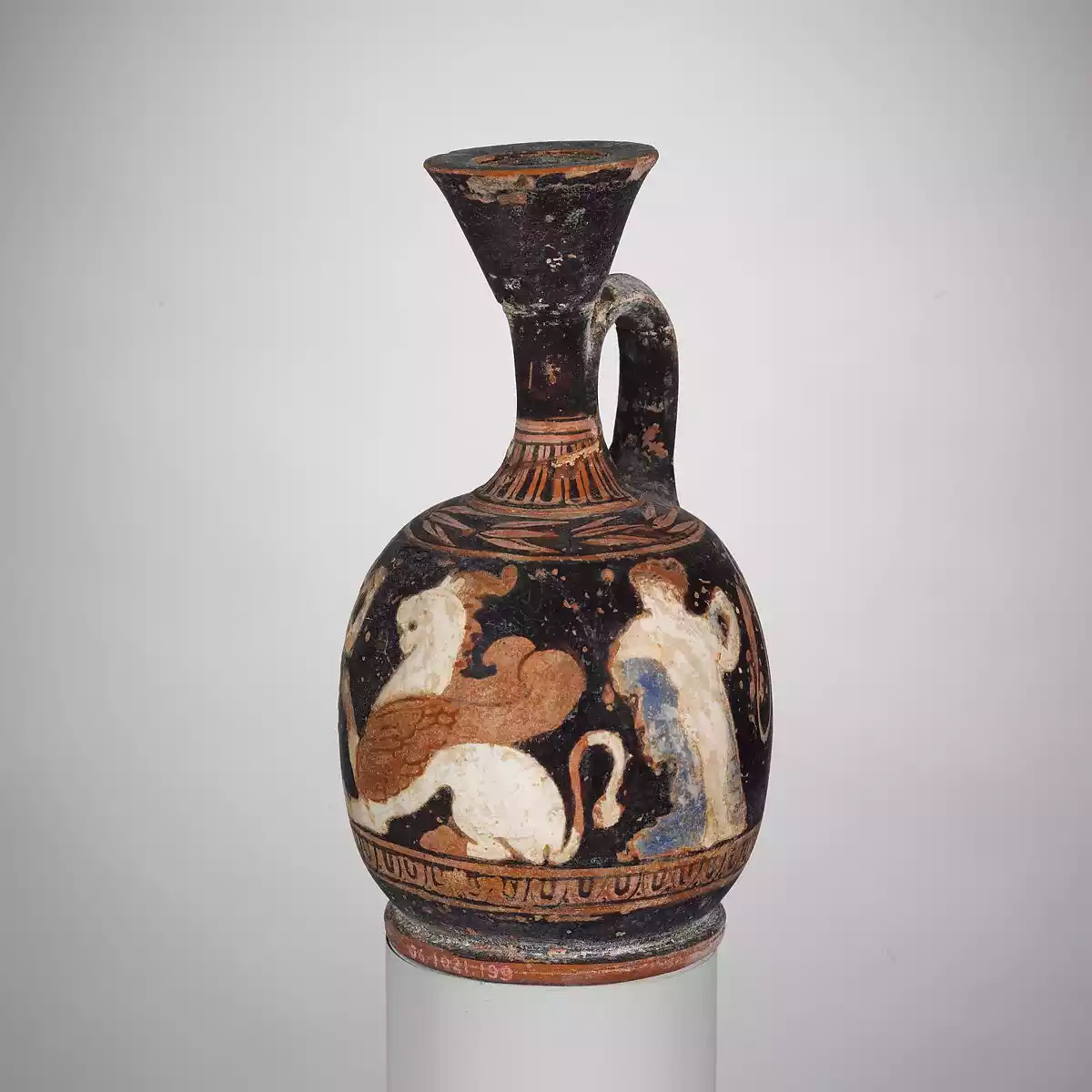
The lekythos (06.1021.199) is part of the collection at the Metropolitan Museum of Art in New York. It dates to the early 4th century BC and depicts a griffin between two women, likely mythological figures.
Guardian, Avenger, and Psychopomp: The Multiple Roles in the Ancient Pantheon
The most recognizable role of the Griffin is undoubtedly that of a guardian. However, it was not just a simple sentinel. It was the ultimate custodian, tasked with protecting the most valuable treasures, whether material, like the gold of the Scythians, or spiritual. This function, rooted in Egyptian and West Semitic traditions where it protected the tombs of pharaohs (Wyatt), found its perfect expression in Greek art. We find it standing proudly atop tomb monuments, serving as a silent guardian of eternal rest, deterring tomb robbers and malevolent forces. The rich archaeological findings from cemeteries in Greece and Eurasia, which include jewelry, vessels, and weapons adorned with griffin forms, confirm this deep connection of the creature with death and the afterlife (Lymer). Its presence signified not just protection; it declared that this space was sacred, inviolable, under the aegis of a powerful, supernatural entity.
However, the nature of the Griffin also contained a dark, punitive aspect. Its very ferocity, essential for its role as a guardian, rendered it a fearsome instrument of divine retribution. In the myth of the Arimaspians, the Griffin is not merely a passive guardian. It is an active avenger, attacking and devouring those who, blinded by greed, dare to violate its territory. This dimension reflects a common moral principle in the ancient world: hubris, the arrogant transgression of limits, is followed by nemesis, divine retribution. The Griffin, with its sharp claws and pointed beak, became the visible embodiment of nemesis, a warning to mortals about the limits of human ambition. Beyond being a guardian and avenger, there is a third, more internal interpretation of its role: that of a psychopomp. As a creature that combines earth and sky, the Griffin was ideally suited to serve as a guide for souls. Its ability to move between the two worlds made it a mediator, a guide capable of safely transporting the soul of the deceased from the earthly realm to the realm of the gods or the Underworld, ensuring its proper transition. This role, though less explicitly stated in written sources, is strongly implied by its consistent presence in funerary art, where it serves not only as a deterrent for the living but also as a companion for the dead on their final journey.
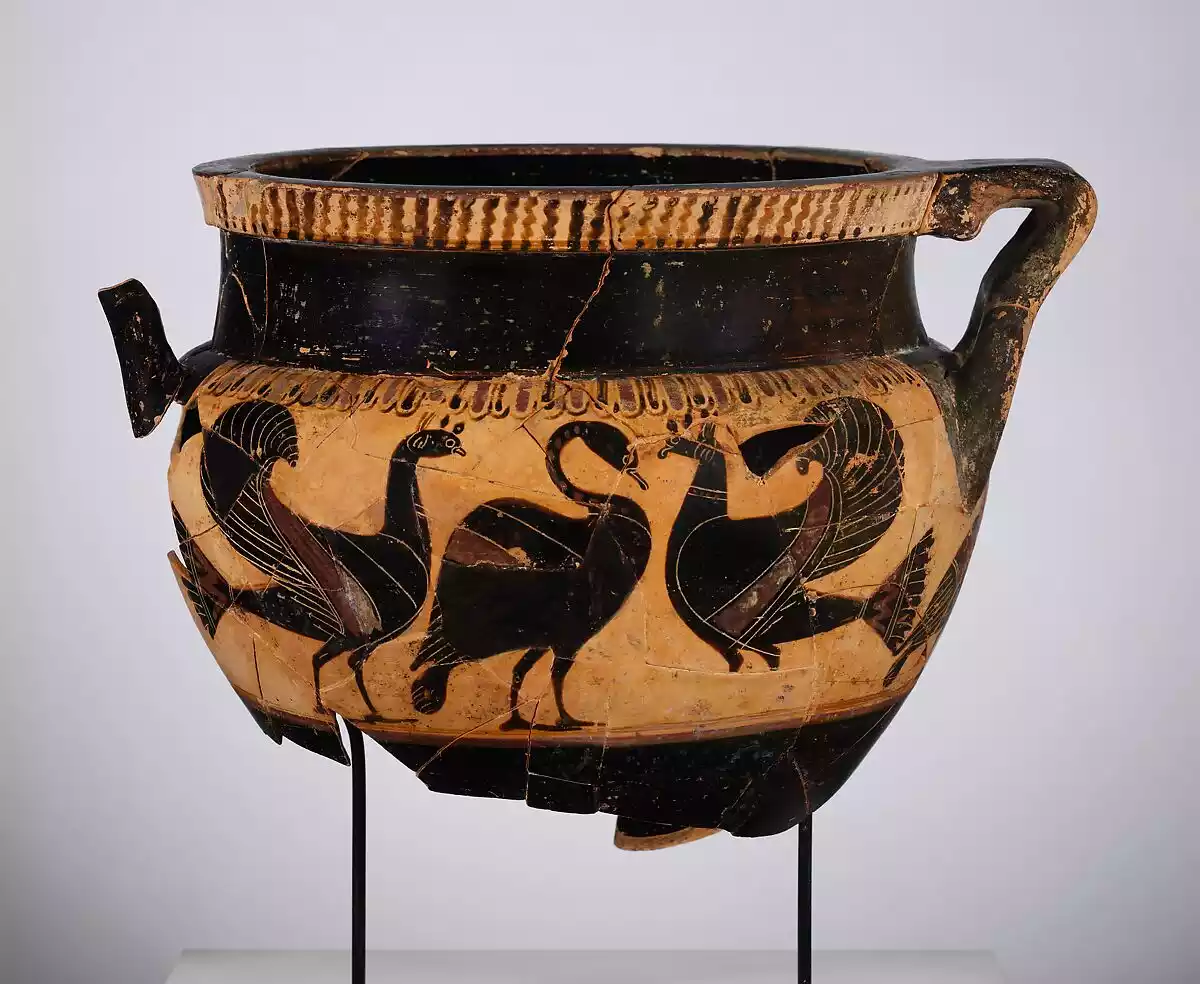
Corinthian krater with Griffins and swan (1979.11.7), circa 580-550 BC, with Chalcidian-type handles. The work, exhibited at The Metropolitan Museum of Art, is the earliest preserved example in Corinthian pottery.
From Myth to Allegory: The Transformation of an Eternal Symbol
The Griffin’s remarkable ability to survive through the ages, transitioning from the role of the fearsome guardian of Scythian treasures—a narrative that may, as modern geomythological approaches suggest, have roots in paleontological findings (Mariolacos)—to that of the Christian symbol of the dual nature of the God-Man, demonstrates the resilience and plasticity of archetypal images that resonate with the deepest chords of the human soul. With the decline of the ancient world, the Griffin did not vanish. Instead, it transformed. In the Roman Empire, it largely retained its decorative and apotropaic character, but it was during the Middle Ages that it experienced a remarkable renaissance. Its dual nature was interpreted by Christian theologians as the perfect allegory for Jesus Christ, who was both man (lion, the king of the earth) and God (eagle, the king of the heavens). Thus, a quintessentially pagan symbol was seamlessly integrated into Christian iconography, adorning churches and manuscripts, symbolizing Resurrection and divine justice.
Simultaneously, the Griffin became one of the most beloved creatures of medieval heraldry. Nobles and royal houses adopted it in their coats of arms as a symbol of absolute valor, military virtue, and wise governance, combining the martial vigor of the lion with the astuteness and noble lineage of the eagle. This cultural journey, from the East to Greece and from there to medieval Europe, illustrates how representations of mythical beings are not static but dynamic entities that adapt, change, and acquire new meanings (Vlachou). The fact that the Griffin became such a common motif in such diverse cultures underscores the universal appeal of its central idea (Mesbah & Shadrokh). Today, its legacy continues unabated. We encounter it in fantasy literature, cinema, and video games, always in the role of the powerful guardian, the noble ally, or the fearsome adversary. The Griffin remains immortal, not because it ever existed as a biological entity, but because it embodies an eternal human idea: the belief that true strength lies not only in physical power but in its harmonious union with spiritual clarity and moral integrity. Ultimately, it is the symbol of the ideal ruler, the perfect warrior, and the vigilant protector. A creature born from myth, yet still speaks to us about the deeper truths of human nature.
Bibliography
Lymer, K., 2018. Griffins, Myths and Religion—a review of the archaeological evidence from ancient Greece and the early nomads of Central Asia. Art of the Orient, 7, pp. 69-93.
Mariolacos, H.D., 2013. Mining and metallurgical activity of the prehistoric inhabitants of the Aegean and peri-Aegean area: a geomythological approach. Bulletin of the Greek Geological Society, 47(4), pp. 1827-1853.
McClanan, A.L., 2024. Griffinology: The Griffin’s Place in Myth, History and Art. Reaktion Books.
Mesbah, B. & Shadrokh, S., 2022. A Comparative Study of Griffin Motif in Iran and Greece. Negareh Journal, 17(61), pp. 49-65.
Vlachou, A., 2005. Representations from the epics and myths in the vase painting of the geometric and early archaic periods (8th-7th century BC). Doctoral Dissertation. University of Thessaly.
Wyatt, N., 2009. Grasping the griffin: identifying and characterizing the griffin in Egyptian and West Semitic tradition. Journal of Ancient Egyptian Interconnections, 1(1), pp. 29-39.


