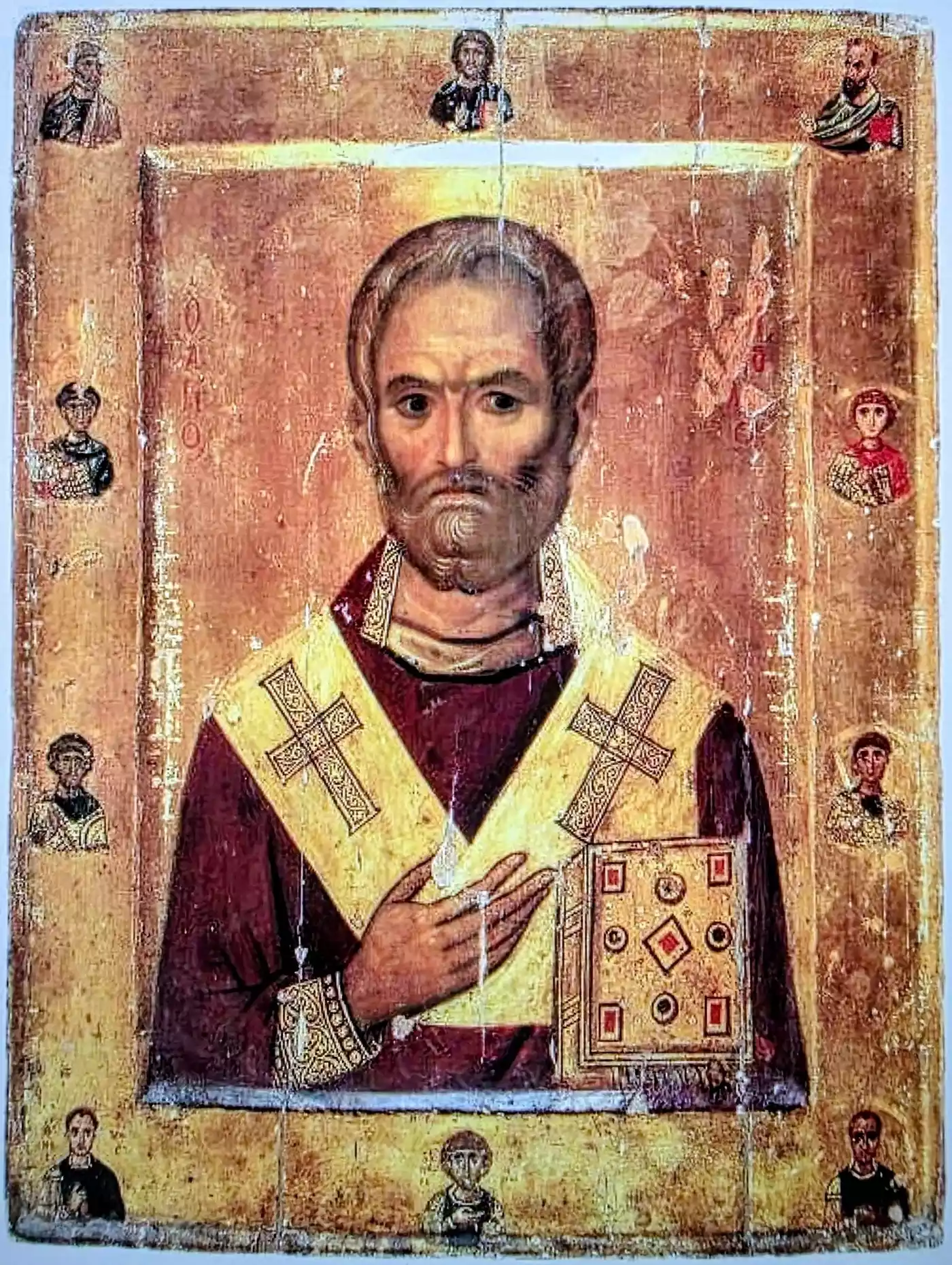
The image of Saint Nicholas from the Monastery of Saint Catherine in Sinai, 11th century, is an exceptional example of Byzantine iconography
The image of Saint Nicholas from the Monastery of Saint Catherine in Sinai is one of the most significant Byzantine masterpieces of the 11th century. Measuring 43 x 33 centimeters, this work serves as an outstanding testament to the iconographic art that flourished in the sacred monastery of Sinai during the Middle Byzantine period (Weitzmann). This particular piece is notable not only for its artistic excellence but also for its theological significance as a historical document of a cultural tradition that has persisted uninterrupted from the early Christian centuries to the present day.
The depiction of Saint Nicholas follows the classic Byzantine typology of frontal busts, where the saint is shown in a frontal position holding a closed Gospel. This iconographic convention reflects the theological emphasis on episcopal authority and the saint’s teaching mission (Weitzmann). His right hand is raised in a gesture of blessing in front of his chest, a movement that encapsulates his teaching and spiritual role. Notably, this representation shows him as middle-aged, contrasting with later illustrations where he appears with white hair and more ascetic, wrinkled features, a detail that reinforces the dating of the work to the 11th century and reveals the evolution of the iconographic tradition.
Theological Dimension and Functionality
The frame of the icon is adorned with ten saints in medallions, a composition inspired by enamel art that reveals the creator’s holistic theological vision (Živković). At the top, Christ Pantocrator is placed, accompanied by the leading apostles Peter and Paul, a trio symbolizing absolute ecclesiastical authority and apostolic succession. On the sides, the military saints Demetrius, George, Theodore, and Procopius are arranged, highlighting the martyrdom aspect of the Christian faith and the spiritual struggle against evil.
At the bottom, we find the healing saints Cosmas, Panteleimon, and Damian. This iconographic choice is not random but reflects the healing and beneficial dimension of the Christian message (Lidova). The inclusion of these specific saints creates a comprehensive program that covers all essential aspects of the Christian experience: ecclesiastical authority, martyrdom, and healing care. The entire composition functions as a small theological system encompassing the Christological, ecclesiological, and hagiological dimensions of the Orthodox faith.
Technical Perfection and Aesthetic Integrity
The halo of Saint Nicholas features a rough surface that contrasts with the golden background. Similar differentiation is seen in the circles surrounding the other saints’ figures. This technical choice is not merely aesthetic but carries deeper symbolic meaning (Innemée). The roughness of the halos creates a visual contrast with the smoothness of the background, emphasizing the spiritual dimension of the depicted faces and separating the sacred from the secular realm.
The color palette of the work is dominated by warm hues of ochre and red in the background, while the saint’s garments combine deep red with the gold of episcopal decorations. The encaustic technique, often used in Sinai icons, allows for exceptional color preservation and the rendering of fine details (Margell). The saint’s face is rendered with almost portrait-like precision, while his large, expressive eyes are directed towards the viewer, creating an immediate spiritual connection.
Historical Testimonies and Cultural Heritage
The image of Saint Nicholas is part of the extensive collection of the Monastery of Saint Catherine, which houses the most significant collection of icons in the world (Pfeiffer). This unique collection has been preserved due to the geographical isolation of the monastery and the protection afforded by Islamic rule, which respected the sacred character of the site. This allows scholars today to examine an uninterrupted tradition of iconography spanning from the 6th to the 13th century.
This particular image is part of a broader program of Byzantine iconography that developed in Sinai during the 12th and 13th centuries, as evidenced by other related works in the collection (Stric̆ević). The typological consistency and high artistic quality of these works reveal the existence of an organized artistic workshop that maintained direct contacts with the major centers of Byzantine art. At the same time, the uniqueness of certain iconographic solutions suggests the development of local traditions that enriched the central Byzantine repertoire.
Functional Purpose and Liturgical Use
The image of Saint Nicholas, like most small private icons of the time, was likely intended for personal devotional use or for decorating a private prayer space (Annemarie). Its relatively small dimensions, while sufficient for functional use, allow for a personal relationship between the believer and the saint, while still maintaining the formality required for liturgical function. The choice of Saint Nicholas as the central figure is not coincidental, as this saint was considered the protector of sailors, merchants, and children, broad social groups that had an immediate need for his protection and intercession.
The functional context of the icon is enriched by the presence of the surrounding saints, who create a complete circle of protection and intercession. The person praying before the icon not only has access to the grace of Saint Nicholas but also participates in a broader community of saints that encompasses all aspects of human experience. This multidimensional approach to intercession reflects the Byzantine theological understanding of the communion of saints as a living reality that transcends the boundaries between earth and heaven.
Bibliography
Annemarie, W. “The Presentation of an Icon at Mount Sinai.” Δελτίον της Χριστιανικής Αρχαιολογικής Εταιρείας (1994).
Innemée, K. “Encaustic painting in Egypt.” L’apport de l’Egypte à l’histoire des techniques. Cairo (2006).
Lidova, M. “Word of image: Textual frames of early Byzantine icons.” Inscribing Texts in Byzantium (2020).
Margell, J. Encaustic Art (2015).
Pfeiffer, H. “The Monastery of Saint Catherine at Mount Sinai. The Icons, Vol. I: From the Sixth to the Tenth Century.” JSTOR (1977).
Seggebruch, PB. Encaustic Painting Techniques: The Whole Ball of Wax (2013).
Stric̆ević, G. “The Monastery of Saint Catherine at Mount Sinai. The Icons. Volume One: From the Sixth to the Tenth Century.” JSTOR (1978).
Weitzmann, K. “Fragments of an early St. Nicholas triptych on Mount Sinai.” Δελτίον της Χριστιανικής Αρχαιολογικής Εταιρείας (1966).
Weitzmann, K. “Icons Programs of the 12th and 13th Centuries at Sinai.” Δελτίον της Χριστιανικής αρχαιολογικής Εταιρείας (1986).
Živković, M. “On the icons of Sinai and Raithou martyrs in Saint Catherine’s monastery at Sinai.” Zograf (2020).


