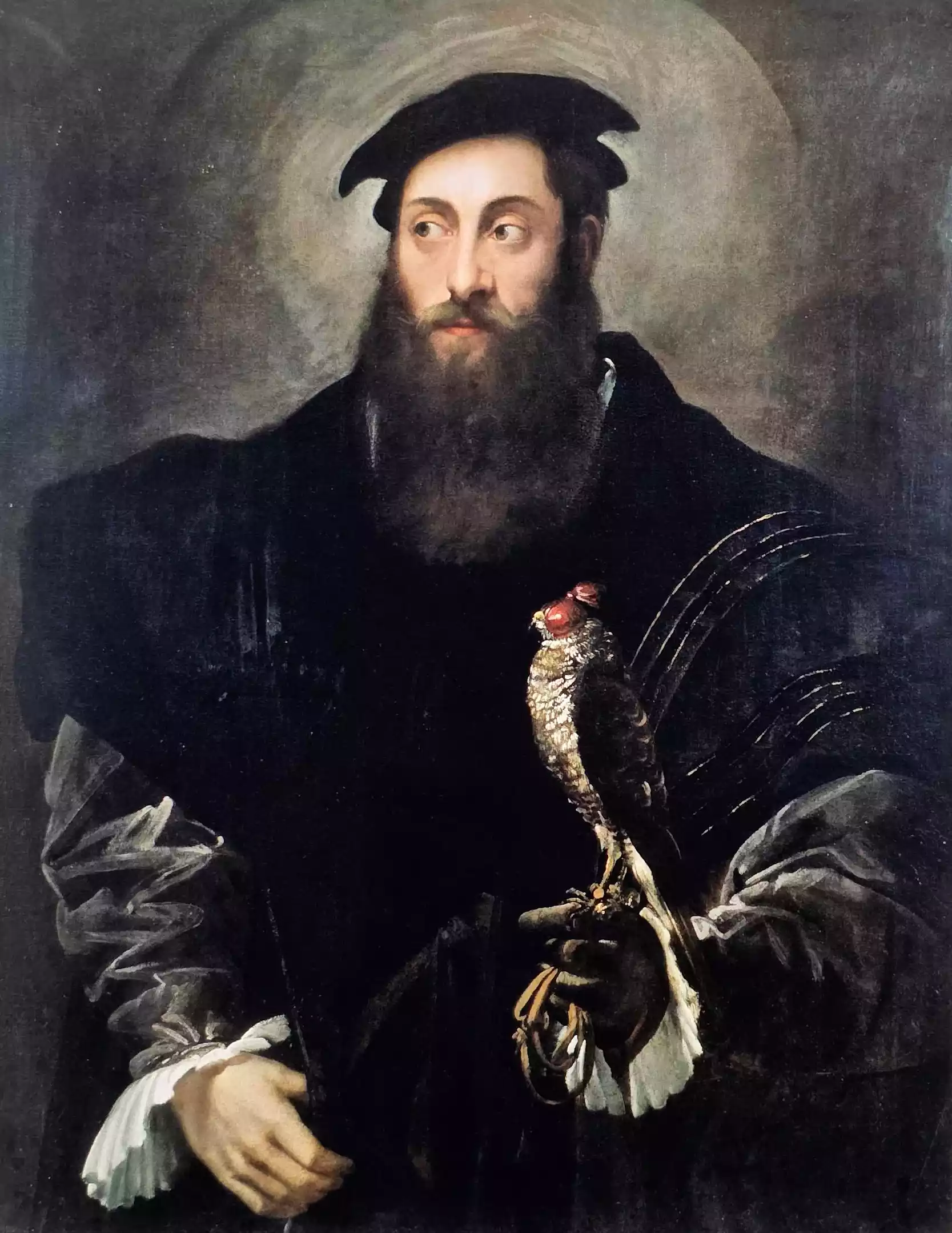
“Portrait of a Man with a Falcon” (1548-50), a masterpiece by Niccolò dell’Abbate, blending realism with the symbolism of the Italian Renaissance.
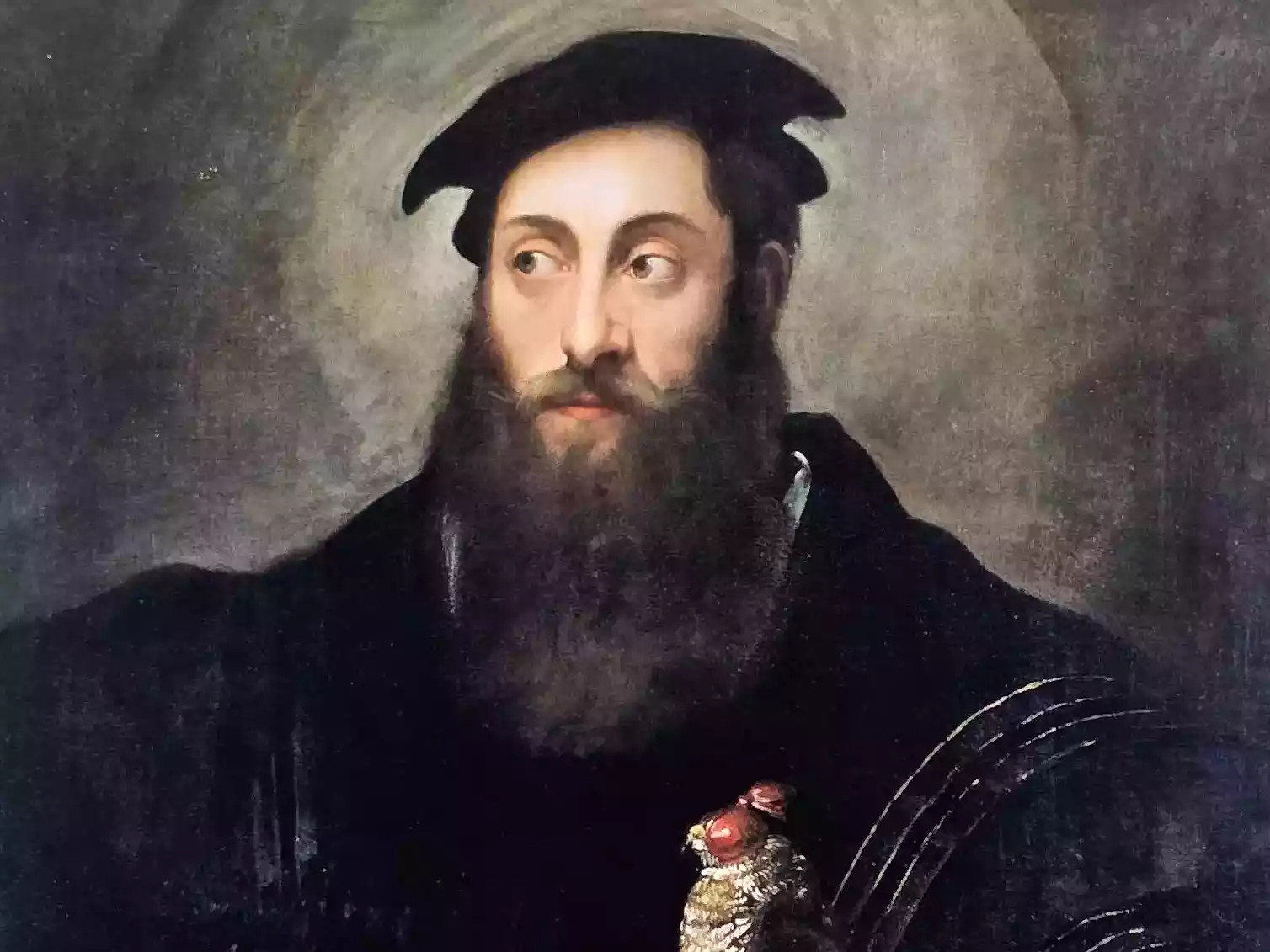
The painting before us, created by the Modena artist Niccolò dell’Abbate (1509-1571), depicts an unknown man. This work, titled “Portrait of a Man with a Falcon,” dates back to around 1548-1550 during the Italian Renaissance. It is currently housed in the Art Gallery of New South Wales in Sydney, painted in oil on canvas, measuring 140 by 117 centimeters. The man presents himself to the viewer as a symbol, transcending the status of an ordinary individual. He wears black garments—considered luxurious at the time due to the difficulty of dyeing—and a hat on his head. His left hand is adorned with a leather glove, upon which a falcon perches, its gaze covered by a red hood.
The Falcon: A Symbol of Nobility
Many of the opulent estates merely embellish life, while others signify power. The falcon held by this man is a clear indication of aristocracy—caring for falconry was a privilege of those who owned vast lands and had leisure time, surpassing the capabilities of the average person. This bird itself serves as a historical testament, going beyond mere artistic detail.
The Art of Falconry
We see the bird, small in size yet fierce in nature, resting on the man’s hand. The red hood serves a purpose in the art of hunting, preventing the falcon from becoming agitated before the right moment. The man himself does not look at us. His gaze is directed away, exuding an air of superiority, perhaps towards the prey the falcon is about to hunt, or perhaps into the depths of his own soul, revealing a hint of melancholy or pride. This averted gaze contrasts with most portraits from Italy, where the subject typically faces the viewer directly, as if seeking judgment or affirming their social standing.

The Essence of Authority
The attire itself is black. Many might interpret this as a sign of mourning or perhaps restraint. However, I perceive something different. In the sixteenth century, black was exceedingly rare and costly, far more than purple or gold. This is evident from the sumptuary laws enacted in many European cities at the time. Thus, this man displays his power through the quality of the fabric—which appears to be velvet—and through the understated luxury of the deep black color, surpassing the mere brilliance of other hues. The glove he wears is also part of the ritual of authority, akin to a scepter, transcending its simple function of protection from the falcon. Here, power whispers.
But what is that faint halo around his head? Some might say it signifies holiness. But what holiness belongs to a hunting man? Perhaps the painter later changed his mind (pentimento), or simply sought a shape (a simple compositional device) to distinguish the man from the surrounding darkness through the circle. Such tricks, often seen in manuscripts and paintings, can cause more confusion than clarity. The question, it seems, remains open.