
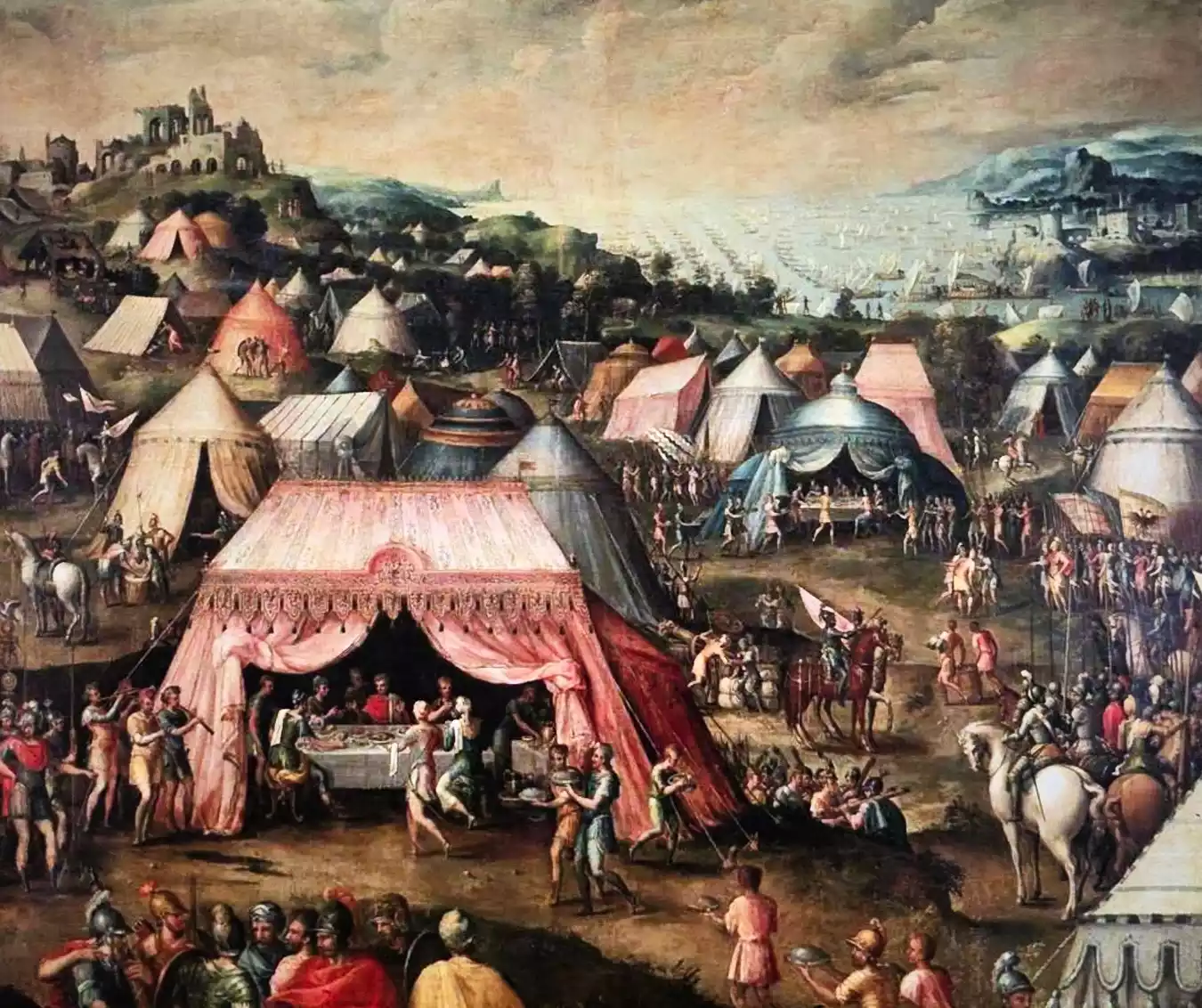
Niccolò dell’Abate dramatically depicts the meeting of Charles V with the Bey of Tunis (1545-50), highlighting the crowd
When one gazes at this painting—the Meeting of Charles V and the Bey of Tunis, created by Niccolò dell’Abate between 1545 and 1550—the first thought that comes to mind is not the historical event, but rather the chaos. An almost festive turmoil spreads across the canvas, a medley of scenes, horses, soldiers, and attendants, as if the entire world has gathered on this beach not to witness a diplomatic meeting, but a kind of theatrical performance. dell’Abate, a painter who honed his craft in the heart of Emilia, seems less concerned with accurately recording the event of the emperor of the Holy Roman Empire’s conquest of Tunis in 1535 and more focused on capturing the atmosphere, the very texture of such a monumental gathering. His style, after all, fits into a broader artistic movement of the time, as evidenced by the study of Emilian Renaissance drawings (Disegni Emiliani del Rinascimento) (Zezza). It is a painting that revels in storytelling, in detail, almost gossiping with its brush. And what is history, after all, if not a well-organized gossip?
Setting the Scene: Balancing Order and Chaos
The gaze wanders, meandering through the crowd. How can one impose a coherent narrative on such a composition? The artist seems to challenge us to find the center while simultaneously undermining it.

A City of Tents
The composition is, if I may say so, an organized anarchy. A whole city of tents rises before us, from simple military encampments to elaborate, luxurious pavilions resembling fabric palaces, and this city spreads irregularly, almost organically, as if it sprouted from the very ground—a temporary installation that nonetheless exudes a paradoxical sense of permanence. In the background, a fleet of ships covers the sea, while on the hill, a fortified city faintly appears, likely Tunis itself, witnessing its own subjugation. This contrast between the temporary camp and the permanent architecture is not coincidental. It is the core of the narrative: power does not reside in stone walls, but in the ability to establish your authority anywhere, at any moment. The tent is the true symbol of imperial power.
The Contract of Power
At the center, or rather slightly to the left of center, a large pink tent draws our attention. There, beneath the open drapes, we discern a gathering of figures around a table. This is supposed to be the heart of the event, the meeting of Charles V with Mulai Hassan, the Bey of Tunis whom the emperor restored to power. Yet, dell’Abate places it almost as a secondary episode. Around them, life continues with a nonchalance that almost offends the gravity of the moment—soldiers carry supplies, others haggle, some simply wander about. It is a strange choice to drown the main subject in a sea of everyday, almost trivial details. Perhaps this is his commentary. That great historical moments, those that fill the books, are for most people merely background noise in their own personal reality. Just like that.


