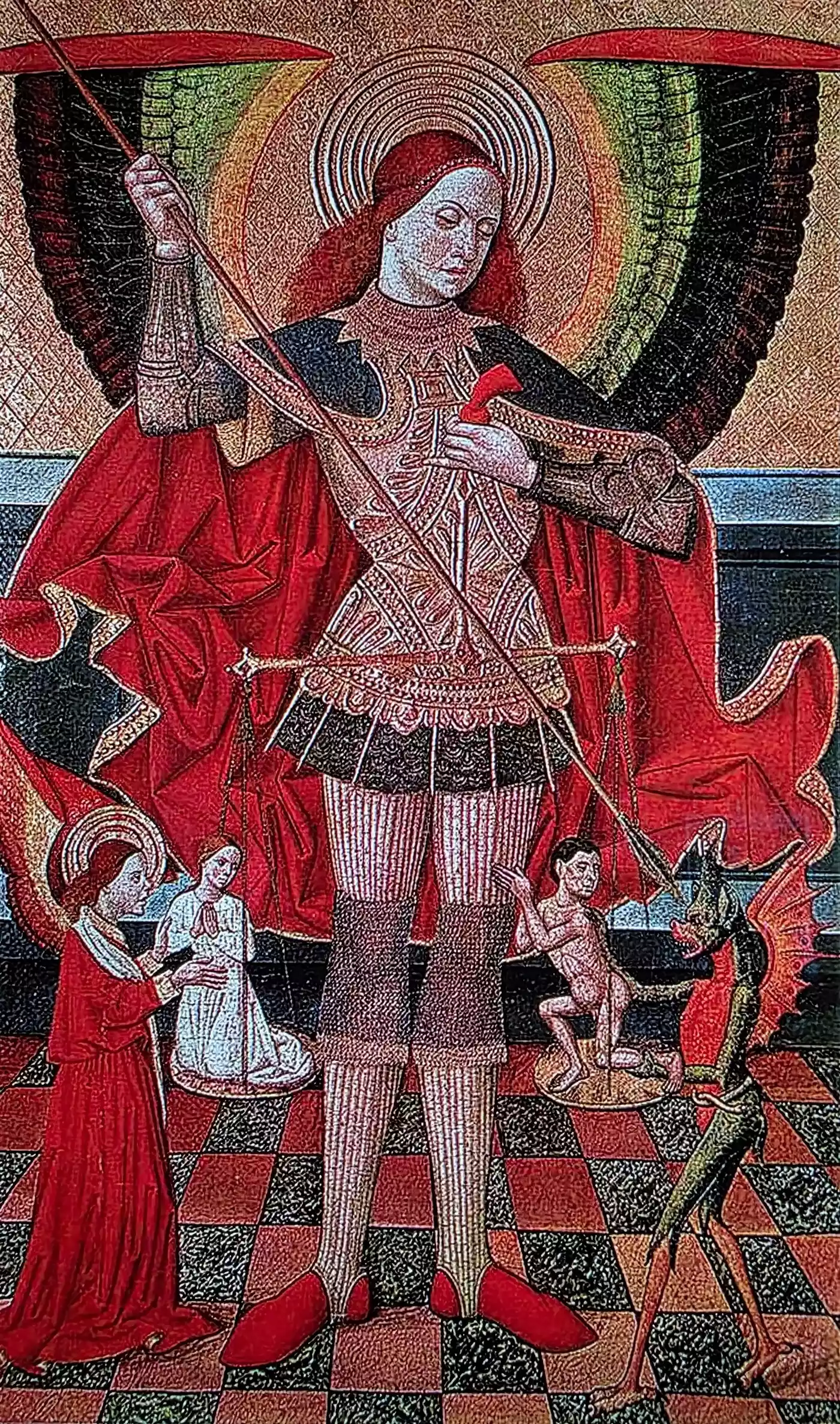
The Archangel Michael by Juan de la Abadia (1490) with the scales of psychostasis, a masterpiece of Aragonese painting at the Museu Nacional d’Art de Catalunya
The painting of the Archangel Michael, created by Juan de la Abadia around 1490, is a distinguished example of Aragonese painting from the 15th century (Pijoan). It is displayed at the Museu Nacional d’Art de Catalunya in Barcelona and measures 127 x 78 centimeters, painted on wood.
The spiritual dimension of the work transcends the narrow confines of its time. Juan de la Abadia, active from 1470 to 1490 in Huesca, belonged to the strong tradition of Spanish primitive painters who merged Flemish influence with local religious needs (Velasco). The work reflects the cultural meeting of East and West that characterized the Iberian Peninsula.
The grand figure of the Archangel dominates the overall composition. He bears traditional archangel wings, while his halo radiates spiritual light through concentric circles. The colors—red, gold, brown—create an atmosphere of warm devotion that blends Byzantine reverence with 15th-century Gothic expressiveness (Salcman).
Psychostasis serves as the central theological theme. Michael holds the white scales of justice, symbolizing the eternal judgment of souls. On the left side of the scales, a white figure is discernible—the soul of the righteous—while the dark figure on the right represents evil. This dramatic composition reflects the medieval perception of the eternal struggle between good and evil, as manifested through the religiosity of the time in Toledo and other centers (Juan).
The Doric column supporting the scene is not merely an architectural element. It symbolizes the stability of divine justice, the permanence of faith against fleeting human passions. The Ionic capital alludes to classical tradition, indicating the Renaissance influence that began to permeate Spanish art.
At the base of the painting, a scene unfolds revealing eternal destinies. Two small figures appear in different postures: one kneeling in worship, the other somber and dejected. The stepped marble floor, with alternating white and dark slabs, enhances the sense of judicial severity and the geometric order that characterizes the divine realm.
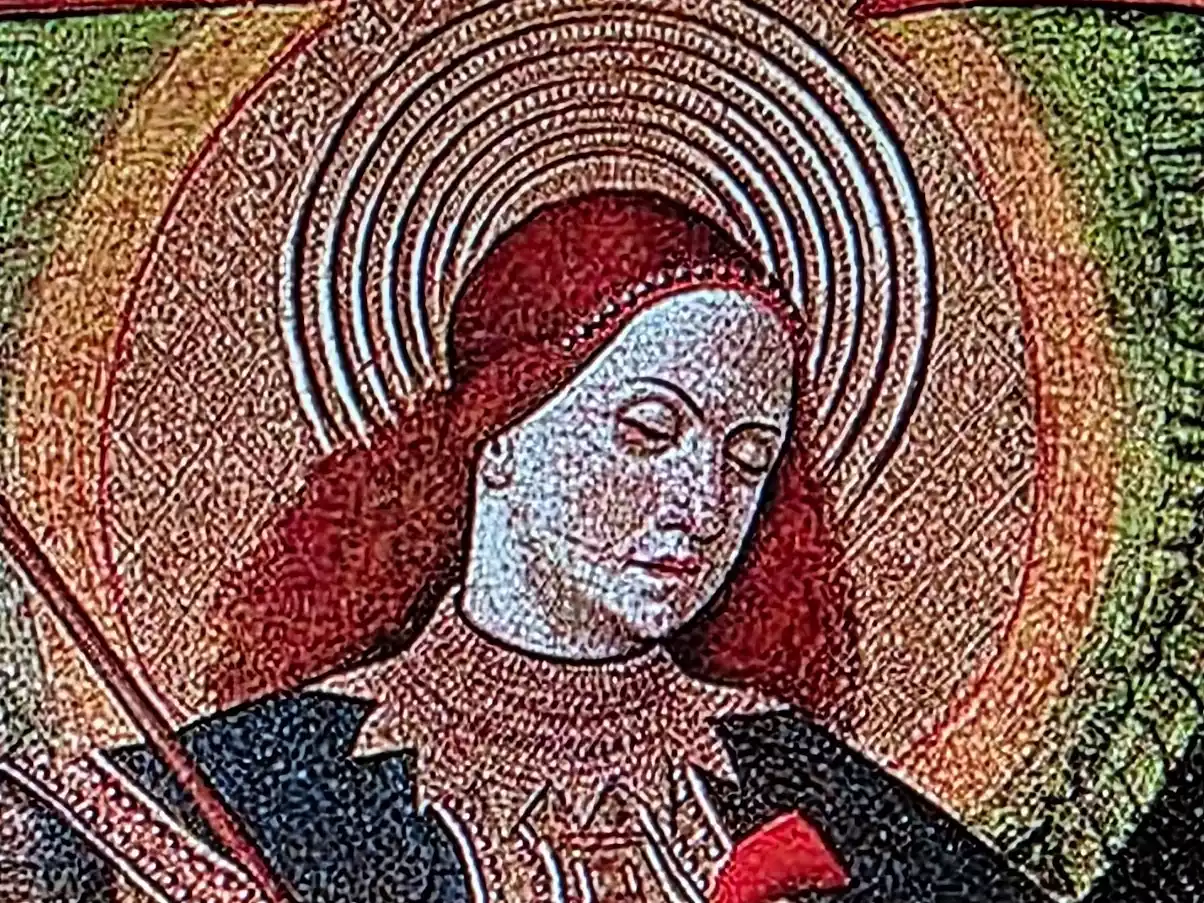
Detail of the Archangel’s halo, showcasing the technical skill of the late Gothic period in Spain
Color Palette and Artistic Influences
The color palette reveals the artist’s connection to Flemish influences that permeated Aragon (Velasco). The vibrant red of the Archangel’s garment creates a dramatic contrast with the white of his face and wings, while the golden tones of the halo and decorative elements add a spiritual brilliance. The composition of colors does not merely follow aesthetic criteria but embodies theological symbolism: the red of sacrifice and love, the white of purity, the gold of divinity.
Michael’s face expresses a paradoxical blend of sternness and compassion. The features are idealized, far from natural realism, oriented towards metaphysical revelation. Juan de la Abadia’s technique reveals the influence of the guilds of Aragonese painters active during the transition from the Gothic to the Renaissance period.
The meticulous treatment of fabrics reveals the painter’s technical skill. The drapery folds follow natural rhythms, while the decorative patterns on the garments reference Byzantine traditions that survived in Spain through Muslim art. This cultural synthesis characterizes the unique identity of 15th-century Spanish art.
The work serves as a historical document of the religious life of the time. It was intended for a church setting, where it would participate in the worship experience of the faithful. Psychostasis was a central theme of medieval eschatology, reminding people of the necessity of moral living. Through artistic representation, Juan de la Abadia conveyed complex theological concepts in an easily understandable iconographic language.
The historical significance of the painting surpasses its artistic merits. It bears witness to the meeting of traditions that shaped the Iberian cultural identity: the Byzantine heritage through Muslim dominions, the Flemish influences via trade networks, the Latin tradition through the Catholic Church. The Archangel Michael by Juan de la Abadia stands as a symbol of this multicultural synthesis that characterized Spain in the late Middle Ages.
Bibliography
- Juan, M.M. ‘Painting, devotion and piety in Toledo in the early 15th century’, bilbaomuseoa.eus.
- Pijoan, J. ‘Aragonese Primitives’, The Burlington Magazine for Connoisseurs, 1913, JSTOR.
- Salcman, M. ‘San Lucas, Spanish School, Early 15th Century’, Neurosurgery, 1995, journals.lww.com.
- Velasco, A. & Fité, F. ‘Late gothic painting in the crown of Aragon and the Hispanic kingdoms’, Annales d’Histoire de l’Art et Archéologie de l’Université de Liège, 1998, brill.com.
- Velasco, A. & Fité, F. ‘Late Gothic Painting in the Crown of Aragon and the Hispanic Kingdoms’, 1998, brill.com.
- Velasco González, A. & Fité i Llevot, F. ‘Late Gothic Painting in the Crown of Aragon and the Hispanic Kingdoms: an Introduction’, 2018, repositori.udl.cat.
- ‘Late Gothic Painting in the Crown of Aragon and the Hispanic’, 2018, books.google.gr.


