
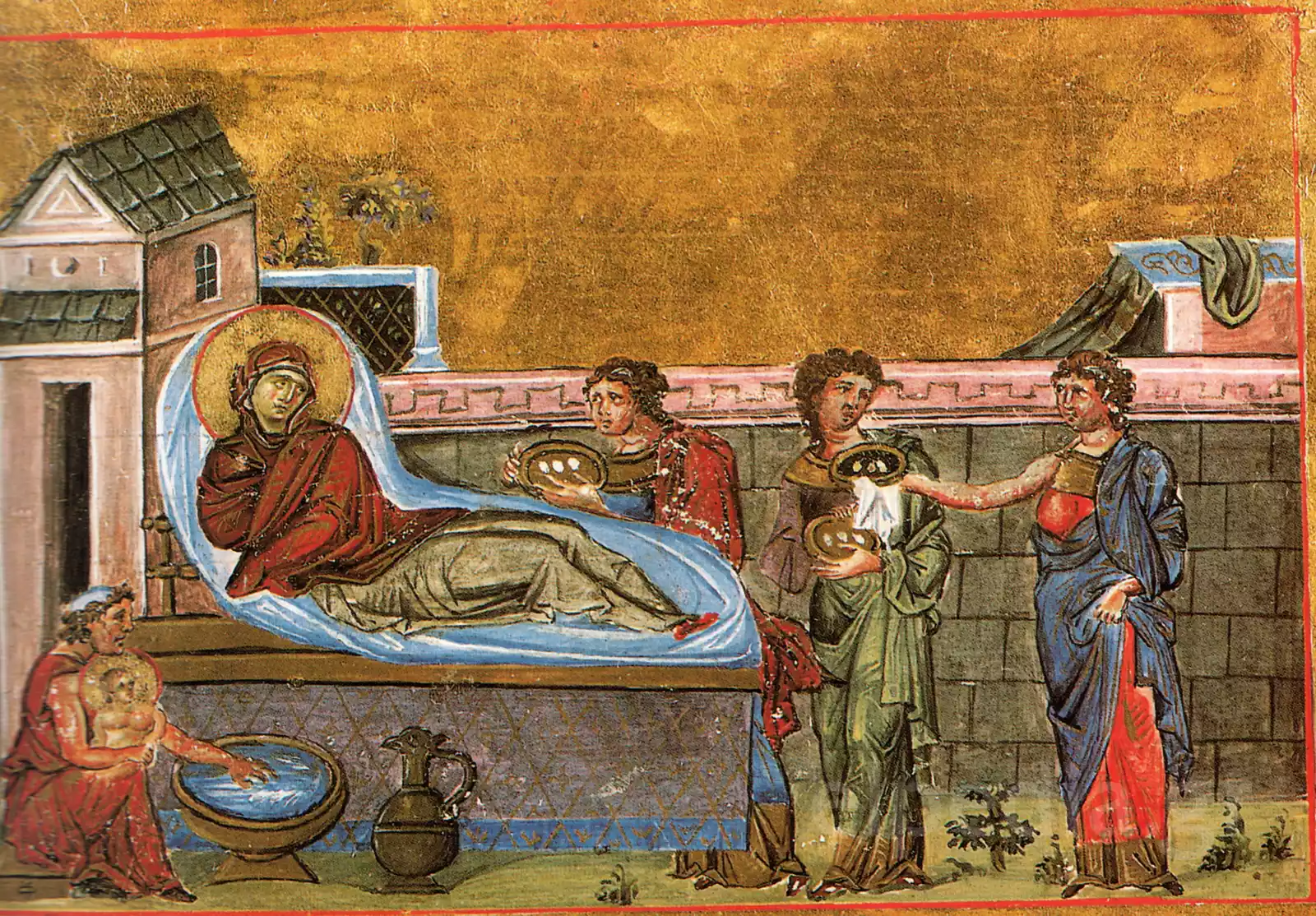
The Birth of the Virgin from the Menologion of Basil II (Vat. gr. 1613 f. 22), circa 985 AD, Biblioteca Apostolica Vaticana, is a significant example of Byzantine iconography
The manuscript Vat. gr. 1613 f. 22 at the Biblioteca Apostolica Vaticana preserves an exceptional miniature dating to around 985 AD. This image, part of the renowned Menologion of Basil II, serves as an important historical document of Byzantine iconography, specifically depicting the theme of the Birth of the Virgin. The work provides a unique insight into how 10th-century Byzantine artists approached this central theme of Christian iconography.
The miniature reflects the maturity of Byzantine art during the Macedonian Renaissance, a period when imperial patronage allowed for the creation of luxurious manuscripts. What are the distinctive features that characterize this representation? The work is part of a complex iconographic tradition that combines biblical narratives with cultural elements of the time.
Main Representation: Architecture and Symbolism
In the complete scene of the birth, we observe a complex composition set in an architectural environment with strong classical elements. Anna lies on a bed. Three male figures hold basins—likely containing water for the baptism of the newborn. The left part of the composition includes a basin and vessels related to the birth, while the center outlines a space welcoming the miraculous event.
The architectural structure of the space reflects the Byzantine perception of organizing the image as a spiritual space. The buildings in the background, with their pink and gray hues, create an environment that transcends mere descriptions of everyday life and introduces elements of transcendent significance. The use of a golden background—a hallmark of Byzantine art—transforms the scene from a historical narrative into a spiritual reality existing beyond time and place.
The iconographic approach here follows a specific traditional line aimed at presenting the birth of the Virgin as an event of cosmic significance. Every detail—from the garments of the figures to the arrangement of objects—carries symbolic weight related to the theological interpretation of the miracle of birth.
The Figure of Anna: Motherhood and Holiness
At the center of the composition, the figure of Saint Anna dominates with her imposing presence. She wears red garments symbolizing love. The golden halo surrounding her head signifies her holiness, while her body posture expresses both exhaustion from childbirth and spiritual superiority. The blue blanket covering her alludes to the symbolic palette associated with the heavenly kingdom.
Anna’s facial expression remains calm and dignified. There are no signs of pain or distress that one would expect in a realistic depiction of childbirth. On the contrary, her figure radiates a sense of spiritual fulfillment and divine grace, in line with the theological views of the time regarding the sanctity of the moment.
The arrangement of the folds in the garments adheres to the principles of Byzantine aesthetics, where every detail serves to express a higher reality rather than to represent physical reality. The fact that the representation avoids descriptive accuracy in favor of symbolic truth reveals the profound spiritual dimension of Byzantine art.
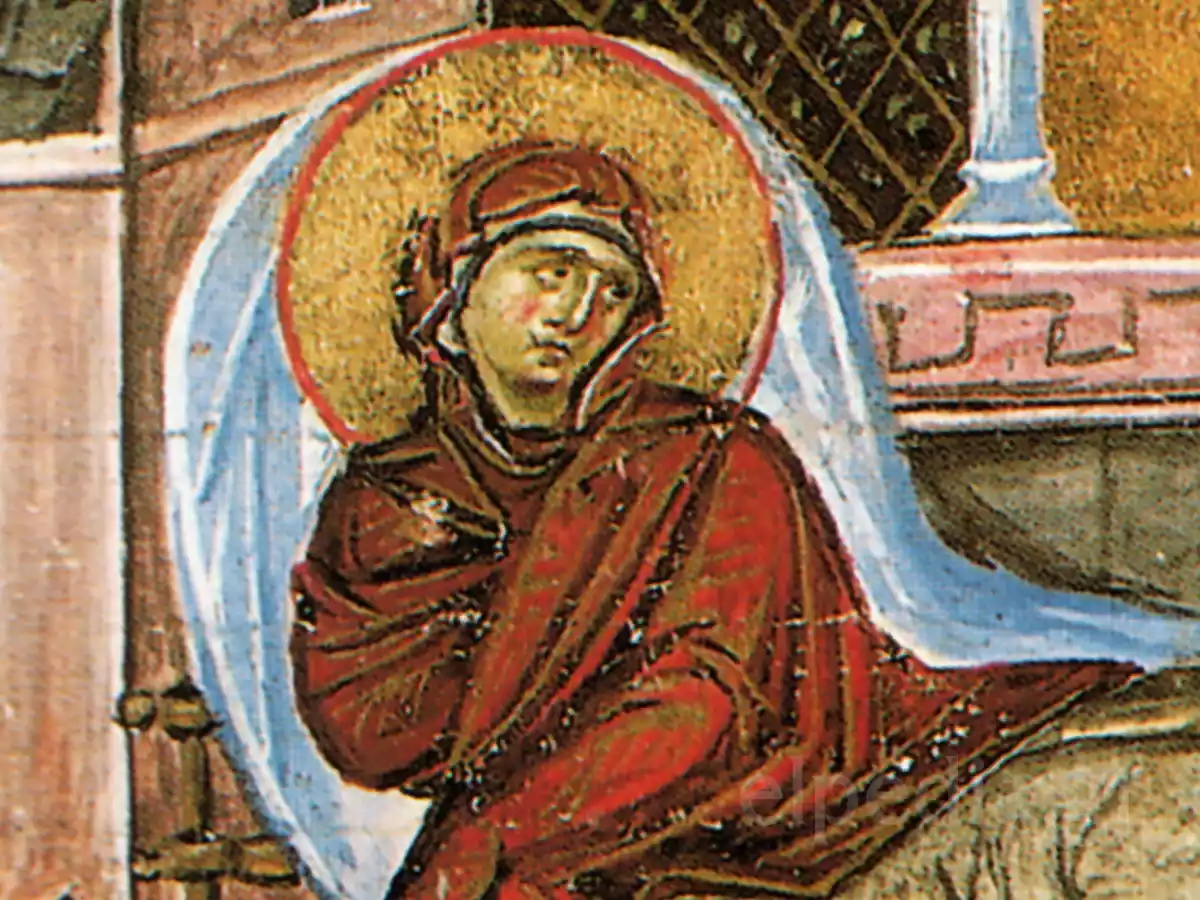
Saint Anna with a golden halo and red garments in the scene of the Birth of the Virgin expresses the theological understanding of the sanctity of the event
The Attendees: Social and Typological Dimensions
On the right side of the composition, three figures in classical garments participate in the scene holding basins of water. These figures represent the social dimension of the event, indicating that the birth of the Virgin is not merely a family affair but holds broader cultural and social significance. Their attire—the green tunic of one and the blue of another—hints at classical antiquity, creating a connection between the Christian present and the Greco-Roman past.
The posture of the figures is formal and ritualistic. Are they attendants or midwives? The interpretation remains open, as the artist seems to emphasize their symbolic function rather than their precise identity. Their presence underscores the worldly dimension of a transcendent event, creating a bridge between the human and the divine. Their interaction through glances and gestures forms a network of relationships that unifies the composition. This network reflects the Byzantine understanding of the community of believers participating in the mysteries of faith through shared testimony and ritual participation.
Theological Dimension and Cultural Heritage
The miniature of the Birth of the Virgin from the Menologion of Basil II transcends the boundaries of artistic creation and enters the realm of theological expression and spiritual teaching. This work, dated to 985 AD, testifies to a time when art served as a vehicle for divine revelation and spiritual transmission. How does this specific representation contribute to the understanding of Byzantine theology of the image?
The iconographic choice to present the birth of the Virgin in such an official and reverent manner reflects the deep theological conviction of the Byzantines regarding the salvific significance of this event. Mary is not merely born as another child, but as the one destined to become the Theotokos—Mother of God. This perspective permeates every detail of the composition, from the use of the golden background symbolizing eternity to the posture of the figures expressing reverence and awe before the mystery.
Image as Theological Narrative
The miniature functions as a form of visual theology, where every element carries doctrinal and spiritual content. The presence of the architectural environment is not limited to merely placing the scene in a specific space but refers to the eschatological vision of the Kingdom of Heaven. The buildings, with their classical proportions, bridge the world of antiquity with the Christian reality, suggesting the continuity of divine economy throughout history.
The basins of water held by the attendees acquire deeper symbolic significance when associated with the sacrament of baptism. They are not merely practical objects of daily life but prophetic images of the mystery of rebirth that will be realized through the work of the one who is now being born. The Byzantine understanding of the typological significance of events is remarkably clear here.
The choice to place Anna at the center and give her a halo reflects the special position that the mother of the Virgin held in Byzantine piety. Although the event of birth is natural, its artistic treatment transforms it into a theophany, a moment where the divine invades human history in a definitive and transformative way.
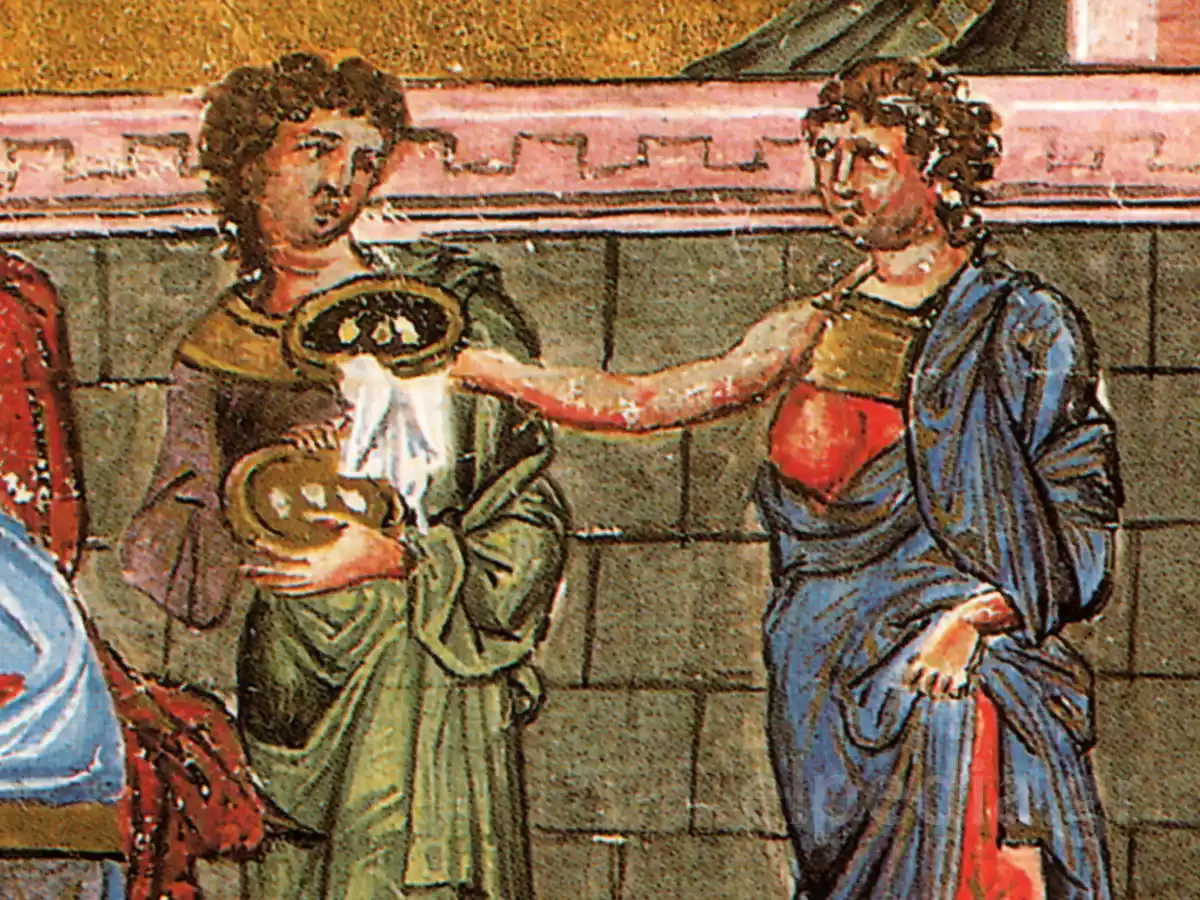
Attendees with water basins at the Birth of the Virgin symbolize the social and ritual dimension of the miraculous event
Miniature and Liturgical Tradition
This work was not intended for museum or autonomous aesthetic viewing but was integrated into the broader context of ecclesiastical and courtly life in Byzantium. As part of the Menologion, the miniature participated in the annual cycle of liturgical and commemorative feasts, playing an active role in shaping religious consciousness and spiritual experience.
The ritual use of the manuscript endowed its images with a unique dynamism—they were not static representations but living means of communication with the divine. Each time the Menologion was opened to the page of the Birth of the Virgin, the image was activated as a window to the mystery it depicted, making the past present and the transcendent accessible.
This liturgical dimension also explains the particular way in which the artist approached the subject. The representation does not aim for emotional impressiveness or realistic description but seeks to create a sacred space where the image and the viewer meet on a level of spiritual communion. Here, art does not imitate nature but creates a new place of spiritual experience.
The influence of this iconographic traditional line extends far beyond the chronological limits of the Byzantine period, shaping how Eastern Orthodoxy and even Western Christianity would approach the iconography of the Virgin in the following centuries. The manuscript traditions that have been preserved testify to a continuous and vibrant relationship with these iconographic patterns.
In this view, the Vatican miniature is not merely a historical document of a bygone era but a living testimony of a spiritual tradition that continues to inspire and teach. The Birth of the Virgin, as presented in the Menologion of Basil II, remains one of the most expressive examples of how Byzantine art managed to synthesize theological depth, artistic perfection, and spiritual functionality into a single, cohesive unity that still captures our attention and admiration today.
The timeless value of this work lies in its ability to immerse us in a holistic understanding of art, where the aesthetic, the theological, and the cultural intersect and interpenetrate, creating a rich mosaic of meanings and experiences that transcend the narrow confines of individual categories.
Bibliography
Der Nersessian, S. ‘Remarks on the Date of the Menologium and the Psalter Written for Basil II’, Byzantion, 1940, JSTOR.
Kottis, K. ‘The Byzantine Image of the Birth of Christ: from Biblical Sources and its Ancient Greek Dialectic to its Dogmatic Expression and Orthodoxy…’, apothesis.eap.gr.
Lauxtermann, M. ‘Byzantine poetry and the paradox of Basil II’s reign’, Sola, 2003, Brill.
Lasareff, V. ‘Studies in the Iconography of the Virgin’, The Art Bulletin, 1938, Taylor & Francis.
Lowden, J. ‘The transmission of “visual knowledge” in Byzantium through illuminated manuscripts: approaches and conjectures’, Manuscript Transmission in Byzantium, 2002, Brill.
Maguire, A.H. ‘Body, Clothing, Metaphor: The Virgin in Early Byzantine Art’, The Cult of the Mother of God in Byzantium, 2016, Taylor & Francis.
Ševčenko, I. ‘The illuminators of the Menologium of Basil II’, Dumbarton Oaks Papers, 1962, JSTOR.
Tsironis, N. ‘From poetry to liturgy: the cult of the Virgin in the Middle Byzantine era’, Images of the Mother of God, 2017, Taylor & Francis.


