
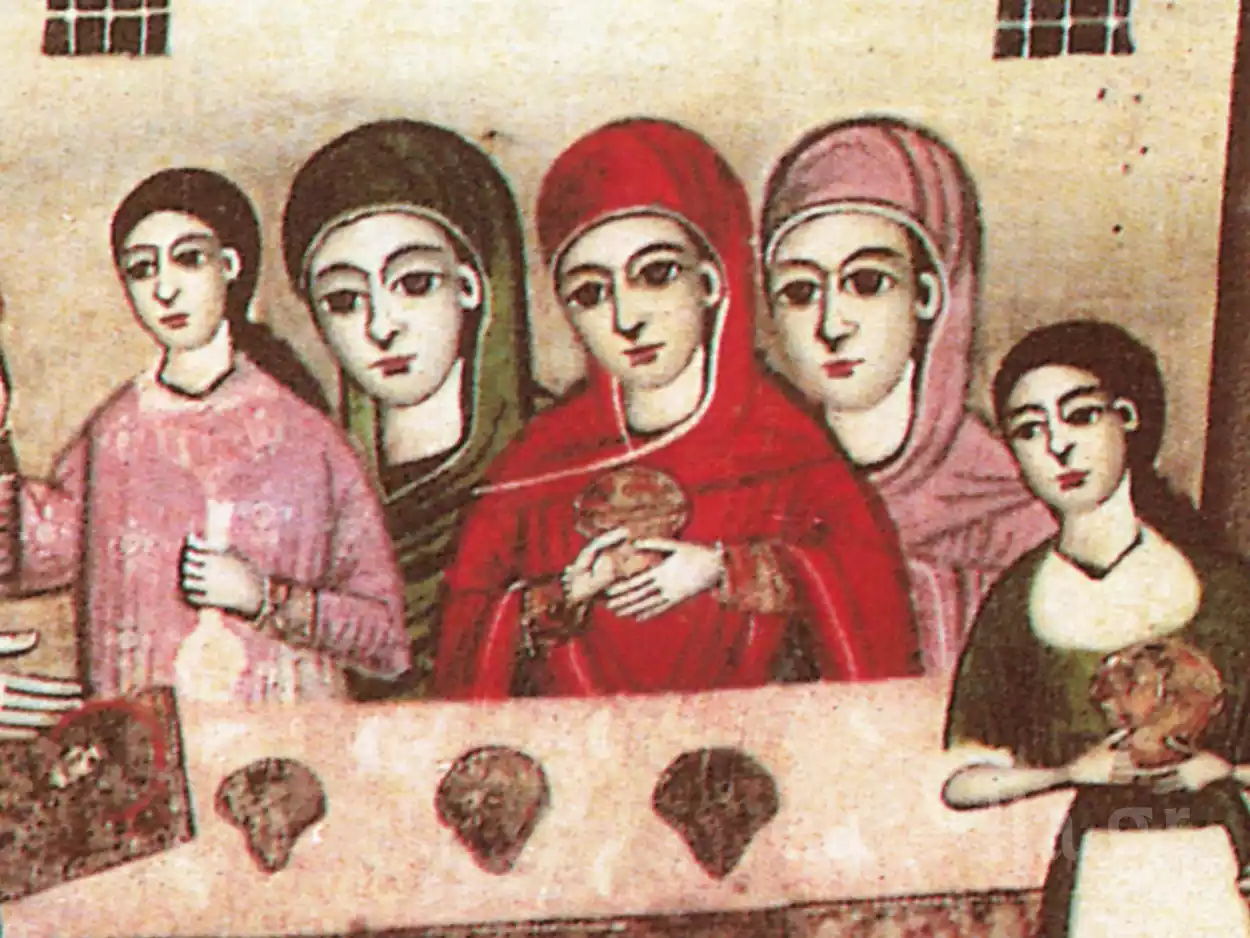
The Nativity of the Virgin Mary, work of the Tryavna School (19th century), National Gallery of Folk Art, Sofia. Scene with five female figures.
In the National Gallery of Folk Art in Sofia, there is an exceptional example of Bulgarian ecclesiastical art from the 19th century: the icon of the Nativity of the Virgin Mary and the Naming, created by the renowned Tryavna School. This sacred work captures the esoteric tradition surrounding the birth of the Theotokos, integrating Byzantine theological tradition into the unique artistic idiom of the region.
The Byzantine iconography serves as a profound spiritual language that transcends narrow artistic boundaries. The Nativity icon reflects the universal significance of the event that prepares for the Incarnation, as the mediating nature of the Virgin becomes evident through typology and symbolism. The images of the Bulgarian school preserve essential theological teachings while simultaneously expressing the local cultural temperament.
The Theological Aspect of the Nativity of the Theotokos
The scene unfolds around the mother of Saint Anne, where five female figures witness the birth of the Virgin Mary. At the center of the composition, Mother Anne holds the newborn child – the future Theotokos – with gestures that foreshadow the great mission ahead. The attending women, with expressions of reverence and admiration, bear witness to an event that the esoteric Protoevangelium of James describes as a preparation for the saving mystery.
Behind the scene, an architectural setting with standardized elements – windows and towers – alludes to the Byzantine iconographic tradition. The event unfolds within a sacred space that is not only domestic but symbolizes the cosmic dimension of the miracle. The Nativity of the Theotokos serves as the prelude to the Incarnation, as through the Virgin, the connection between the human and the divine will be realized.
The iconography adheres to the rules of Byzantine typology while incorporating local characteristics. The faces of the figures exhibit the simplicity and immediacy characteristic of images from the Tryavna region, with expressiveness that approaches popular piety. The color palette features warm tones – reds, pinks, and browns – creating an atmosphere of intimacy and closeness.
The theological messages embedded in the icon are multifaceted: on one hand, it celebrates the joy of the birth of her who will become the “land of the uncontainable,” while on the other, it heralds the saving mystery of the Incarnation. The female figures surrounding the infant are not merely assistants to the mother but symbolize the entire world awaiting salvation. Their expressions reflect the anticipation for the mystery that will follow.
The composition unfolds on two levels: the earthly, where the birth occurs, and the heavenly, implied through the sacredness of the event. This dual dimension resonates with Byzantine theology regarding the participation of the material world in the divine economy, where even the most mundane events – such as the birth of a child – can bring salvation to the world.
The sacred presence permeates every detail of the composition, from the gestures of the figures to the architecture of the background. The painters of Tryavna succeeded in conveying the spiritual intensity of the event without losing its human dimension. The result is an image that serves simultaneously as a tool for prayer, a teaching medium, and an artistic expression of an entire cultural tradition.
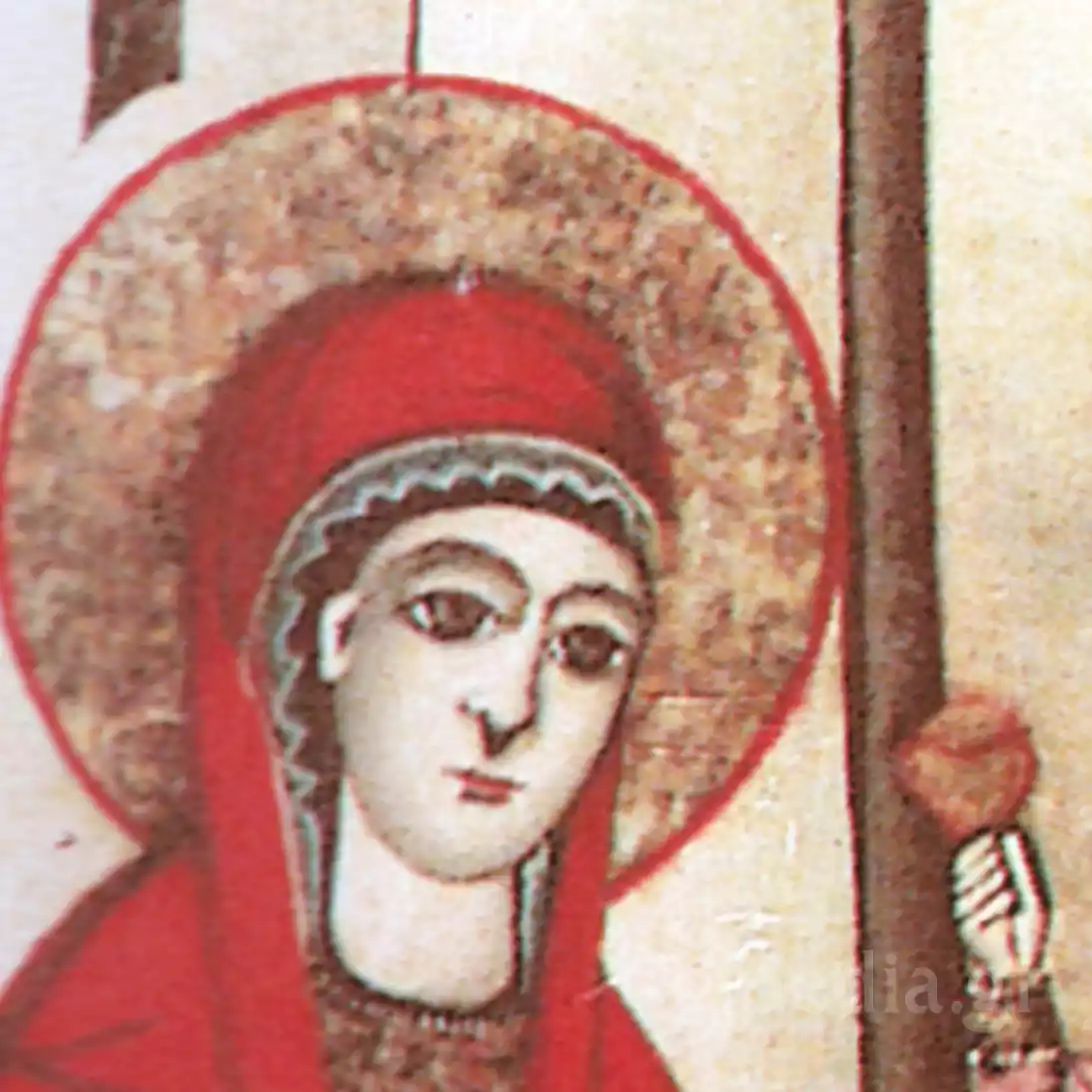
Detail of Saint Anne with a red maphorion from the Nativity icon. A characteristic example of the Byzantine iconographic tradition in the Tryavna School.
The Iconographic Style of the Tryavna School
The Tryavna School emerged in the 19th century as one of the most significant centers of ecclesiastical art in the Balkans, blending traditional Byzantine techniques with innovative local approaches that characterized the period of the Bulgarian Renaissance. The artists active in the region developed a unique mode of expression that preserved the theological reverence of the Orthodox tradition while incorporating elements reflecting the new cultural consciousness.
In the Nativity icon, one can discern characteristic features of this school. The faces exhibit the typical simplicity and immediacy that distinguished Bulgarian folk art, with large expressive eyes and sweet smiles that lend the scene a sense of intimacy. The color palette employs traditional tones – deep reds, warm browns, soft pinks – creating a harmonious whole based on the functional aesthetics of ecclesiastical painting.
The composition is organized in a way that reflects the interconnected influence of different traditions. The central theme of the birth is set within an architectural framework that combines Byzantine and local elements, while the representation of the figures reveals a pursuit of emotional closeness with the faithful. The female figures do not carry the severity of courtly Byzantine art but the warmth of popular piety.
The Sacred Morphology of the Theotokos
In the detail depicting the Virgin Mary with the red maphorion, we identify the compositional dimension of the work. The iconographic typology follows the rules of the Byzantine tradition – the maphorion with three stars of eternal virginity, the posture of the head expressing humility and contemplation of the divine. However, the execution carries the naturalness characteristic of the 19th-century iconographers, who sought to communicate with the faithful through accessible forms.
The color stimuli function symbolically: the red of the maphorion symbolizes divine love and purity, while the golden flash on the fabric refers to the divine light surrounding the Theotokos. The iconography maintains the hierarchical scaling of Byzantine models but adapts to the aesthetics prevalent in Bulgarian ecclesiastical art of the time.
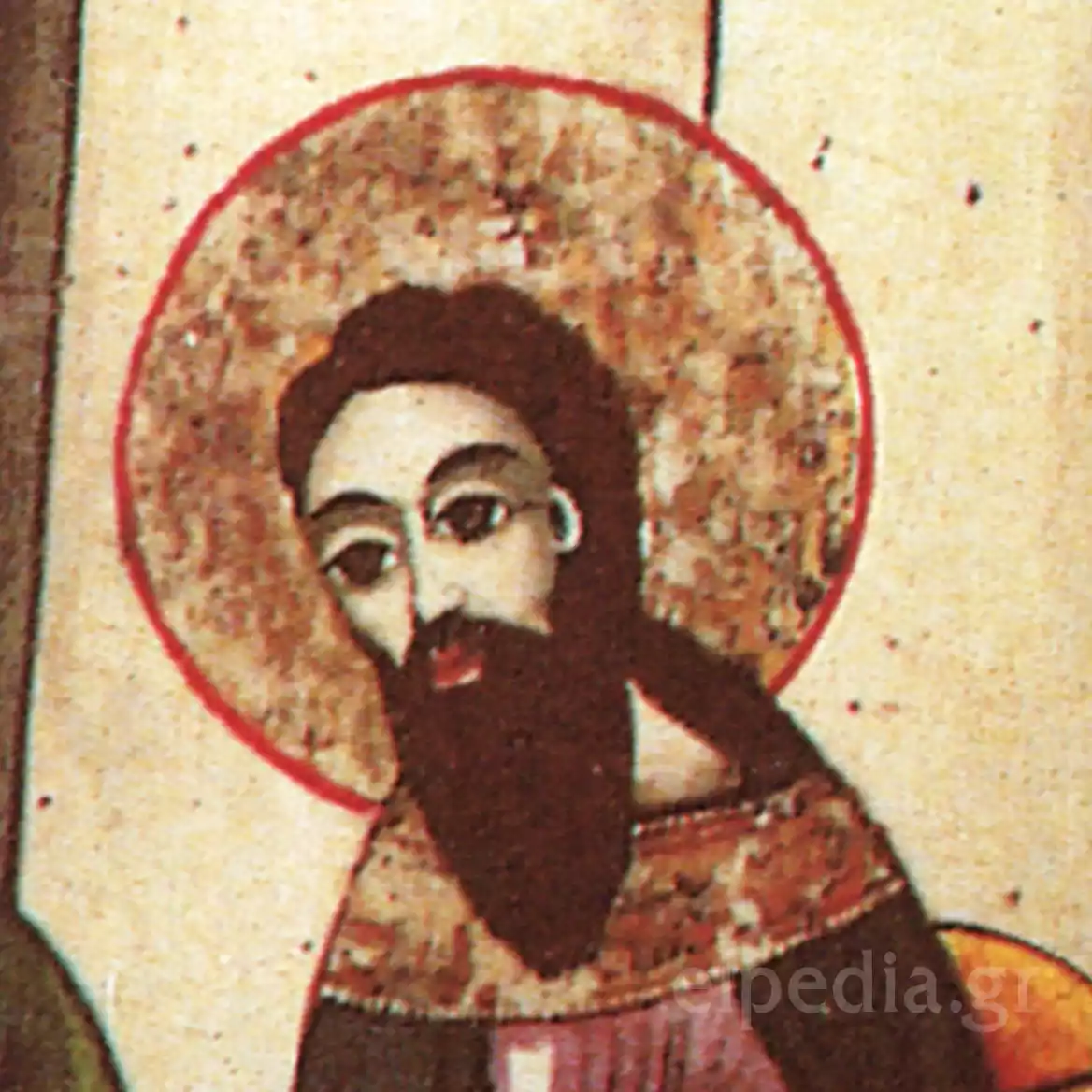
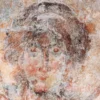
Bearded saint of hierarchical type in the Nativity scene of the Virgin. Technical proficiency and symbolic significance in Bulgarian ecclesiastical art.
The Hierarchical Type
The figure of the bearded saint with the red omophorion represents the hierarchical type often seen in Nativity scenes of the Theotokos, typically as the priest who will perform the naming. The features of the face – deep eyes, an expression of wisdom and reverence – follow the typology of hierarchs in Byzantine iconography.
The detailed rendering of the face reveals the technical proficiency of the creators, despite the simplicity of the means. Each line serves both anatomical accuracy and symbolic significance, creating a form that acts as a mediator between the earthly and the heavenly realms.
The traditional Bulgarian ecclesiastical painting of the 19th century is characterized by this balance between fidelity to tradition and adaptation to new aesthetic pursuits. The result is works that maintain their functional value as tools for prayer and teaching while simultaneously serving as testimonies of a rich cultural moment.
The Timeless Significance of the Icon: Between Tradition and Renewal
Cultural Heritage and Theological Continuity
The icon of the Nativity of the Virgin Mary from the Tryavna School is more than just a work of art. It serves as a bridge between different eras, uniting the Byzantine theological tradition with the new cultural quests of the 19th century. In the way the Bulgarian ecclesiastical schools approached the sacred theme, we discern a distinct balance: fidelity to theological truths combined with a desire for cultural renewal (Stoyadinova).
The creators of the icon managed to preserve the essential theological teaching surrounding the Nativity of the Theotokos while incorporating elements that echoed popular piety and the cultural temperament of their region. The result is not a mere copy of Byzantine models but a vibrant recreation that speaks to the soul of the contemporary believer while maintaining a connection to the eternal tradition.
The iconographic language employed serves multiple purposes: educational, functional, and spiritual. Every figure, every color, every detail carries symbolic weight that transcends superficial viewing. The female figures surrounding the mother of Saint Anne are not just elements of the scene but symbols of the universal joy accompanying the birth of her who will become “the land of the uncontainable.”
Within the context of Bulgarian ecclesiastical tradition, the icon serves as a testimony of a specific historical moment where national consciousness meets religious identity (Sabev). The artists of Tryavna did not merely create a decorative work but a tool for spiritual communication that conveyed theological concepts through accessible and relatable forms. The simplicity of expression does not limit the depth of the message but makes it accessible to a broader audience.
The Symbolic Dimension and Contemporary Significance
Examining the icon through the lens of contemporary theological thought, we find that its messages retain their radiance. The Nativity of the Theotokos symbolizes not only a historical event but the eternal dynamism of the divine manifesting within human history in ways that transcend logic and expectation. The theme of theology concerning the Theotokos remains central to Orthodox spirituality, as it encapsulates the mystery of divine grace that transforms human nature (Linaradatu).
The work of the Tryavna School teaches us that authentic tradition is not static but dynamic, capable of expressing itself through new forms while maintaining its essential truth. The Bulgarian ecclesiastical schools of the 19th century succeeded in creating a living composition that speaks to the souls of the faithful regardless of the era (Garmidolova). This timelessness may be the strongest argument for the artistic and spiritual value of the work.
Within the framework of the international Byzantine tradition, the icon fits into a broader family of works exploring the theme of the Nativity of the Virgin, while retaining the distinctive characteristics of the local tradition (González). The result is a unique artistic expression that converses with the universal Church while simultaneously reflecting the specific cultural and spiritual identity that birthed it.
The timeless significance of the icon lies precisely in its ability to speak to different eras and cultures. The sacred mystery of the Nativity of the Theotokos, as captured through the art of Tryavna, remains a source of inspiration and reflection, bridging the gap between past and present. In the simple yet expressive forms of Bulgarian iconographers, we recognize an eternal truth: that divine light can shine through any artistic expression born of genuine faith and love.
This is a legacy that belongs not only to Bulgarian cultural identity but to the global treasure of human creativity when it seeks to express the sacred.
Bibliography
Bakalova, E. (2012). Art History in Bulgaria: Institutional Frameworks, Research Directions and Individual Scholars. Art History and Visual Studies in Europe. Brill.
Dyulgerova, K. (2016). New Information on the Churches in Gorna and Dolna Verenitsa in the Context of an Unpublished Document. Anuarul Institutului de Cercetări Socio-Umane „CS…”. CEEOL.
Garmidolova, M.M. (2021). The Arts Education System In Bulgaria. Facta Universitatis, Series: Teaching, Learning and Teacher Education.
González, J.M.S. (2015). Byzantine iconography of The Nativity of the Virgin Mary in the light of a homily of St. John Damascene. Mirabilia Ars. Universidad de Rioja.
Hart, N. Bulgarian Art and Culture. University of Texas at Austin.
Linaradatu, E. THE THEOLOGY OF THE THEOTOKOS IN THE LITURGICAL BOOK OF THE TRIODION. Hellenic Open University.
Sabev, P. (2020). Painters of the Boka-Kotor School and Their Icons (18th–19th Centuries). University of Veliko Tarnovo Journal.
Stoyadinova, K.Z. (2023). Four Icons from the Church “St. Dimitar”, Dlagnya, in the Exhibition of Ikonomov House, Dryanovo. INIS Series, Online Series of the Interdisciplinary Scientific Network.


