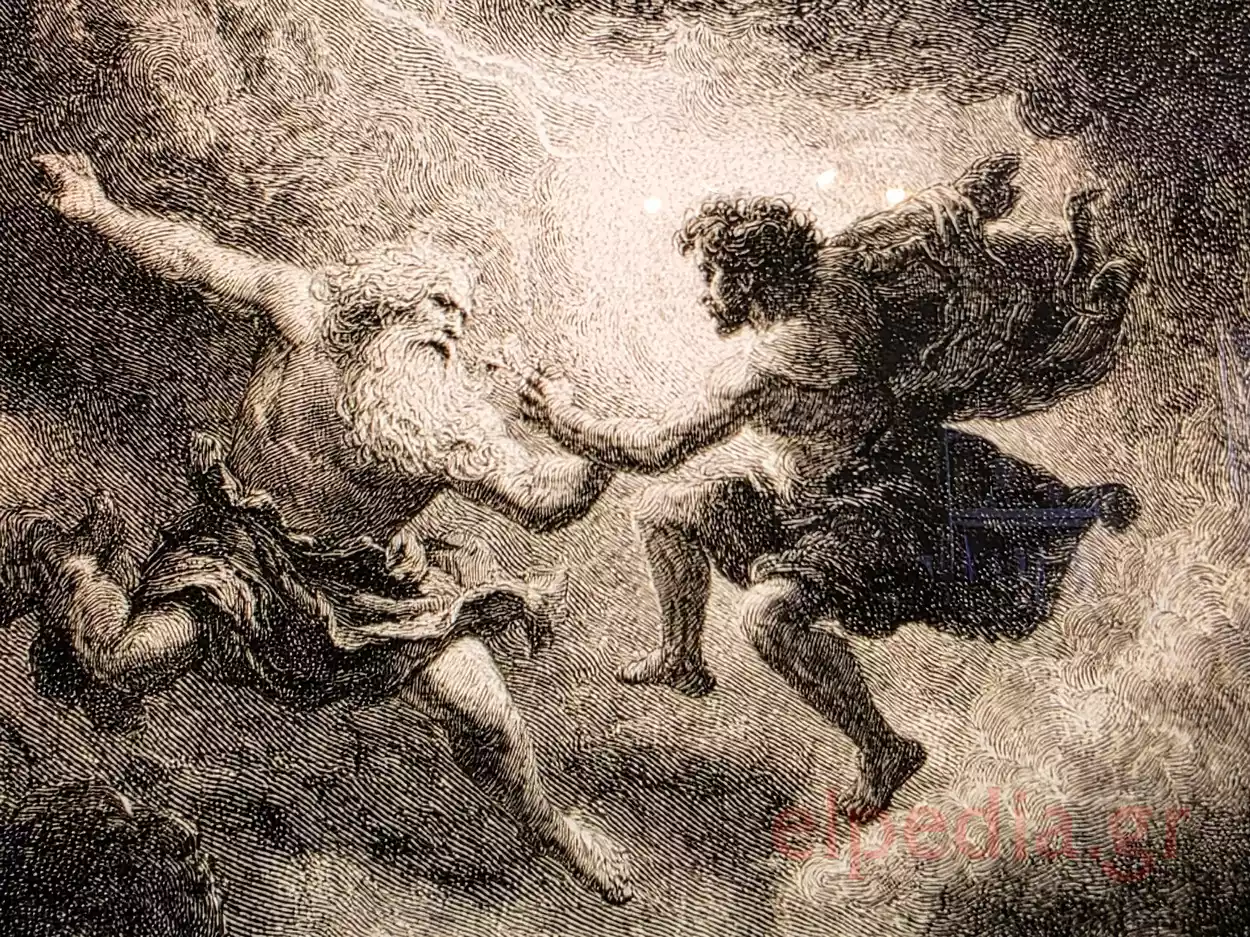
According to the Theogony, Cronus castrated Uranus at Gaia’s urging, marking the beginning of the Titan era.
In the dawn of the world, before the Olympian gods, the primordial forces of nature reigned supreme, with Gaia, Mother Earth, and Uranus, the starry sky enveloping her, forming the first divine couple. From their unending union emerged a whole generation of powerful beings: the twelve Titans, the one-eyed Cyclopes, and the fearsome Hecatoncheires. However, this creative explosion would lead to one of the most violent and defining acts ever recorded in Greek mythology (Graf), an act of rebellion, mutilation, and overthrow that would forever alter the balance of the universe. The castration of Uranus by his own son, Cronus, was not merely an act of patricide; it was the cosmic severance that separated heaven from earth, ending an era of unchecked creation and ushering in a new order based on fear and violence. This dark narrative, primarily conveyed through Theogony of Hesiod (Scully), serves as the cornerstone for the succession of divine generations.
The Act of Rebellion and Its Dark Roots
The narrative begins with an act of revulsion. Uranus despised his children. He viewed them as a threat to his dominion, so immediately after their birth, he hid the Cyclopes and the Hecatoncheires deep within the Earth, in Tartarus, causing unbearable pain to their mother. Gaia, groaning under the weight of her imprisoned children, decided to take action. She forged a massive sickle from steel and called upon the Titans, her other children who roamed free, to help her punish their father for his cruelty. They all hesitated, gripped by fear, except for one. Cronus, the youngest and most ambitious, boldly accepted the challenge. Gaia gave him the sickle and explained her plan, a scheme based on betrayal and ambush. Indeed, the collaboration between mother and son led to the overthrow of patriarchal power (Akçeşme).
Thus, when Uranus, driven by his lust, approached to embrace Gaia, Cronus, hidden in ambush, sprang forth and with a decisive motion severed his father’s genitals, casting them into the sea. This violent act, the castration of Uranus, was not merely a symbolic gesture; it had immediate and monstrous consequences. From the drops of blood that fell to the earth, the Furies, the relentless goddesses of vengeance, the towering Giants (Dirckx), and the honey nymphs, the Meliae, were born. The very act of mutilation, so raw and specific, has led many researchers to wonder if it reflects real, forgotten rituals. How could such an image be conceived by the human imagination? A contemporary historical study (Nacchia et al.) of castration across various cultures shows that this practice was widespread, often as an act of punishment or subjugation. Some scholars dare to suggest that the myth may reflect an archaic reality, perhaps rituals applied to war captives, as was the case with certain African tribes that used ritual sickles to castrate their enemies.
This story, however, is not unique to the ancient world, as it bears striking similarities to myths from the East, particularly those of the Hittites. In Hittite mythology, the god Kumarbi (the equivalent of Cronus) attacks his father, the sky god Anu (the equivalent of Uranus), bites him, and severs his genitals, swallowing them. This parallel narrative suggests a possible cultural exchange and a common root in ancient concerns about succession, fertility, and power. Uranus’s hatred for his children and their imprisonment in Tartarus, an act that ultimately armed Cronus’s hand, is a central motif in the narrative (Tsili et al.). Therefore, the myth of castration should not be examined in isolation but as part of a broader web of narratives that seek to explain the transition from a primitive, chaotic divine order to a more structured, albeit no less violent, reality. Cronus’s act, although instigated by Gaia, was an act of absolute defiance (Wade), transforming the cosmic order and unleashing forces that even he could ultimately not control, as evidenced by his later, equally tragic fate. The Theogony (Athanassakis) remains our primary source for these cosmogonic conflicts.
The Blood Legacy: An Endless Cycle of Violence
Cronus’s triumph was fleeting, built upon an act that would haunt him forever. After the castration of Uranus, the Titans freed the Cyclopes from Tartarus and declared Cronus the new ruler of the universe. However, power gained through violence breeds the fear of overthrow. Almost immediately, Cronus showed that he was no different from the father he had dethroned; he imprisoned the Cyclopes and the Hecatoncheires once again in the depths of the earth, revealing his tyrannical nature. The blood legacy of Uranus did not stop with the monsters that emerged from the earth. The Furies, born from the very act of patricide, became the eternal deities of punishment, relentlessly pursuing anyone who committed crimes against family, especially against parents. Their existence served as a constant reminder that no act of violence, particularly domestic violence, goes unpunished.
Now holding absolute power, Cronus married his sister, Rhea, inaugurating the reign of the Titans. However, a prophecy from his parents, Gaia and the wounded Uranus, haunted him. One of his sons, they told him, would overthrow him, following in his own footsteps. Blinded by fear and paranoia, Cronus resorted to an even more heinous solution: he decided to swallow his children as soon as Rhea gave birth to them. Hestia, Demeter, Hera, Hades, and Poseidon all found themselves imprisoned in their father’s belly. The castration of Uranus had set in motion an unstoppable cycle of violence, where the son repeated and escalated the sins of the father. Desperate, Rhea managed to save her last child, Zeus, by giving Cronus a swaddled stone to swallow. Zeus’s upbringing in Crete, away from his father’s gaze, prepared the stage for the next, even more catastrophic chapter of this divine conflict: the Titanomachy. Cronus’s act, which initially seemed like a liberating rebellion against a tyrant, proved to be merely the precursor to a new, even harsher tyranny, confirming that violence only begets more violence.
The Final Confrontation and the Birth of a New Order
Cronus’s paranoia, born from his betrayal against his father, had turned his reign into a prison of fear, with him acting as both jailer and the very cell for his children. However, fate, which he desperately tried to avoid, had already found its way. Zeus, the son who escaped his father’s greed thanks to Rhea’s cunning, was growing up in Crete, nourished by the nymph Amalthea and protected by the Curetes, who clashed their shields to cover his cries. It was the silent upbringing of the future king. When he came of age, guided by the goddess Metis, he returned to claim not just power but also the freedom of his siblings, initiating the final act of the cosmic tragedy that began with the castration of Uranus. Zeus managed to make his father drink a vomit-inducing potion, forcing him to regurgitate, in reverse order, first the stone and then all the children he had swallowed. Hera, Poseidon, Demeter, Hades, and Hestia emerged once more into the light, grown and ready for revenge. The conflict was now inevitable.
What followed was a colossal war, the Titanomachy, a ten-year conflict that shook the foundations of the universe. On one side were the Titans, led by Cronus, fortified on Mount Othrys, representing the old, primitive, and violent order. On the other side were the younger gods, the Olympians, led by Zeus from the summit of Olympus, fighting for a new beginning. The battle was evenly matched, and no one could gain the upper hand. Then, Zeus, following a piece of advice from Gaia, the eternal mother who watched her grandchildren slaughter each other, made a strategic decision that would determine the war. He descended into Tartarus and freed the Cyclopes and the Hecatoncheires, the forgotten brothers of the Titans, whom both Uranus and Cronus had kept imprisoned. With this act, Zeus not only gained powerful allies; he proved that he was different from his predecessors, a leader who corrected the injustices of the past rather than perpetuating them. As a token of gratitude, the Cyclopes forged powerful weapons for the gods: they gave Zeus the thunderbolt, the lightning, and the roar, Poseidon the trident that could shake the earth and sea, and Hades the helm that made him invisible. The Hecatoncheires, with their hundred hands, unleashed a rain of rocks upon the Titans. The balance had now definitively tipped. Zeus’s thunderbolt was irresistible. The Titans were defeated, and Zeus cast them into Tartarus, the same dark place where his father had imprisoned his brothers, thus completing the cycle of punishment. Cronus, the god who feared succession, finally faced the overthrow he had so long avoided.
After the victory, the three brothers, Zeus, Poseidon, and Hades, divided the world, establishing a new, stable hierarchy that ended the era of violent successions. Zeus took the heavens, Poseidon the seas, and Hades the Underworld, while the earth remained common. The age of the Olympians had begun. However, looking back at this entire cosmogonic chain of events, it becomes clear that the castration of Uranus was not merely the beginning of a dynastic conflict. It was an act with profound symbolism, open to multiple interpretations. On a cosmological level, the violent separation of Uranus from Gaia was necessary for the world as we know it to be created. Until that moment, these two primordial forces were united in an unbroken coupling, preventing birth and growth. The mutilation created the space between heaven and earth, allowing light, life, and order to emerge from chaos. It is a creation that springs from destruction. The most astonishing proof of this paradox is the birth of Aphrodite. From the genitals of Uranus that fell into the sea, a foam was created from which the goddess of beauty, love, and fertility emerged. From the most horrific act of violence, the ultimate beauty was born, demonstrating the duality of existence itself, where life and death, creation and destruction, are inextricably linked. The Furies, born from the blood on the earth, and Aphrodite, born from the sea foam, represent the two sides of the same coin: the darkness and the light that arose from the same cosmic wound.
On a psychological level, the myth serves as an eternal allegory for the Oedipal conflict, the archetypal struggle of the son against the authority of the father. Cronus embodies the ambition of the new generation to dethrone the old, while his subsequent paranoia reflects the anxiety of the usurper, the knowledge that the violence he used to rise to power would be used against him as well. Time (Cronus) ultimately devours everything, even his own children, in an endless attempt to halt change and succession. The myth of the castration of Uranus, therefore, transcends the boundaries of a simple, archaic story. It is a fundamental myth of Greek mythology (Graf) that raises profound questions about the nature of power, the legacy of violence, and the eternal cycle of creation through destruction. It is the story of how order was born from chaos, light from darkness, and beauty from brutality. Uranus’s cry may have fallen silent for millennia, but its echo continues to teach about the dark forces that shape both the worlds of gods and the souls of men.

Bibliography
Akçeşme, B. (2023). THE TRACES OF WOMB ENVY IN THE PATRIARCHAL PANTHEON IN GREEK MYTHOLOGY. İnönü Üniversitesi Uluslararası Sosyal Bilimler Dergisi.
Athanassakis, A. N. (2022). Hesiod: Theogony, works and days, shield. Johns Hopkins University Press.
Dirckx, J. H. (1996). Enduring myths. The American journal of dermatopathology, 18(6), 657-660.
Graf, F. (1993). Greek mythology: An introduction. Johns Hopkins University Press.
Nacchia, A., Lombardo, R., Tubaro, A., & De Nunzio, C. (2023). From terror to treatment: a history of Human castration. Int J Urologic History, 2(2), 44-50.
Scully, S. (2015). Hesiod’s Theogony: from Near Eastern creation myths to Paradise lost. Oxford University Press.
Tsili, A. C., Benekos, T., & Argyropoulou, M. I. (2024). The genitourinary system in ancient Greece: a historical perspective. Acta Radiologica, 02841851241250346.
Wade, J. (2019). The castrated gods and their castration cults: revenge, punishment, and spiritual supremacy.


