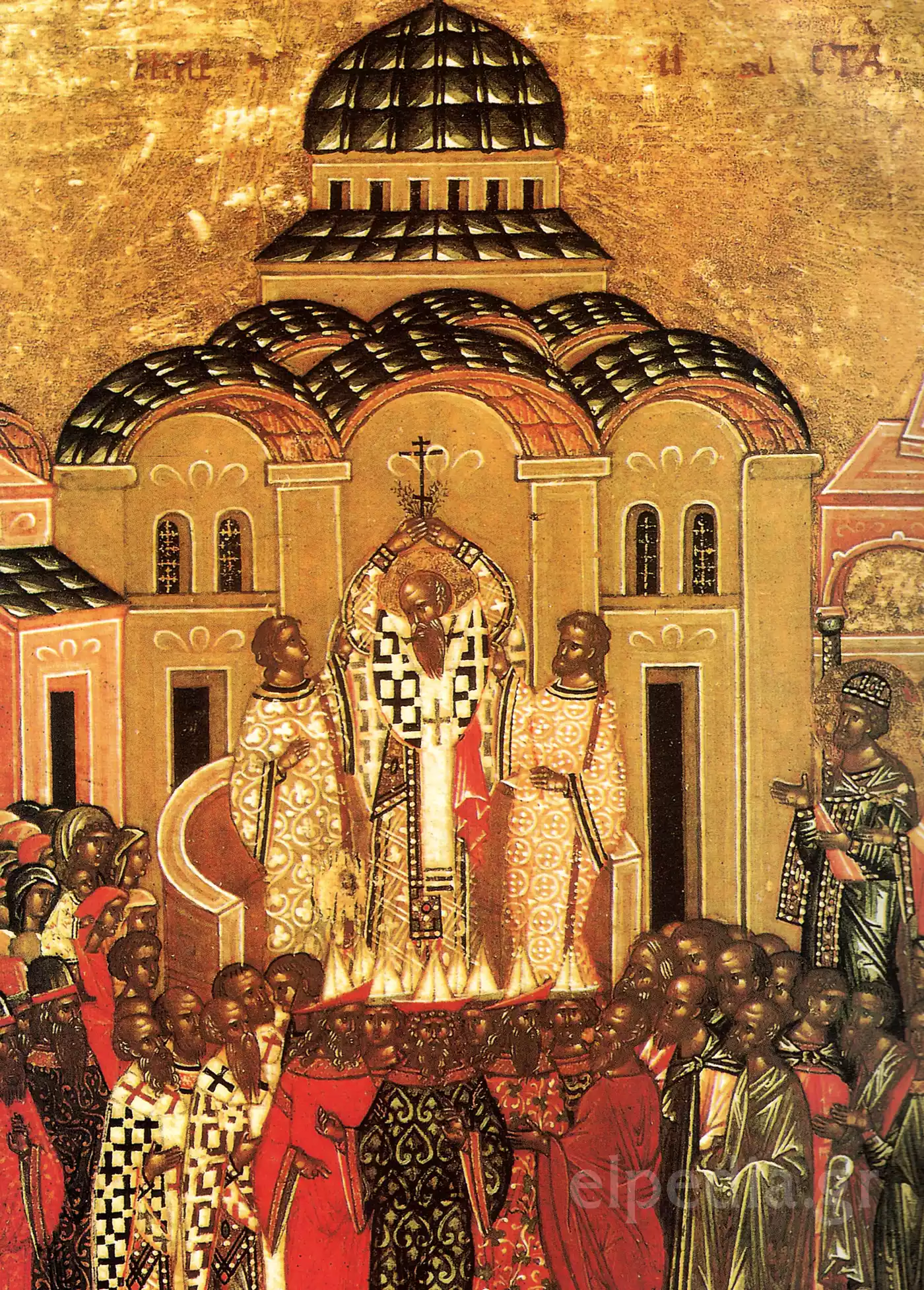
The Exaltation of the Holy Cross by the Novgorod School (15th century) with a gold background and architectural elements reflecting Byzantine influence
The image of the Exaltation of the Holy and Life-Giving Cross housed in the Historical Museum of Architecture in Novgorod serves as a significant historical document of Russian iconography from the 15th century (Papayiannou). It was created in the Novgorod School, one of the most important artistic traditions of medieval Russia, which developed a distinctive iconographic language separate from the schools of Moscow and Pskov. The work depicts the liturgical ceremony of the feast that appeared in the Byzantine iconographic repertoire from the 7th century onwards (Özrili).
It belongs to a period when the Novgorod School experienced significant flourishing, producing works that combined Byzantine influences with local aesthetic pursuits (Olsufiev). The image bears witness to the cultural exchange between Byzantium and the Russian principalities, as the iconographers of Novgorod regarded Greek icons as models and standards of their art. It is a composition that reflects not just a religious scene but a multi-layered cultural dialogue.
Liturgical Aspect of the Representation
The composition is organized around the central figure of the bishop who raises the Cross before a crowd of believers and clergy. This liturgical act of the Exaltation is directly linked to the feast of September 14, which commemorates the recovery of the Cross by Patriarch Zacharias of Jerusalem after Emperor Heraclius’s victory over the Persians in 628 AD (Janocha). However, the iconographic depiction is not limited to historical reference. It transforms into a timeless symbol.
The architectural setting with the domes and arcades represents a temple, likely inspired by the Holy Sepulchre, creating a spatial context that enhances the liturgical atmosphere of the scene. The three domes with characteristic tiles suggest Byzantine architectural influence, while the ochre and gold emphasize the heavenly dimension of the event (Gerol’d). The symmetrical arrangement of the architectural elements is intentional; it represents the cosmic order reflecting heavenly harmony.
Color Economy and Symbolism
The gold background dominates the composition, functioning not as a physical space but as a metaphysical environment that transcends time. The golden surfaces, characteristic of Novgorod art in the 15th century, create a sense of radiance and otherworldliness, as light reflects and transforms the visual field into a space of theophany. The whites, reds, and golds of the priestly garments visually structure the scene, distinguishing the hierarchical positions of the figures. The white of the episcopal omophorion symbolizes purity and spiritual holiness, while the red of the deacon’s vestments alludes to martyr blood and self-sacrifice.
The figures of the faithful surrounding the bishop are arranged in concentric levels, creating a sense of depth without employing the linear perspective of Western painting. This spatial technique is characteristic of Russian iconography and reveals a different perception of reality—a reality not measured in geometric terms but experienced as a spiritual encounter (Velizhanina). The crowd is presented as a unified body of faith, where individual figures merge into a collective liturgical act.
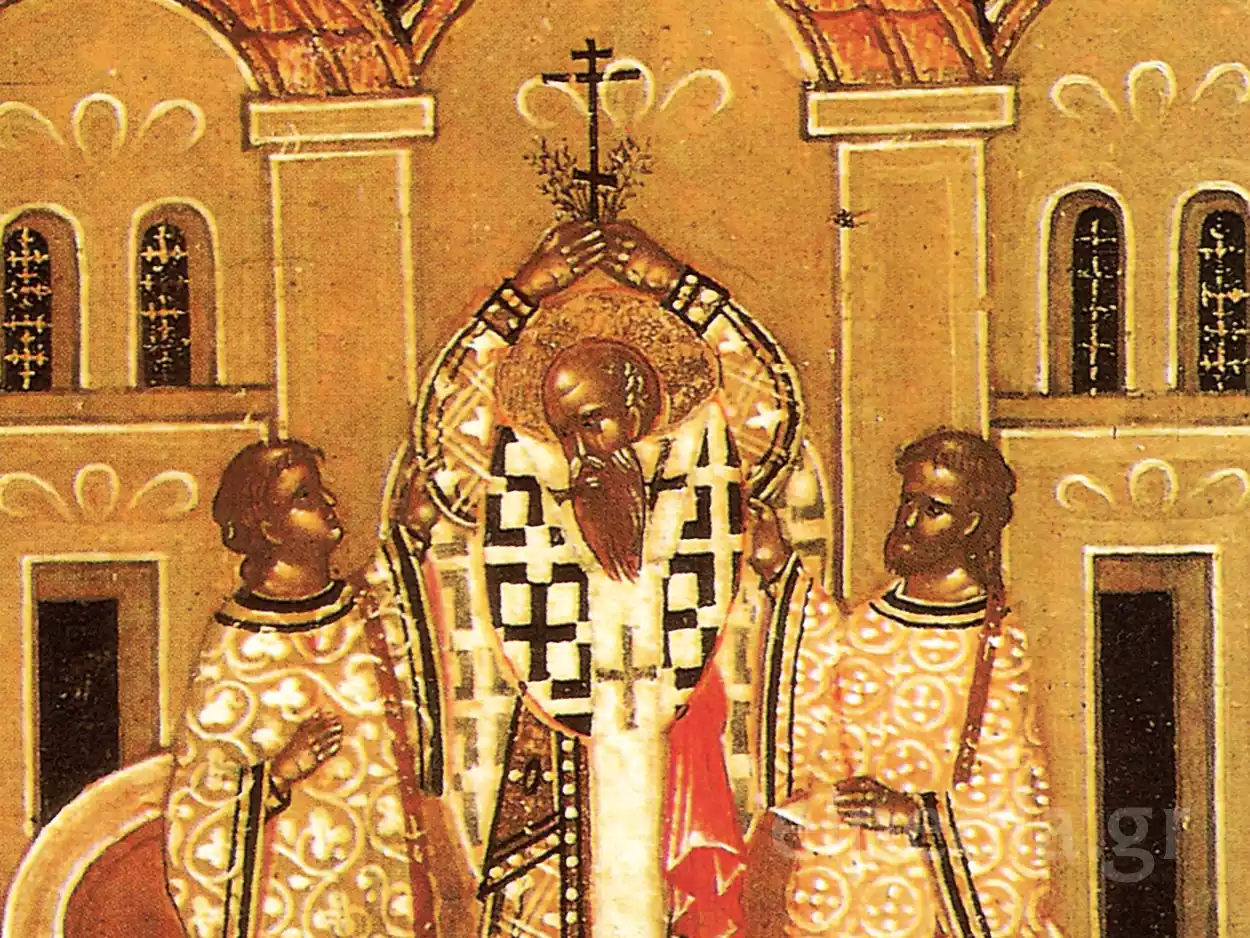
Central scene of the liturgical ceremony where the bishop raises the Cross before a crowd of clergy and believers in Russian iconography
Historical Document and Spiritual Heritage
The image of the Exaltation of the Holy Cross from the Novgorod School transcends its purely artistic dimension. It serves as a historical document of an era when art acted as a vehicle for theological teaching, cultural identity, and collective memory. The 15th century in Russia was marked by intense spiritual quests and artistic innovations, as local schools of iconography—Novgorod, Moscow, Pskov—developed distinct expressive languages while maintaining a vibrant connection to the Byzantine tradition (Papayiannou).
The work testifies to the cultural continuity that connected medieval Russia with the universal Byzantium, a relationship that was not limited to mere imitation of models but manifested as creative assimilation and reinterpretation. The iconographers of Novgorod did not mechanically reproduce Greek prototypes. They transformed them through the local cultural lens, creating works that combined Eastern theological thought with Northern aesthetic sensitivity.
The Image as Theological Text
The Byzantine icon veneration, as shaped after the Iconoclasm of the 8th and 9th centuries, established a unique theology of the image that the Novgorod School adopted with reverence (Özrili). The image was not merely a decorative representation or aesthetic satisfaction for the viewer; it functioned as a “window to heaven,” as a mediator between the visible and the invisible reality. The doctrine of the incarnation, which theologically justified the depiction of the divine, allowed the image to become a meeting place for humanity and the sacred.
In the representation of the Exaltation, the Cross as a central symbol encapsulates the essence of the Christian faith: death and resurrection, pain and glory, human fall and divine elevation. The symbolic polysemy of the Cross in Byzantine iconography transcends the historical reference to Christ’s martyrdom and opens up to cosmological and eschatological dimensions (Janocha). It emerges as an axis of salvation, as a tree of life that regenerates fallen humanity, as a symbol of victory over death and decay.
Timeless Value and Cultural Memory
Studying this image as a historical document reveals how art preserved and transmitted cultural memory in pre-modern societies. It was a time when literacy was limited, where texts remained accessible only to a small minority of the educated, and where the image took on the role of the “book of the illiterate,” as the Church Fathers famously argued. Iconography functioned as visual theology, as a means of catechesis and spiritual education that addressed all social classes.
The Novgorod School, with its distinctive aesthetic approach, played a crucial role in shaping Russian cultural identity (Olsufiev). Its images were not merely religious objects but also carriers of national consciousness, means of preserving historical memory, and expressions of collective values. Every color choice, every gesture of the depicted figures, every architectural element in the background of the composition carries multiple layers of meaning that were decoded by contemporary viewers through a shared culture of symbols and liturgical practices.
Today, this image is preserved in the Historical Museum of Architecture in Novgorod not just as a museum exhibit but as a living testimony of an entire worldview. It invites us to transcend the modern tendency for purely aesthetic viewing and to approach it as a historical document that reveals ways of thinking, values, and spiritual quests of another era (Gerol’d). Studying it requires an interdisciplinary approach that combines art history with theology, cultural anthropology, liturgical studies, and architectural history—only then can we uncover the full range of its significance.
The Exaltation of the Holy Cross remains eternally relevant. It reminds us that art can serve higher purposes beyond aesthetic satisfaction, that cultures communicate and intertwine, creating rich hybrid forms of expression, and that historical memory is preserved and transmitted not only through written texts but also through visual narratives. In our time, where the image has become ubiquitous yet often superficial, this 15th-century work teaches the value of depth, symbolic density, and the spiritual dimension of visual language.
Bibliography
Gerol’d, V.I., The History of the Discovery and Study of Russian Medieval Painting, 2017.
Janocha, M., ‘The Exaltation of the Cross in Byzantine Iconography’, Ikonotheka, 2008.
Olsufiev, Y.A., ‘The Development of Russian Icon Painting from the Twelfth to the Nineteenth Century’, The Art Bulletin, 1930.
Özrili, Y., ‘The Cross in Byzantine Art: Iconography Symbolism and Meaning’, KutBilim Sosyal Bilimler ve Sanat Dergisi, 2023.
Papayiannou, K., Byzantine and Russian Painting, trans. El. Nakou, Athens: Alternative Editions, 2007.
Velizhanina, N.G., ‘On the History of Icon Painting’, Culture: Religion, Gender, and Customary Law, 1992.


