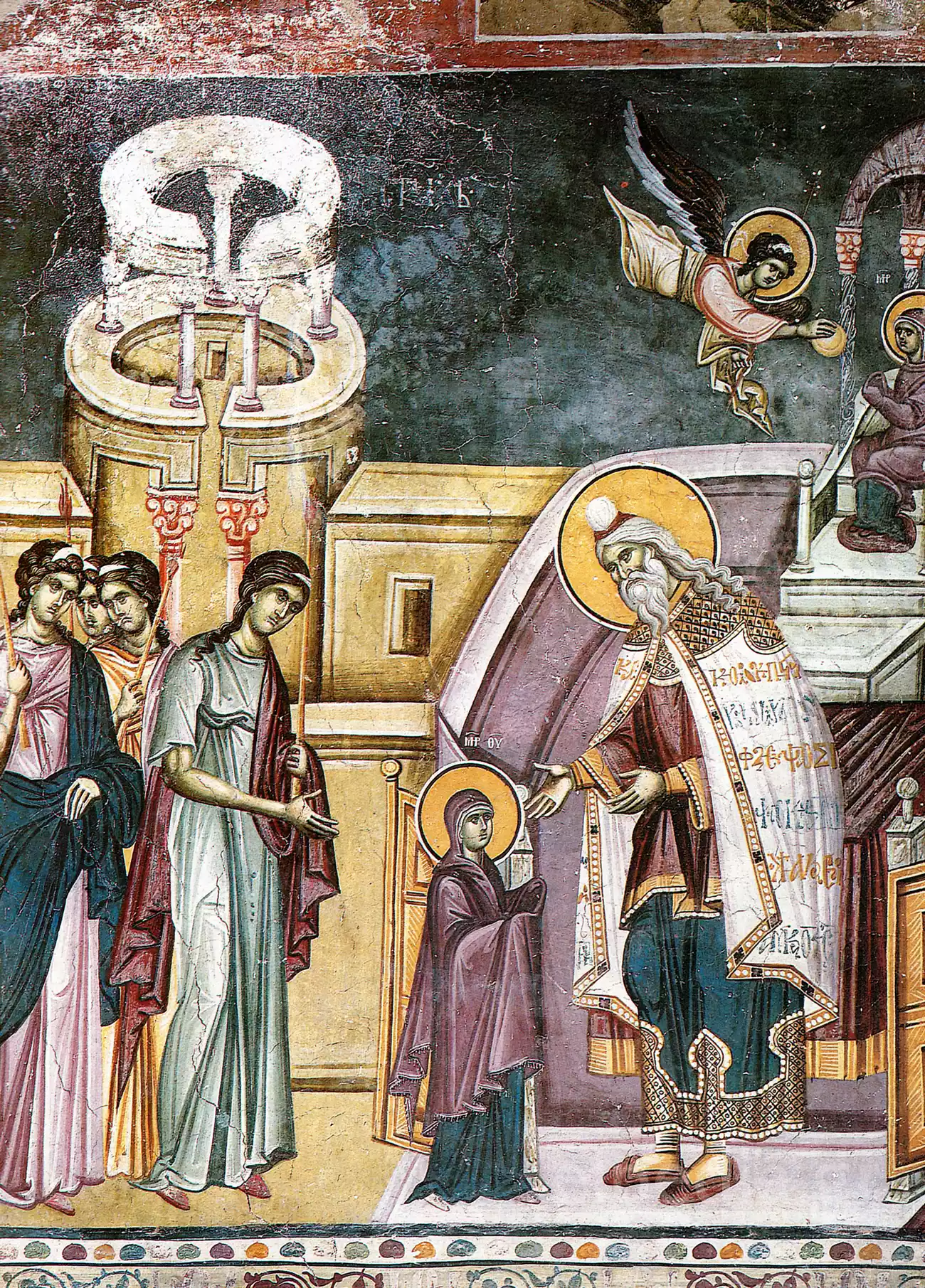
The Entrance of the Theotokos to the Temple (1313-14). The Palaeologan fresco in the Church of the King, Studenica Monastery, Serbia. Created by Michael and Eutychius.
One can often see these images and might think they know everything about them. We observe the young girl, the Virgin, being presented to the priest Zacharias by her parents, Joachim and Anna. This is precisely the subject—the Entrance of the Theotokos. However, this artwork, located in the Church of the King at Studenica (Studenica monastery), painted around the years 1313 or 1314, tells more than just a simple story. In these frescoes—created by Serbian kings Milutin and their painters, Michael and Eutychius, I believe—they showcase more than mere piety. There is a sense of melancholy, a heavy gaze, and a contorted body shape that characterize Palaeologan art. The theme here revolves around the necessity of sacrifice, as it seems. The drama begins even before the angel arrives.
Zacharias and the Reception Scene
This composition is divided into two parts but moves towards the center. On the right is the priest, and on the left is the procession. In the middle lies the cause.
So, what does Zacharias do? The elderly priest, large in stature and modest in his splendid attire, bends his body. He bows. This bent shape signifies both reverence and recognition. He acknowledges that this small child, the Mother of God (ΜΡ ΘΥ is inscribed beside her), is something greater than she appears—she herself is the living temple entering the stone temple. His movement towards her seems to flow, with arms extended to receive the mystery. Those painters, participating in the Palaeologan renaissance, knew how to depict the weight of the body and the gravity of the moment. The architecture in the background… somewhat irrational, as always. Tall columns and arches, out of place, yet indicating the inner space, the Holy of Holies, I believe.
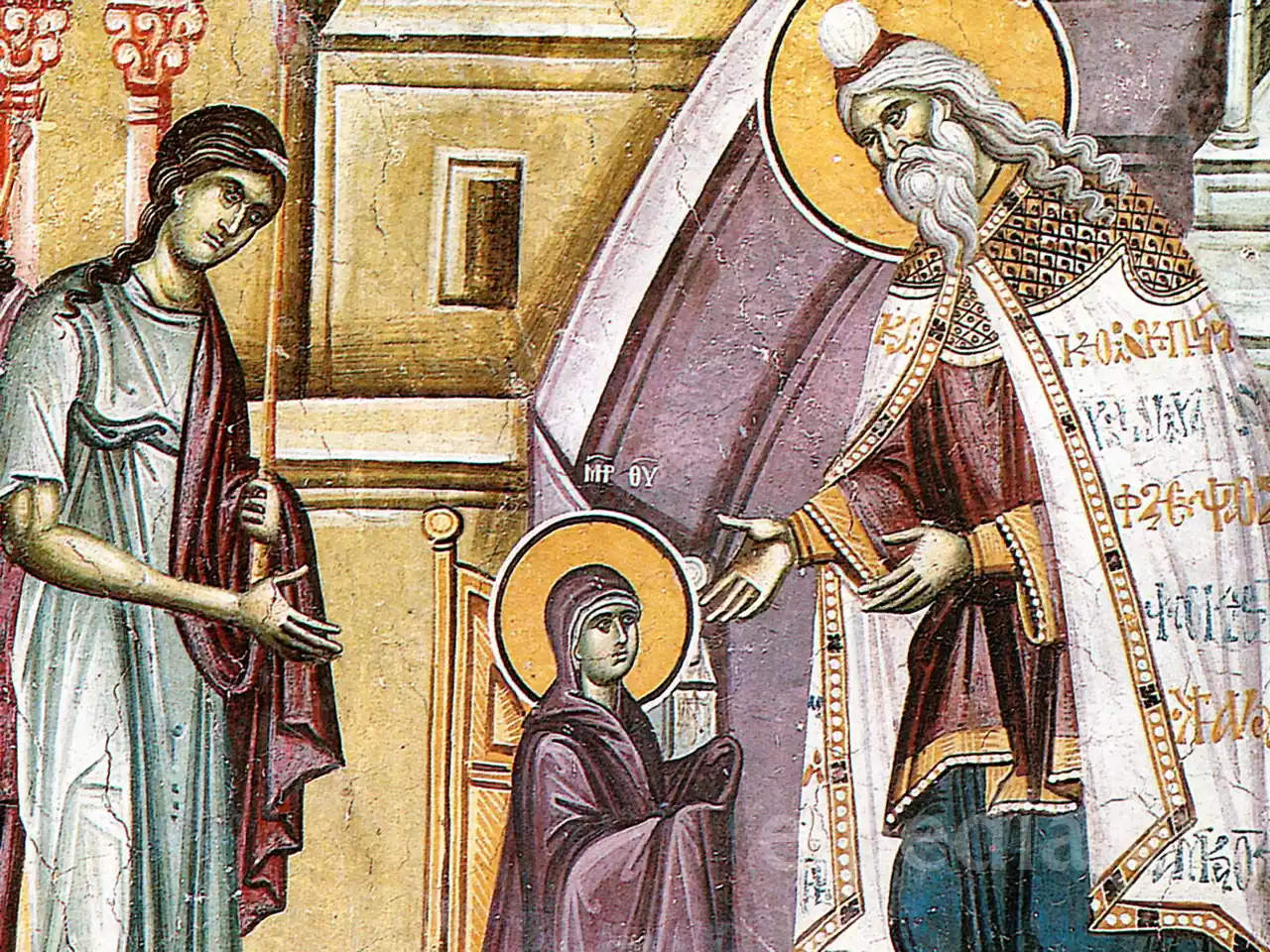
Priest Zacharias, adorned in rich vestments, bends to welcome the three-year-old Mary, who gazes at him with unusual maturity.
The Virgin’s Gaze
As for Mary, she is small in stature, resembling a three-year-old child, but her face is not childlike at all. She looks intently at Zacharias, and that gaze… carries a seriousness. It is filled with wisdom, and perhaps sadness. She seems to know the path she is destined to walk. These Palaeologan painters sought to capture the inner character. Her figure, standing between her mother Anna and the priest, becomes the axis of the entire composition. The light on her face and the delicate lines of her nose all signify the importance of the moment—the beginning of the drama. Her dark garment foreshadows the future passion, even though she is just a child.
The Attendant Virgins
And indeed, we see on the left the other girls, the torchbearers. Anna leads the way (the older woman presenting Mary), extending her hand as if to hand over the child, while behind her follow the virgins. These young maidens carry torches, as the Protoevangelium states, but their faces… oh, their faces. They share that same melancholy characteristic of Palaeologan art. Their necks are bent, their eyes large and contemplative. They seem to be leading a serious procession. This art always prioritizes character over passion. The folds of their garments, rich and classic in style, appear heavy, as if drenched. This is the style of those great artisans, Michael and Eutychius, who blended ancient beauty with new Christian sorrow. And again, that gaze. That gaze.
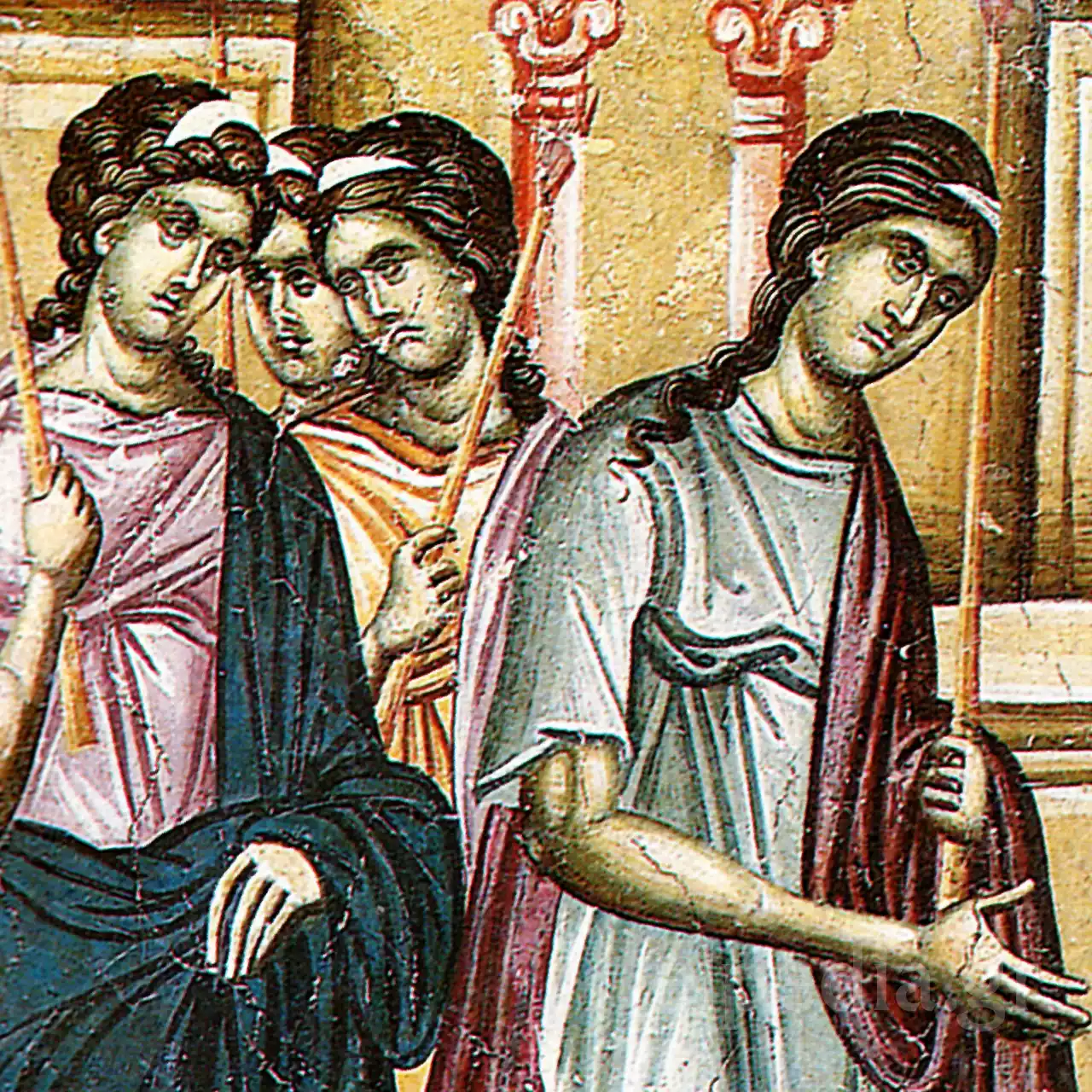
The “torchbearer virgins” accompanying Anna and the Virgin Mary. Their faces reflect the distinctive melancholy of Palaeologan art.


