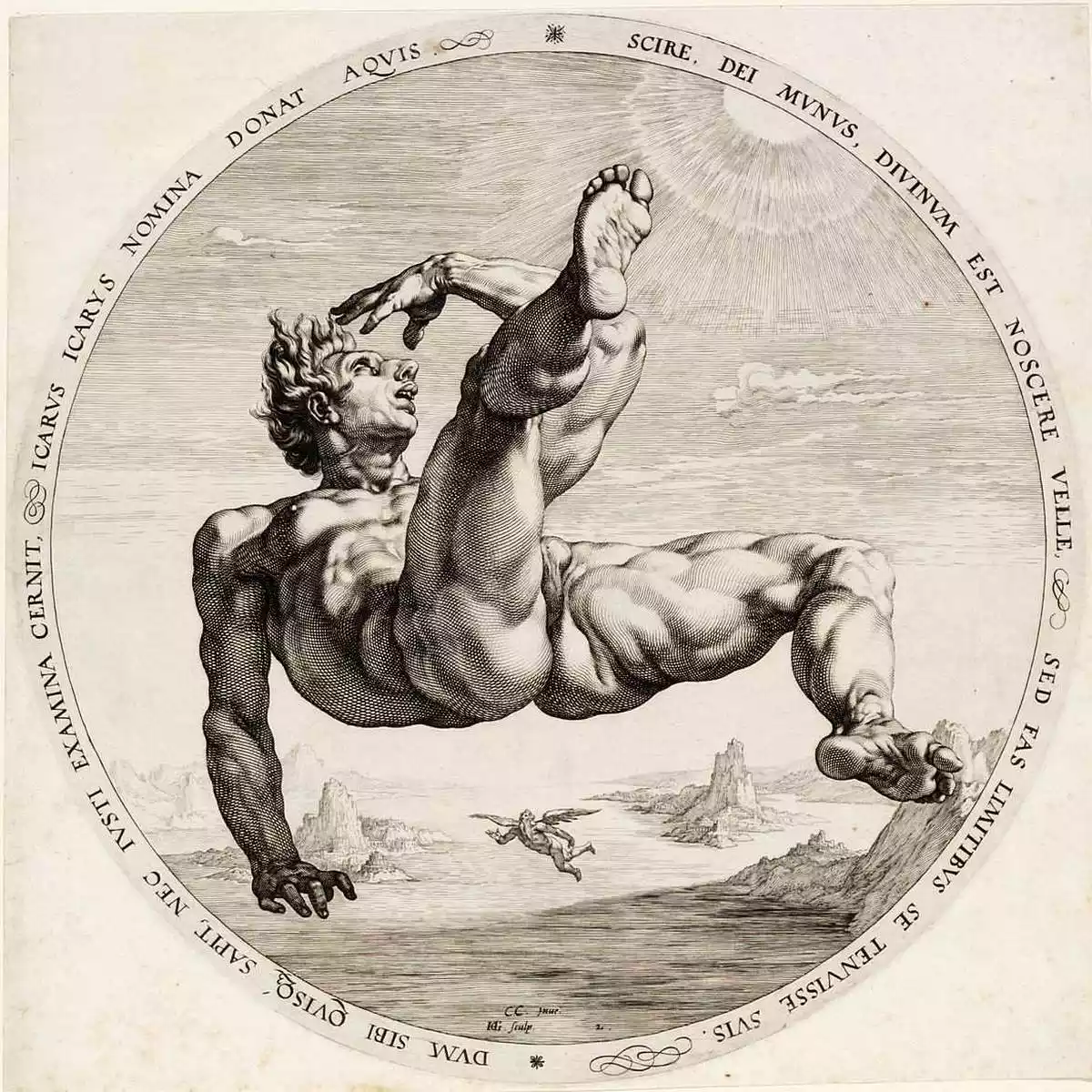
The fall of Icarus from the collection of the Szépmûvészeti Múzeum. Engraving on paper by Hendrick Goltzius, ca. 1588.
Icarus is one of the most striking and timeless figures in ancient Greek mythology. The son of the legendary craftsman Daedalus, the young hero embodies humanity’s desire for freedom, the courage of curiosity, and the disastrous consequences of hubris. The myth of Icarus (Turner) has inspired countless artists, poets, and thinkers throughout the ages.
This tragic tale recounts the escape of Daedalus and his son from Crete, where they were held captive by King Minos. By crafting wings from wax and feathers, the ancient master devised a means of escape that would prove both salvific and catastrophic. Over the blue Aegean, Icarus would lend his name to the sea of Icaria, leaving behind a myth that would accompany humanity for centuries (Chamberlain).
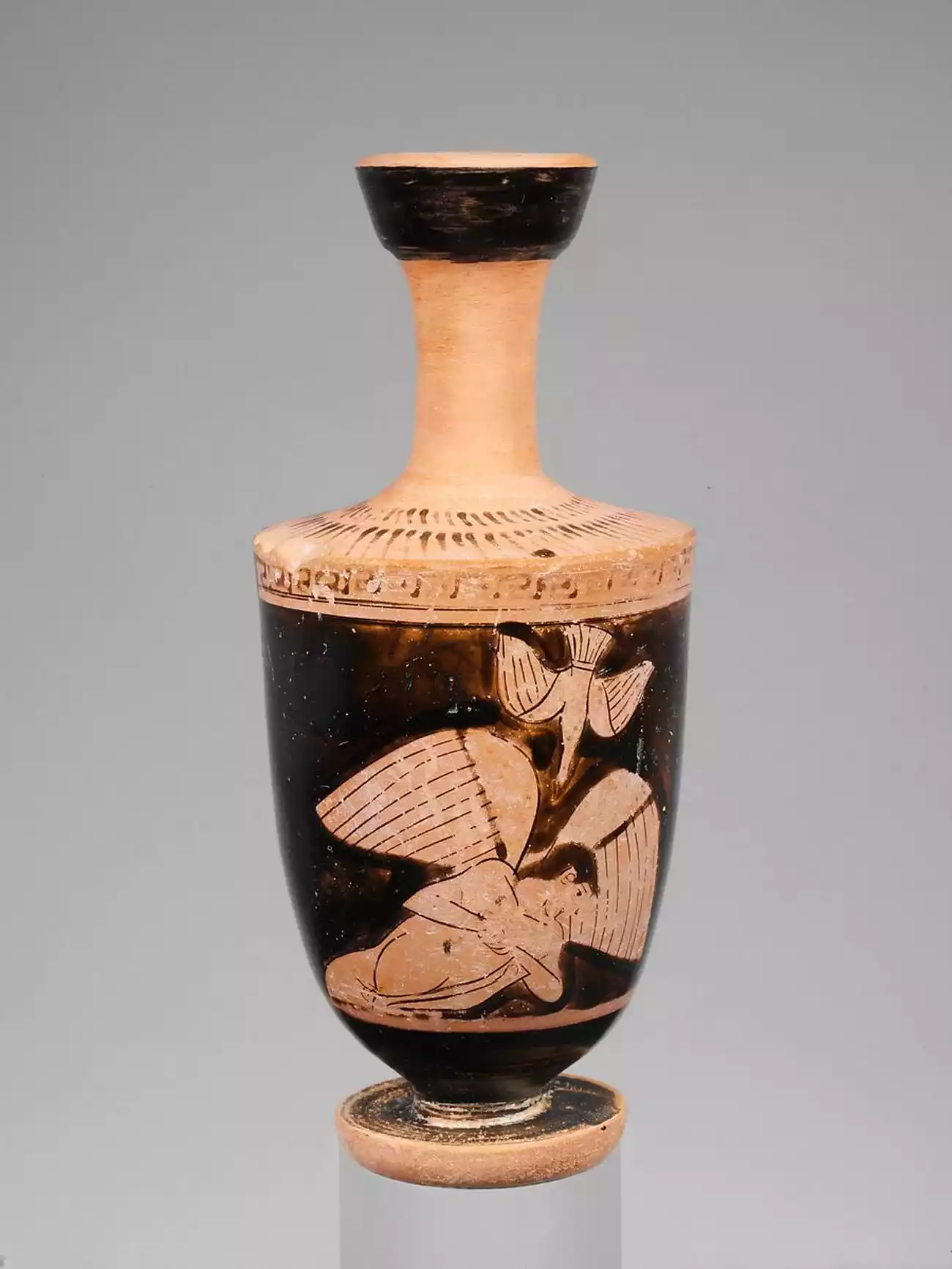
Red-figure lekythos (oil vessel) attributed to the Painter of Icarus. The depiction of a winged youth, likely Icarus, is a characteristic work of the classical period. Metropolitan Museum of Art, New York.
The Legendary Escape and Fall of Icarus
According to ancient tradition, Daedalus had fallen out of favor with Minos due to his assistance to Ariadne in helping Theseus escape from the Labyrinth. Imprisoned in his own labyrinth alongside Icarus, the ingenious craftsman realized that the only way out was through the air. What a brilliant idea! Observing the birds flying freely over Crete, he decided to mimic nature and create artificial wings that would allow them to fly away from their captivity.
With the skill that only a master craftsman could display, Daedalus gathered feathers from various birds and bound them with threads and wax, creating two pairs of wings that would forever change the course of mythology. The ancient Greek literature details this intricate construction, symbolizing humanity’s desire to transcend its natural limits (Ullyatt).
When the moment of takeoff arrived, Daedalus imparted advice to his son that would be remembered as an example of paternal wisdom and prophetic warning. “Do not fly too high, my son, for the heat of the sun will melt the wax of your wings,” he said with a seriousness that reflected the gravity of the moment. “But do not fly too low either, for the sea’s spray will wet the wings and ruin them.” This golden guidance for the middle path, for the virtue of moderation, would prove prophetic.
In the early moments of flight, joy and euphoria prevailed. Father and son soared over the Aegean, enjoying a freedom that until then belonged only to birds and gods. Icarus, filled with excitement from this unprecedented experience, felt the intoxication of flight overwhelm him. The Icarus complex, as it is termed in modern psychology, began to manifest (Salis).
Drunk on the limitless sense of freedom that flight provided, young Icarus gradually began to disregard his father’s advice. He flew higher and higher, as curiosity and ambition pushed him toward the sun. Ancient Greek thought viewed this act as the embodiment of hubris, excessive ambition that leads to destruction. As he ascended, the sun’s rays began to melt the wax holding his wings together.
The tragic conclusion came swiftly and mercilessly. The wings disintegrated, feathers scattered in the air, and young Icarus began his disastrous fall into the sea. The cries of his father, witnessing his son vanish into the blue waters of the Aegean, echoed in the sky as a tragic lament. The sea that welcomed Icarus’s lifeless body was named after him – the Icarian Sea – and remains a monument to the young man who dared to fly toward the sun.
Daedalus, devastated by the death of his son, continued his flight alone to Sicily, where he lived the rest of his life overshadowed by grief and remorse. The modern analysis of the myth interprets it as one of the earliest recorded “aviation” disasters in history, with lessons that remain relevant for contemporary aeronautics and flight safety (Cookson).
The Symbolism of the Myth and Its Timeless Impact
The myth of Icarus transcends the boundaries of a simple fairy tale and evolves into a profound philosophical reflection on human nature. On one level, the story warns against hubris, excessive ambition that leads to destruction. Icarus becomes a symbol of those who defy limits and rules, seeking a transcendence that ultimately leads to their downfall.
At the same time, the myth expresses positive values. Icarus’s thirst for knowledge, his courage to explore unknown territories, and his refusal to remain captive – all reflect fundamental human quests. In 20th-century modern literature, Icarus has been reinterpreted as a symbol of artistic creation, scientific inquiry, and political resistance (Salis).
The analysis of the resonance of the myth in mass art over recent decades reveals the enduring vitality of this ancient narrative (Chiglintsev). From cinema to pop culture, from contemporary poetry to visual arts, Icarus continues to inspire and provoke.
The Spanish poetry of the Renaissance adopted the figure of Icarus as a metaphor for poetic inspiration and artistic creation (Turner). In the hands of poets, the young man who fell into the sea becomes an image of the artist who sacrifices his life for his art.
The central message of the myth remains timeless: wisdom lies in the middle path, in the ability to balance between inertia and extreme boldness. Daedalus, who adhered to his own advice, managed to survive and reach his destination. Icarus, who allowed his youthful impulse to overwhelm him, paid the ultimate price.
In modern psychological analysis, the myth is interpreted as a reflection of the father-son relationship and the challenges of adolescence. The young man striving to surpass his father, seeking his own identity even at the cost of his safety, is a theme that resonates across all eras and cultures. The tragedy of Icarus reminds us that maturation requires a combination of courage and prudence, a desire for exploration and respect for the limits of reality.
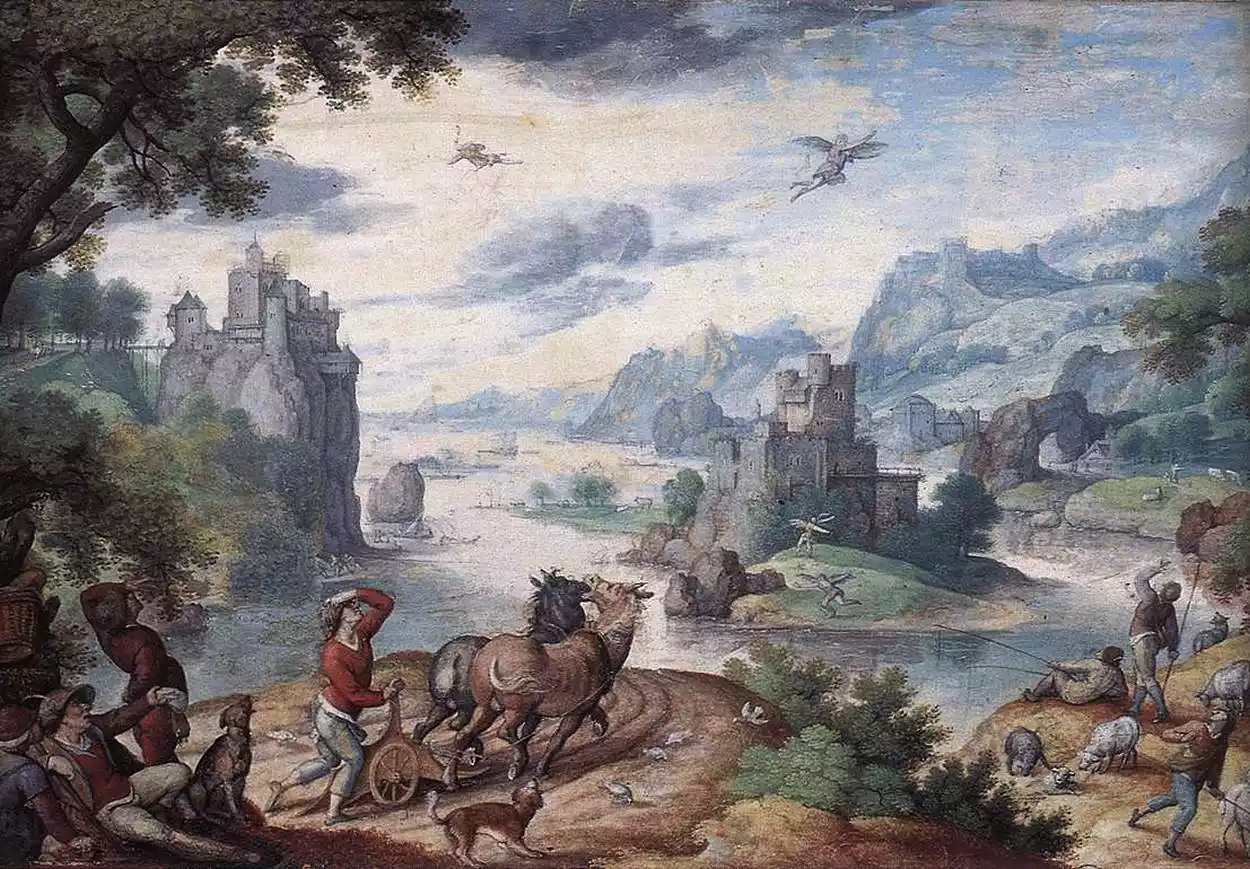
Watercolor on paper by the Flemish painter Hans Bol, located in the Mayer van den Bergh Museum. The work, dated to the late 16th century, showcases the artist’s skill in landscape and mannerist aesthetics.
Icarus in Art and Modern Thought: An Eternal Symbol
The influence of the myth of Icarus extends far beyond the confines of ancient Greek literature, permeating centuries of art, philosophy, and culture. From the ancient Apulian vase paintings depicting the grieving Daedalus holding his son’s lifeless body (Woodford), to Renaissance masterpieces and contemporary films, Icarus remains a vibrant presence in our collective imagination.
The iconography of the myth has evolved dramatically over the centuries. In ancient Greece, artists often focused on the moment of wing construction or on Daedalus’s pain after the tragedy. The Romans, inheriting this tradition, added their own elements to the narrative, while medieval myth collectors preserved the memory of the story, adapting it to the Christian values of their time.
The Renaissance and the Revival of Classical Ideals
The Renaissance marked a pivotal shift in the interpretation of the myth of Icarus. Artists of the era, inspired by ancient Greek and Roman traditions, discovered in the story of the young man who dared to fly toward the sun a rich symbolism that resonated with the spirit of their time. This period, characterized by the revival of classical ideals and the exploration of new horizons, found in Icarus a representative of human aspirations.
Spanish Renaissance poets particularly embraced the figure of Icarus, often within the context of the literary disputes of the time (Rico García). The name of the young hero became a metaphor for poetic inspiration that dares to reach great heights, despite the risk of “falling” from criticism or misunderstanding. In the hands of great poets, Icarus transformed from a cautionary example into a symbol of artistic boldness and creative transcendence.
Simultaneously, the visual arts of the Renaissance gave the myth new dimensions. Paintings like Pieter Bruegel’s “The Fall of Icarus” became reference points for generations of artists and thinkers. The analysis of Bruegel’s work reveals a completely new approach: the tragedy of Icarus unfolds against the backdrop of everyday life, while people continue their tasks, indifferent to the drama occurring above their heads (Ullyatt).
Modern Interpretations and Philosophical Approaches
In modern times, the myth of Icarus has acquired new dimensions and interpretations that reflect the challenges and anxieties of contemporary society. Psychologists have identified the so-called “Icarus complex”, a psychological state characterized by a tendency toward dangerous overambition and an inability to recognize one’s limitations (Salis).
This phenomenon gains particular significance in the age of technological revolution and globalization. Many contemporary thinkers see Icarus as a prophetic character for the state of modern humanity, which possesses unprecedented technological capabilities but often lacks the wisdom to use them responsibly.
The French philosopher André Comte-Sponville dedicated an entire book to the philosophical examination of the myth, exploring the relationship between hope and despair, ambition and pragmatism. In his work, Icarus becomes a symbol of a human condition that oscillates between creative boldness and destructive hubris.

In contemporary Latin American literature, the myth of Icarus often intersects with that of Prometheus, creating a dialogue between two different approaches to human transcendence (Lizardo). Prometheus, who steals fire from the gods to give it to humanity, represents the revolutionary boldness that consciously takes risks for the good of mankind. Icarus, on the other hand, embodies individual ambition that leads to self-destruction.
The influence of the myth in mass art over recent decades is evident in countless works, from films to pop culture songs (Chiglintsev). Each era discovers in Icarus elements that reflect its own challenges and fears. In the modern age of climate change, for example, the myth is often interpreted as a warning against the environmental destruction caused by human hubris.
The myth of Icarus remains relevant because it addresses fundamental issues of human existence that never lose their universality and significance. How do we balance the need for security with the desire for exploration? How do we distinguish between courageous innovation and irrational hubris? When does the pursuit of freedom become a destructive delusion?
Today, as humanity faces unprecedented challenges – from artificial intelligence to space exploration, from genetic engineering to climate change – the myth of Icarus gains new relevance. It reminds us that every technological or scientific advancement must be accompanied by wisdom and caution. Daedalus’s wings can lift us to great heights, but only if we remember his advice for the middle path.
The story of the young man who dared to fly toward the sun is not merely a cautionary parable. It is a complex reflection on human nature, recognizing both the importance of courage and the necessity of prudence. Icarus dies, but his vision of flight survives and inspires. In his tragic death lies the seed of countless future achievements, from the first airplanes to space explorations.
Thus, the myth of Icarus remains a living dialogue between the past and the future, a bridge connecting ancient wisdom with modern quests. Each generation discovers in this eternal story new meanings, new challenges, and new hopes. Icarus falls, but humanity continues to dream of flight.
Bibliography
Chamberlain, P.G. “Myth of Icarus.” The Trumpeter, 2000.
Chiglintsev, E.A. “Reception of the Icarus myth in the mass art of the late 20th-21st century.” SCOPUS, 2014.
Comte-Sponville, A. El mito de Ícaro: Tratado de la desesperanza y de la felicidad/1. Books.google.com, 2015.
Cookson, S. “An Important Failure: Lessons from Daedalus and Icarus.” Advances in Human Aspects of Transportation, Springer, 2016.
Lizardo, G. “Los mitos de Ícaro y Prometeo en la obra de Severino Salazar.” FILHA, 2005.
Rico García, J.M. “El mito de Ícaro en la controversia gongorina.” Rodin.uca.es, 1992.
Salis, G. “The Icarus complex: The Influence of the Greek myth of Icarus and Daedalus in 20th century literature.” Galaxy: An International Multidisciplinary, 2016.
Turner, J.H. The Myth of Icarus in Spanish Renaissance Poetry. Books.google.com, 1976.
Ullyatt, A.G. “Icarus, Brueghel and the poets a study of meaning in the myth of Daedalus and Icarus.” Scholar.ufs.ac.za, 2001.
Woodford, S. “Daidalos and Ikaros on an Apulian Fragment newly acquired by the British Museum.” Bulletin of the Institute of Classical Studies, JSTOR, 2009.


