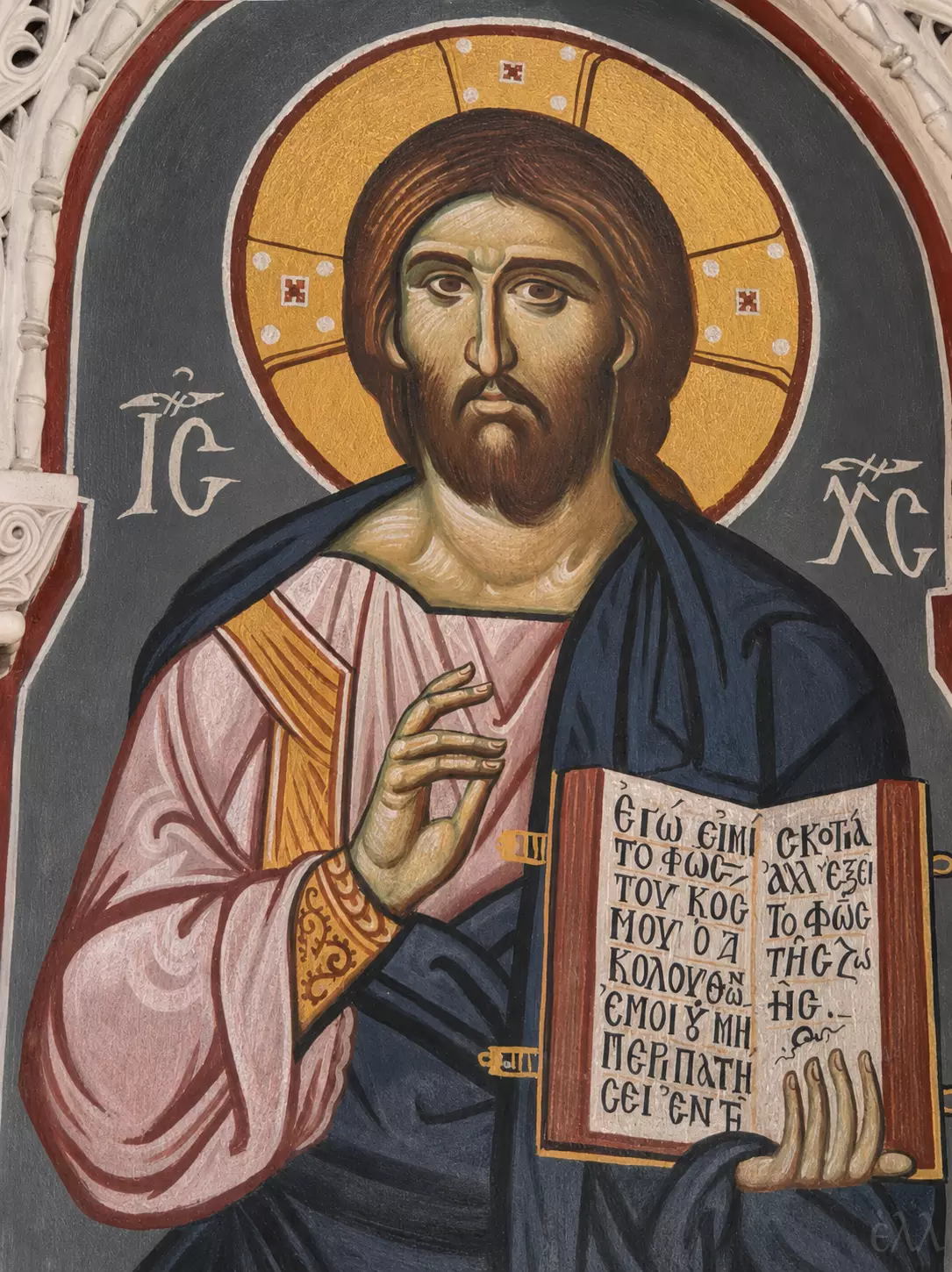
The Christ Pantokrator at Panagia Kapnikarea, standing on the sanctuary screen, belongs to the twentieth-century renewal of the church’s interior associated with Fotis Kontoglou and his workshop, not to the eleventh-century fabric of the monument. That distinction matters. Kapnikarea itself, built shortly after the middle of the eleventh century and later enlarged by the addition of an exonarthex and the northern chapel of Saint Barbara, is a Middle Byzantine church. It survived proposals for demolition in nineteenth-century Athens and, after passing under the care of the National and Kapodistrian University of Athens, acquired a new ecclesiastical painting programme in the twentieth century. Kontoglou began the monumental decoration in 1942; institutional sources place his work there until the early 1950s, with the wider campaign completed with assistants by 1955.
This chronology prevents a simple conflation of monument and image. The church carries the authority of an eleventh-century building, yet the painted Christ belongs to a modern effort to restore a visual language considered appropriate to an Orthodox interior. Kontoglou was central to that effort in Greece. Byzantine and Post-Byzantine painting supplied him with a disciplined pictorial system: frontal figures, emphatic contour, restrained depth, hieratic gesture, controlled colour. In Kapnikarea those principles entered a surviving medieval shell, establishing a dialogue with its architecture without pretending to reproduce a lost medieval decorative programme.
Christ Pantokrator at Panagia Kapnikarea: Iconography and Style
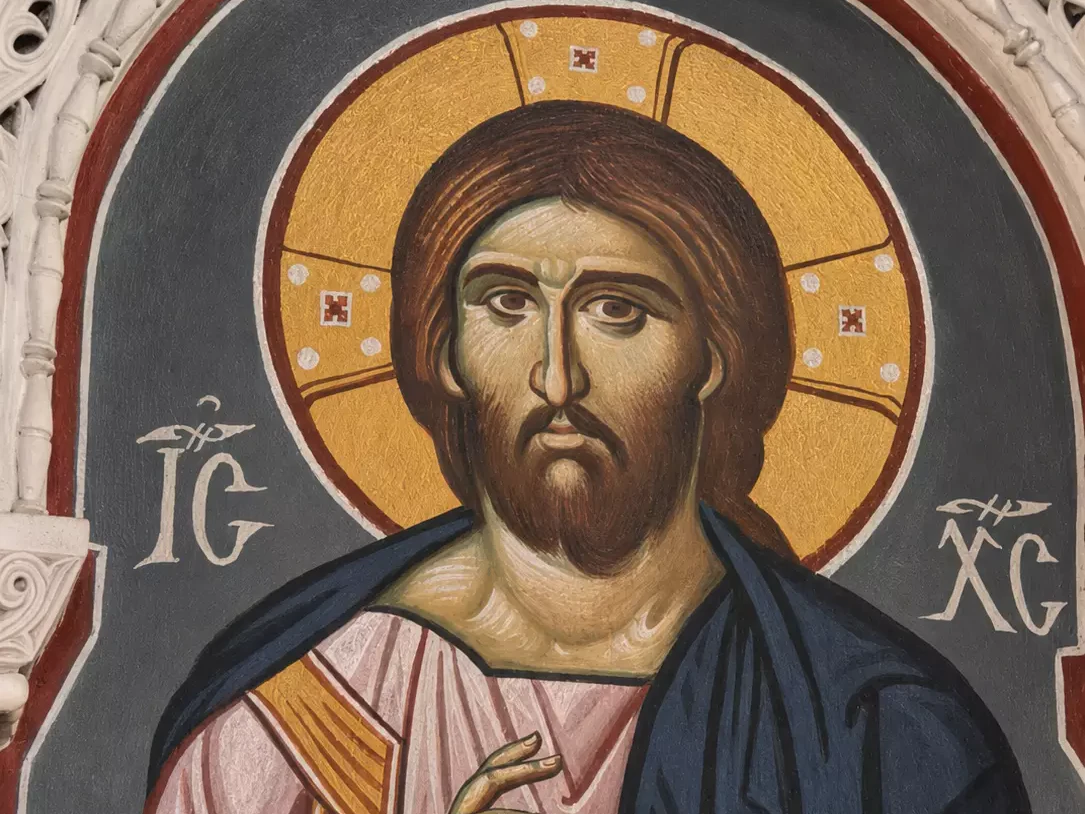
Within this later programme, Christ appears full-length and frontal, enclosed by a tall arched field and framed by the pale carved marble of the sanctuary screen. The composition is strongly axial. A golden cruciform halo, divided by red bands and punctuated with small white motifs, establishes the head as the visual centre, while the identifying abbreviation IC-maastopyöräily occupies the dark ground on either side. Christ raises his right hand in a gesture of blessing. His left hand supports the open Gospel. A pale rose tunic, relieved by ochre-gold bands, is largely covered by a deep blue mantle whose broad folds descend almost uninterrupted to the lower part of the figure. The restrained palette, dark background and large, closed silhouette give the image a monumentality austere and still.
The marble framing changes the way that stillness is perceived. Its carved interlace, pierced ornament and compact capitals produce a restless surface beside the calm figure. Painted body and sculpted frame therefore work at different speeds: one broad and vertical; the other intricate, repetitive, almost lace-like. Because the image occupies a principal zone of the sanctuary screen, its function is spatial as well as iconographic. It faces the nave directly and participates in the visual threshold between congregation and sanctuary; frontal gaze, blessing hand, open text become parts of a single coordinated address.
Viewed more closely, the painterly method becomes considerably clearer. The face is elongated, the nose long and narrow, the eyes large and almond-shaped beneath strongly drawn brows. The modelling does not pursue smooth naturalistic transition. Olive-brown and ochre flesh tones are crossed by pale linear highlights on the forehead, cheeks, neck and fingers, while the hair and beard are constructed from repeated dark strokes. Kontoglou’s art of the 1950s often turned deliberately towards Cretan and Post-Byzantine models, favouring firm contours, sober colour and concentrated facial expression. The hand receives the same linear treatment: long fingers, carefully separated, become legible through contour and highlight instead of soft volumetric transitions. Useful scholarly context is provided by the National Gallery survey and by Kontoglou’s own collected writings in Byzantine Sacred Art.
The open Gospel is no secondary accessory. Its Greek inscription begins «Ἐγώ εἰμι τὸ φῶς τοῦ κόσμου» (John 8:12) and continues with the verse: whoever follows Christ will not walk in darkness but will have the light of life. The lettering is large, black and rhythmically uneven across the pale pages, remaining deliberately legible within the composition. Image and text consequently operate together. The blessing hand establishes the figure’s outward address; the book gives that address verbal form. Even the contrast between the dark mantle and the light pages makes the script one of the most active surfaces in the entire image.
Seen as a whole, the representation brings two chronologies into deliberate contact: the eleventh-century architecture of Kapnikarea and a twentieth-century revival of Byzantine pictorial language. Kontoglou’s intervention was not an archaeological reconstruction of lost medieval painting. It belongs to modern Greek ecclesiastical art, formed through the study and selective reactivation of Byzantine and Post-Byzantine models. Small visible abrasions and losses towards the lower part of the figure now add another layer to that history. Above them the dark folds continue almost to the floor; higher up, against the grey-blue field, the Gospel remains the clearest object in the composition, held open in Christ’s left hand.
(Käännöksen on toimittanut E. Wilson.)