
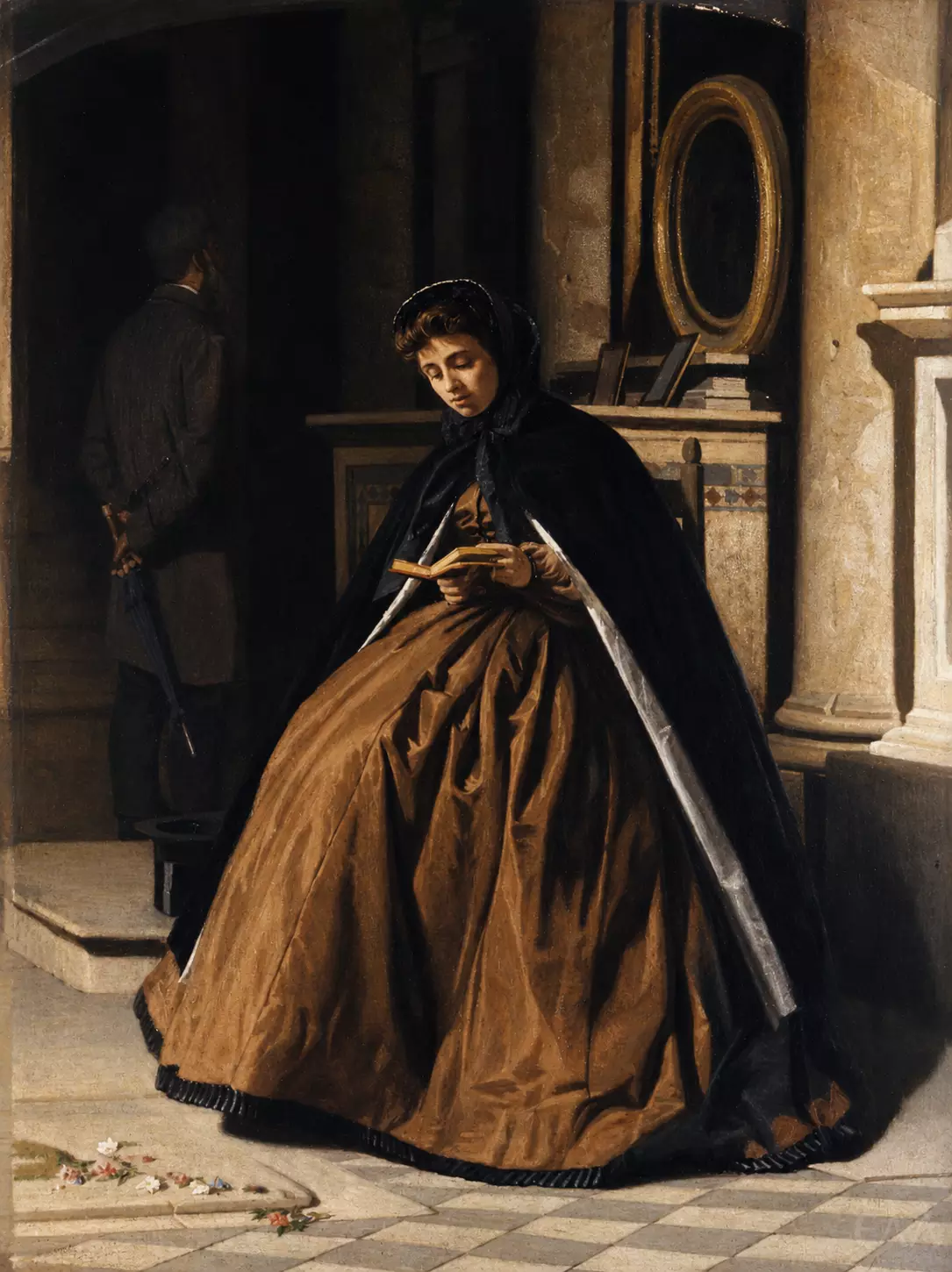
Giuseppe Abbati painted Oration (The prayer) in 1866, at a moment when his association with the Macchiaioli had already transformed the academic foundations of his earlier training into a more immediate study of light, tonal contrast and ordinary experience. The small oil on canvas, measuring 57 × 42 centimetres and now in the Gallery of Modern Art at Palazzo Pitti in Florence, presents a young woman seated inside a church, absorbed in prayer over a small open book. Her identity is known: she is Teresa Fabbrini — the wife of the critic and collector Diego Martelli, one of the most important supporters of Abbati and his Florentine circle.
Little occurs in narrative terms. A woman reads; a second figure, almost swallowed by the darkness behind her; flowers scattered over a tombstone in the foreground. Yet Abbati constructs from these restrained elements a remarkably concentrated pictorial event. The brown taffeta dress occupies much of the lower canvas, expanding into broad angular folds; over the shoulders falls a dark cloak whose pale satin lining cuts diagonally through the composition. Illumination arrives softly from outside the visible field and catches surfaces selectively—forehead, hands, book, fabric, stone—before being absorbed into the deep interior shadow.
The subject of prayer therefore develops through posture and attention, but also through the measured distribution of visibility. Some forms declare themselves immediately, others withdraw. In that movement between light and obscurity lies much of the painting’s particular stillness.
Oration (The prayer): Light, Space and the Macchiaioli Vision
Abbati places Teresa somewhat below and to the right of the compositional centre, allowing the enormous spread of her skirt to stabilise the vertical format. Her body is compact above the waist; below it, the dress broadens until its hem almost becomes an architectural base. The arrangement is quietly pyramidal without becoming rigid. Head, hands and book descend along a subtle sequence towards the centre of the figure, while the pale lining of the cloak traces a much sharper diagonal from shoulder to floor. That single band of light fabric has considerable structural importance. It separates the brown dress from the black outer garment, establishes the contour of the seated body and leads the eye back towards the hands and lowered face.
Interrupted only by the cream-white satin and the small reddish-orange edges of the book, ochres, warm browns, black, grey and subdued stone tones dominate the palette. These limited chromatic relationships allow value—the relative degree of light and darkness—to organise the composition more forcefully than local colour alone. The darkest passage extends across much of the upper left and central background. Against it, the woman’s face appears without any need for a hard contour; light establishes the forehead, cheek, nose and lowered eyelids, while the hood merges gradually into the surrounding shadow.
Such an approach is closely related to Abbati’s position among the Macchiaioli. Their pictorial investigations depended upon clearly perceived masses of illumination and shadow, often reducing forms to decisive tonal relationships before recovering secondary detail within them. Abbati’s earlier Le cloître de Santa Croce, painted in 1861–62, had already made blocks of stone, sunlight and deep shadow the material of an almost geometric visual experiment. The Uffizi describes that work in terms of synthesis, sharply established contrasts and the study of shapes through sunlight; the same concern remains perceptible in Discours solennel, although applied to an interior and to a human figure rather than a building site.
The resulting technique should not be confused with an absence of description. Abbati observes surfaces carefully. On the skirt, the light does not fall uniformly but breaks across projecting folds, creating narrow highlights beside large planes of warm brown and abrupt recesses of shadow. The fabric consequently acquires weight. The museum identifies the gown as taffeta and the lighter border of the cloak as satin, distinctions that matter because Abbati differentiates them pictorially: the dress responds to light through broad, broken planes, while the cloak’s lining produces a cooler, smoother and more continuous luminosity.
Around the figure, architecture is subjected to the same economy. A pale vertical structure at the right, horizontal mouldings behind the chair and the large oval form above them remain sufficiently defined to establish an ecclesiastical interior, yet Abbati refuses to make them compete with Teresa. Detail diminishes as the space recedes into darkness. On the opposite side, the standing man is almost reduced to a tonal presence: dark clothing against deeper shadow, a limited edge of illumination defining enough of his body for him to remain legible. The Uffizi identifies him as a bearded man dressed in black, intent upon something outside the spectator’s field of vision.
His obscurity is compositionally useful. Teresa’s isolation arises from the differences of visibility distributed across the shadowed interior, rather than from any surrounding emptiness. The man belongs to the same physical interior but occupies another perceptual register. His presence prevents the church from becoming a private, imaginary chamber, while his lack of narrative interaction leaves the woman’s concentration undisturbed.
At floor level Abbati introduces another restrained element, easily missed when attention remains on the figure: a tombstone with several small flowers scattered across its surface. Their colour is slight, almost fragile against the surrounding stone. Because the painting gives no explicit explanation for them, they should not be turned automatically into a fixed symbolic programme. Their association with commemoration and death is nevertheless difficult to ignore in a church setting, especially beside a figure engaged in prayer. Abbati lets the implication remain open, allowing the flowers to persist quietly at the edge of vision without asserting any symbolic claim.
This measured withholding distinguishes the painting from a conventional religious composition. No sacred apparition enters the scene, no altar or devotional image assumes pictorial supremacy, no dramatic gesture declares Teresa’s emotion. Prayer is represented as an activity within contemporary life. Her clothing belongs unmistakably to the nineteenth century, her body occupies substantial physical space, and even the church is apprehended as a place of stone, furniture, darkness and intermittent illumination. The sacred subject is approached through observed behaviour.
That orientation towards lived experience was central to the wider transformation in Abbati’s work after his arrival in Florence. Having first trained with his father Vincenzo and later at the Academy of Fine Arts in Venice, he entered the milieu of the Caffè Michelangelo and became closely involved with the Macchiaioli. In 1863 he participated with Silvestro Lega, Odoardo Borrani and Raffaello Sernesi in what became known as the school of Piagentina, whose artists sought quieter surroundings beyond the crowded city and cultivated subjects of greater intimacy. Discours solennel belongs naturally within that sensibility even though its setting is architectural rather than rural.
Its date, 1866, also places the painting near the culmination of Abbati’s extraordinarily brief career. The work was exhibited that year by the Florentine Società d’Incoraggiamento, received favourable critical attention and was purchased by the Ministry of Public Education for the developing state collection of contemporary art. Those holdings, later displayed at the Gallery of the Academy of Fine Arts between 1868 and 1912, became part of the foundation of the present Gallery of Modern Art at Palazzo Pitti. The painting’s museum history is therefore closely connected to the emerging institutional recognition of the new Italian painting that Abbati and his companions had helped establish.
There is an additional personal connection beneath this public history. Teresa Fabbrini was the wife of Diego Martelli, critic, collector and friend of the Macchiaioli, who welcomed members of the group at Castiglioncello and supported their work. Abbati also painted Teresa in a full-length portrait wearing the same cloak that appears in Discours solennel. The repeated garment links the apparently self-contained church scene to the artist’s immediate social world. What might initially seem an anonymous figure of private devotion consequently acquires the specificity of a known woman painted by someone within her own circle.
The Macchia Within an Interior
The Macchiaioli are frequently associated with painting outdoors, yet Abbati’s handling of this church interior demonstrates that their investigation of light was not dependent upon open landscape. Enclosed space could intensify it. A soft illumination filtered from a window, documented by the Uffizi although the source itself remains outside the visible composition, strikes only selected areas and leaves much of the architecture unresolved. Light therefore does two things simultaneously: it describes material form and decides what the spectator is permitted to see.
Abbati had long been particularly attentive to this relationship between illumination and constructed space. In Le cloître de Santa Croce, heavy marble forms emerge through oppositions of sun and shadow; in his later views around Castiglioncello, light similarly articulates volumes and establishes spatial intervals. The Uffizi identifies this investigation of light in relation to volume, together with close observation of reality, as one of the principal concerns of Macchiaioli painting. In Discours solennel, those concerns become quieter and psychologically suggestive because the principal illuminated volume is a human being.
The composition is therefore built from large masses before it is enriched by particulars: dark upper field, brown lower field, pale architectural strip, illuminated flesh, white satin diagonal. From a distance these areas remain remarkably clear. At closer range, however, their edges loosen, folds multiply, small tonal transitions recover the tactile character of dress and stone. Abbati moves between synthesis and observation without allowing either to dominate completely.
The Seated Figure: Face, Hands and the Open Book
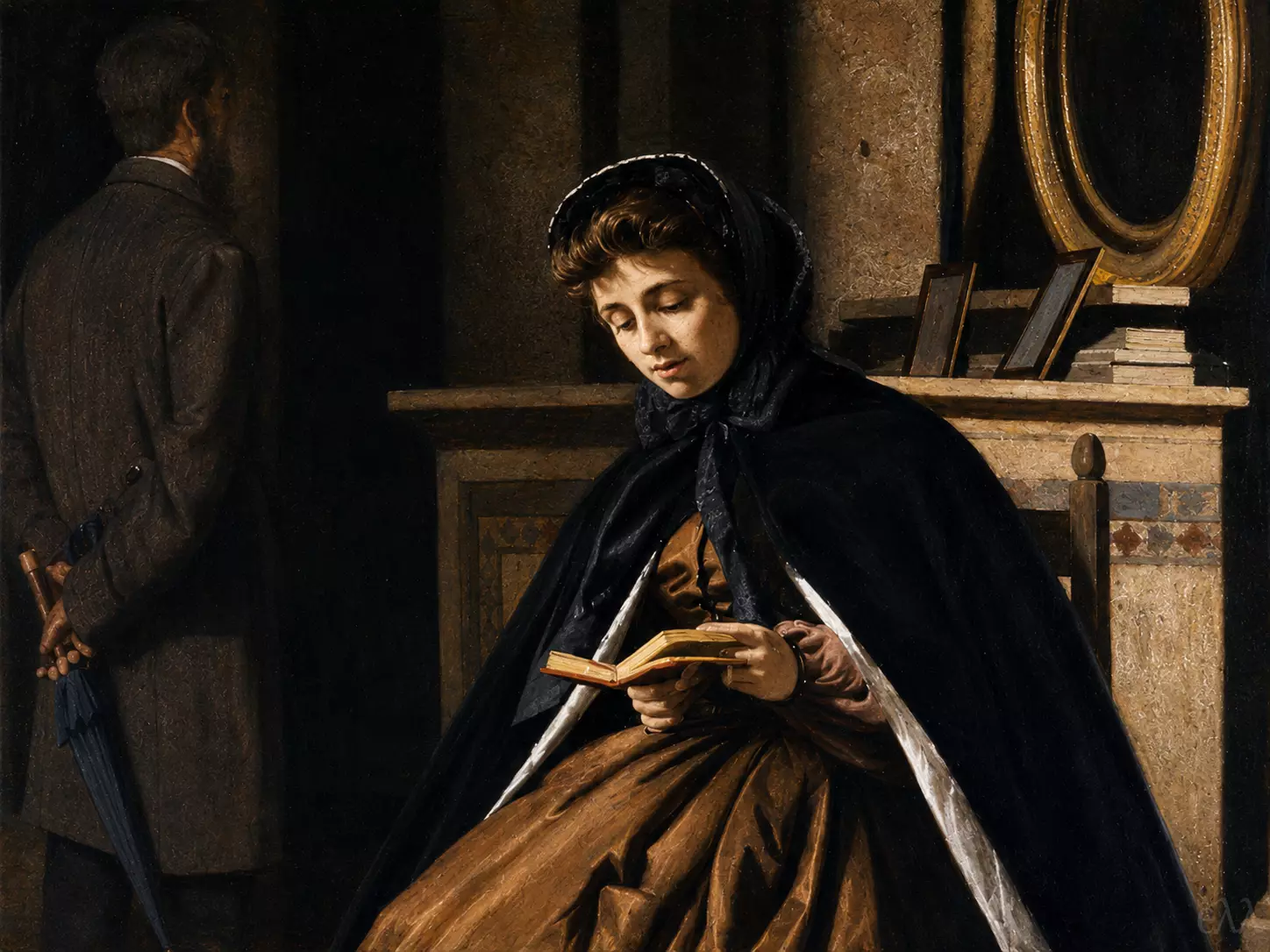
Seen more closely, Teresa’s concentration is conveyed through very small adjustments rather than expressive exaggeration. Framed by the dark hood, the head bends forward and slightly to one side. Her eyelids are lowered. Light catches the upper forehead, runs down the bridge and side of the nose, then softens across the cheek before disappearing beneath the face. The expression is introspective, yet Abbati avoids turning it into a theatrical display of piety. Nothing in the features appears strained.
The hands occupy a narrow illuminated zone immediately below. They meet around the small open book, whose warm reddish-orange edge becomes one of the strongest colour accents in the painting. Because the surrounding cloak and bodice are dark, the hands and pages form a compact secondary focus. Face above, book below: the two are joined by the direction of the gaze.
This detail also clarifies Abbati’s control of visual hierarchy. The white satin lining — broad and assertive across the complete composition — narrows as it approaches the upper body, directing attention inward. Brown fabric, dark cloak, illuminated hand, book, face—the eye crosses these successive fields almost without noticing the mechanism. No emphatic outline is needed.
The portrait-like specificity of Teresa’s features coexists with the more general theme announced by the title. She is recognisable as an individual, yet Abbati does not stage her as a formal sitter presenting herself to the spectator. Her gaze remains entirely occupied by the act before her. In another context the same clothes and physiognomy could construct a portrait; within Discours solennel, their function changes. The individual is present, but self-presentation has disappeared.
This perhaps explains the painting’s unusual balance between genre painting and portraiture. Its material world is exact and contemporary, the model identifiable, the action modest. At the same time Abbati makes the physical arrangement of light carry an emotional weight that the figure herself never states openly. The silence of the scene is constructed visually: shadow held back from the face, folds arrested across the lap, hands remaining close together over the book, another person present yet remote.
Nothing needs to happen next. The painting preserves the duration of concentration itself.
(La traduction a été révisée par M. Taylor.)