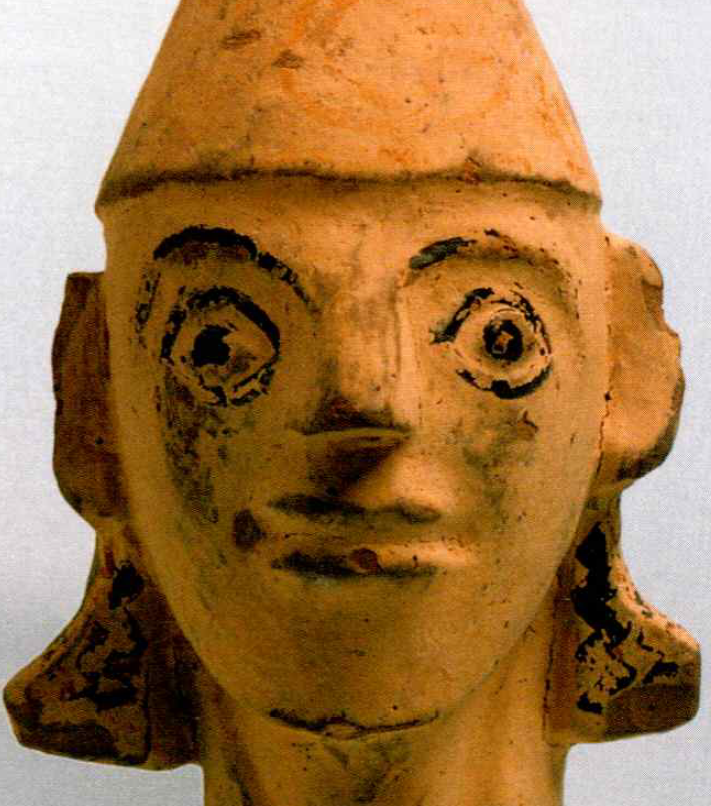
Terracotta head from a temple in Amyklai near Sparta, depicting a warrior with a conical helmet. Circa 700 BC. Height 11 cm. (Athens).
The Geometric Period (900-700 BC) marks a pivotal moment in the evolution of ancient Greek art, characterized by a rich variety of artistic expressions and styles. This transitional era saw the artisans of ancient Greece creatively respond to external influences, particularly from the Near East, while simultaneously preserving and developing their own artistic traditions. The geometric style extended well beyond vase painting, appearing in a multitude of objects made from various materials. The findings from this period primarily come from grave goods from burial monuments and offerings in sanctuaries, both in pan-Hellenic religious centers like Delphi and Olympia, as well as in local worship sites. The examination of objects from this period reveals a gradual transition from strictly geometric forms to more naturalistic representations, while also showcasing the assimilation and transformation of foreign influences by Greek artists. This specific period laid the groundwork for the later development of Greek art, which would reach its peak during the classical era.
Diversity of Forms and Materials in Geometric Art
Geometric Vase Painting as a Primary Expression
Geometric vase painting is the most characteristic expression of the Geometric Period, featuring strictly organized decorative patterns and the gradual introduction of human and animal forms. The vessels from this period are distinguished by the precision of their designs and the rhythmic distribution of decorative space. The evolution of geometric vase painting reflects the trajectory of the entire period, starting from simple geometric shapes and culminating in more complex compositions with narrative character.
Metalwork and Jewelry with Geometric Patterns
The artistic expression of the geometric era is equally evident in metalwork and jewelry. Notable examples include flat brooches and safety pins, which bear engraved decorative designs similar to those found on vases. Particularly significant are the gold bands discovered in burial assemblages, which feature simpler geometric patterns. The artisans of the time demonstrated remarkable skill in metalworking, combining the art of metalwork with the aesthetic principles of the geometric period.
Terracotta Figurines and Their Artistic Significance
The terracotta figurines of the geometric period exhibit a remarkable variety of forms and styles. Beyond the simpler examples that show limited evolutionary progress, we encounter more complex creations, such as the bell-shaped figurines from Boeotia, which featured decorations similar to those on vases. Of particular interest are the more elaborate works, where the characteristics of the forms are rendered with paint, while the heads are shaped with geometric precision and detail that surpasses that of bronze figurines. The ceramic production of these figurines highlights the evolution of geometric art beyond vase painting.
The Revival of Seal Engraving in Greece
The re-emergence of seal engraving in Greece during the geometric period is another indication of influence from the Near East. Seals from the 9th century BC made of ivory and from the 8th century BC made of stone have been discovered, primarily produced on the islands. These are simple square tools with purely geometric designs, which, despite their eastern origin, maintain a Greek character. A notable detail in some stone seals is the depiction of mythological scenes, such as battles between centaurs and archers, indicating the beginning of narrative art.
Bronze Figurines and Their Style
The bronze figurines of the geometric period, rarely taller than ten centimeters, represent a significant category of artistic expression. They include stylized forms of horses and deer, which show similarities to flat hammered figurines, from which they likely evolved. Their small scale and abstract representation of forms reflect the aesthetic values of geometric art. It is worth noting that the construction technique and the degree of stylization of the bronze figurines demonstrate careful observation and abstract rendering of natural forms, characteristic elements of the geometric perception.
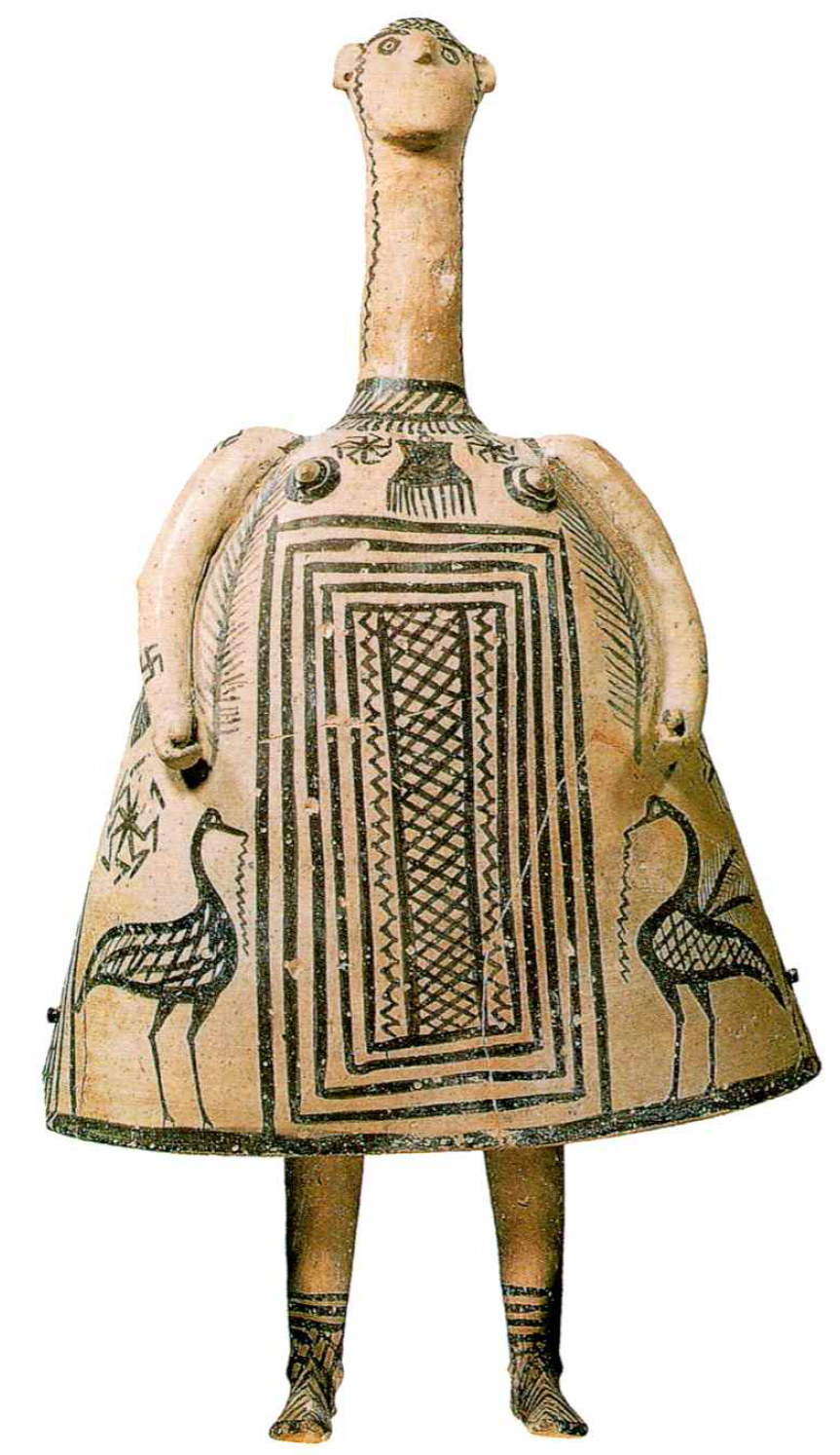
Terracotta female form from Boeotia with suspended legs within a bell-shaped structure and decorations similar to geometric vases. Circa 700 BC. Height 39.5 cm. (Louvre).
Eastern Influences and Greek Artistic Assimilation
Channels of Eastern Influence Transmission
The geometric period is characterized by a remarkable dialectical relationship with the cultures of the Near East, a relationship that significantly shaped the evolution of Greek art. The trade networks connecting Greece with Syria, Phoenicia, and Egypt served as the main channels for the transmission of artistic standards and techniques. Particularly influential were the ports of the Aegean islands and Crete, which acted as intermediaries in this cultural exchange. Greek merchants and sailors brought not only material goods but also artistic ideas, while wandering artisans from the East contributed to the dissemination of new techniques and patterns. It is noteworthy that this cultural interaction was not one-sided, as elements of Greek art also traveled eastward, creating a complex network of mutual influences.
Symbolism and Iconography from the Near East
The influence of the Near East on Greek geometric art is strongly manifested in the realm of symbolism and iconography. Mythical entities with hybrid characteristics, such as sphinxes and griffins, were introduced into the Greek iconographic vocabulary from Mesopotamia and Egypt. At the same time, complex decorative motifs such as the tree of life and the sacred lotus appear in Greek artifacts of the period. However, Greek artists did not limit themselves to mere imitation of Eastern models. Instead, they selectively incorporated elements into their own aesthetic framework, transforming them according to the principles of geometric art. This process of cultural assimilation reflects the exceptional ability of the Greeks to creatively absorb foreign influences while maintaining their own artistic identity.
Creative Adaptation of Foreign Elements
The manner in which Greek artisans adapted Eastern elements to their own artistic idiom is perhaps the most remarkable feature of this period. Geometric art was not merely a recipient of foreign influences but a dynamic field of artistic transformation. Eastern representations, when incorporated into Greek art, acquired characteristics of geometric aesthetics – outlines became clearer, proportions adjusted to Greek standards, and compositions followed principles of symmetry and harmonious spatial organization. This creative process gradually led to the development of a distinct Greek style that, while acknowledging external influences, maintained its own artistic personality. The ability of the Greeks to synthesize different cultural elements into a cohesive aesthetic whole was a decisive factor in the subsequent development of archaic and classical art.
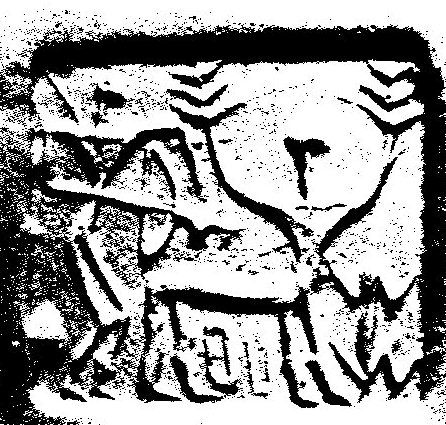
Detail of a geometric stone seal depicting a battle scene between a centaur and an archer, possibly Heracles
Transition to Archaic Art
Gradual Introduction of Plant and Animal Motifs
The later phase of the geometric period is characterized by the gradual introduction of plant and animal motifs, marking the beginning of the transition to archaic art. This evolutionary process reflects a deeper change in the aesthetic perception of Greek artists, as the strictly geometric vocabulary is enriched with more organic forms. Plant motifs, such as the lotus, palm, and anthemion, initially appear as secondary decorative elements combined with traditional geometric shapes. Gradually, however, they gain greater significance in the overall composition, indicating a shift towards an Orientalizing style. Animal forms, on the other hand, evolve from the stylized silhouettes of the geometric period to more naturalistic representations, with increasing attention to anatomical details and dynamic movement.
From Geometric Abstraction to Naturalism
The transition from geometric abstraction to naturalism represents one of the most significant developments in the history of Greek art. During this transitional period, artists began to gradually abandon strict geometric stylization in favor of a more realistic rendering of forms. This evolution is particularly evident in the representation of the human figure, where the schematic rendering of the geometric period gradually gives way to more naturalistic representations. Human figures acquire greater volume, proportionality, and expressiveness, reflecting a deeper understanding of anatomy and an increasing desire for realistic depiction. This gradual transformation of technique lays the foundations for the full development of archaic art, characterized by the distinctive smiles of kouroi and korai.
The Development of Narrative Art
A defining development that marks the end of the geometric period is the emergence of narrative art. While early geometric representations were primarily limited to isolated, static figures, the later geometric period introduces more complex scenes with narrative character. Mythological episodes, battles, funerary rituals, and other social activities begin to be depicted, reflecting an increasing desire for visual storytelling. The study of family tombs and their grave goods has revealed the growing trend for narrative representations in everyday objects. This development foreshadows the extensive mythological iconography that will characterize archaic and classical vase painting, while also reflecting the emerging significance of mythology and epic poetry in Greek society.
Technical Innovations and Their Importance
The technical innovations that emerged during this transitional period play a crucial role in the evolution of Greek art. In vase painting, the outline technique begins to be complemented by the silhouette technique, allowing for greater expressiveness and plasticity. In metalwork, new casting and forging methods are developed, expanding the expressive possibilities for artists. Stone carving begins to revive, heralding the monumental sculpture of the archaic period. These technical innovations are not merely methodological advancements but reflect a deeper change in artistic perception, as Greek artisans seek new ways of expression that transcend the limitations of geometric tradition.
The Contribution of the Islands to the Exchange of Artistic Ideas
The Aegean islands, particularly Euboea, Naxos, Paros, and Rhodes, played a crucial role in the transition from geometric to archaic art. Due to their strategic position on trade routes between East and West, these islands served as crossroads for cultural exchanges. Local workshops developed distinctive styles that combined elements of the geometric tradition with Eastern influences, creating hybrid styles that foreshadowed the Orientalizing phase of archaic art. Island artisans, exposed to different artistic traditions, were particularly receptive to innovations and experimentation, significantly contributing to the formation of new aesthetic standards that would dominate the forthcoming archaic period.
The geometric period was a critical milestone in the evolution of ancient Greek art, marking the transition from the dark ages to the archaic era. It is a time when the strict geometric vocabulary meets Eastern influences, creating a fertile ground for artistic expression and experimentation. The craftsmanship of Greek artisans was not limited to mere imitation of foreign models but demonstrated remarkable ability for creative assimilation and transformation, laying the foundations for the magnificent achievements that would follow. The study of geometric art allows us to understand the origins of the Greek artistic temperament and appreciate its enduring significance in shaping Western civilization.
Frequently Asked Questions
What are the chronological boundaries of the geometric period in ancient Greek art?
The geometric period is chronologically placed between approximately 900 and 700 BC. It is typically divided into three phases: Early Geometric (900-850 BC), Middle Geometric (850-760 BC), and Late Geometric (760-700 BC). Each phase is characterized by a different degree of complexity in decorative patterns and the rendering of forms, with the last phase serving as a transitional stage toward archaic art.
How did Eastern influences affect the formation of geometric style?
The influences from the Near East played a crucial role in the evolution of geometric art, enriching the artistic vocabulary of Greek artisans. New decorative patterns, construction techniques, and iconographic themes were introduced through trade contacts. However, Greek style did not simply replicate Eastern models but creatively adapted them to its own aesthetic, combining external elements with geometric tradition.

What materials and techniques did artists of the geometric era use?
Artisans of the geometric period utilized various materials in their creations. Clay was the primary medium for making vessels and figurines, while copper, gold, ivory, and stone were also used. Techniques included pottery, metalwork, seal engraving, and wood carving. The use of black-figure painting in vase decoration was particularly significant, allowing for the creation of strong contrasts between the dark decoration and the light background.
Why is geometric art considered an important stage in the evolution of ancient Greek artistic tradition?
The artistic production of the geometric era represents the bridge between prehistoric and historical Greek art. During this period, the foundations were laid for the aesthetic principles that would characterize Greek art in the following centuries: an emphasis on order, symmetry, and harmony. At the same time, the narrative dimension of art and its connection to myth emerged, elements that would further evolve in the archaic and classical periods.
How did the depiction of the human form evolve during the geometric period?
The representation of the human figure in geometric art shows remarkable evolution. In the early phase, human forms were almost entirely absent from the artistic vocabulary. In the middle and late geometric periods, stylized human figures with triangular torsos, slender waists, and geometric features appear. Towards the end of the period, a gradual transition to more naturalistic renderings is observed, with greater attention to anatomical details and movement.
What are the main centers of geometric art production in Greece?
The most significant artistic centers of the geometric period include Athens, renowned for the monumental vases of the Dipylon, Corinth with its finely crafted vessels, Euboea known for its metal creations, and the Aegean islands that served as crossroads of cultural influences. Each region developed local variations of the geometric style, contributing to the rich diversity of Greek art during this period.
Bibliography
-
Labbé, P., Tirocinium linguae graecae primogenias voces sive radices, 1693.
-
Ars Orientalis: The Arts of Islam and the East, vols. 26–27 (1996), σ. 13.
-
Thierry, J., Méthode graphique et géométrique appliquée aux arts du dessin, 1833.
-
Rossi, F., Ceramica geometrica daunia nella Collezione Macrini Ceci, 1979.
-
Μενδώνη, Λ.Γ., Αρχαιολογικός άτλας του Αιγαίου: από την προϊστορία έως την ύστερη αρχαιότητα, 1998.
-
Xénaki-Sakellariou, A., Οι Θαλαμωτοί Τάφοι των Μυκηνών: Ανασκαφής Χρ. Τσούντα, 1985.
-
Rankavēs, A.R., Αρχαιολογία: ιστορία της αρχαίας καλλιτεχνίας, 1865.


