
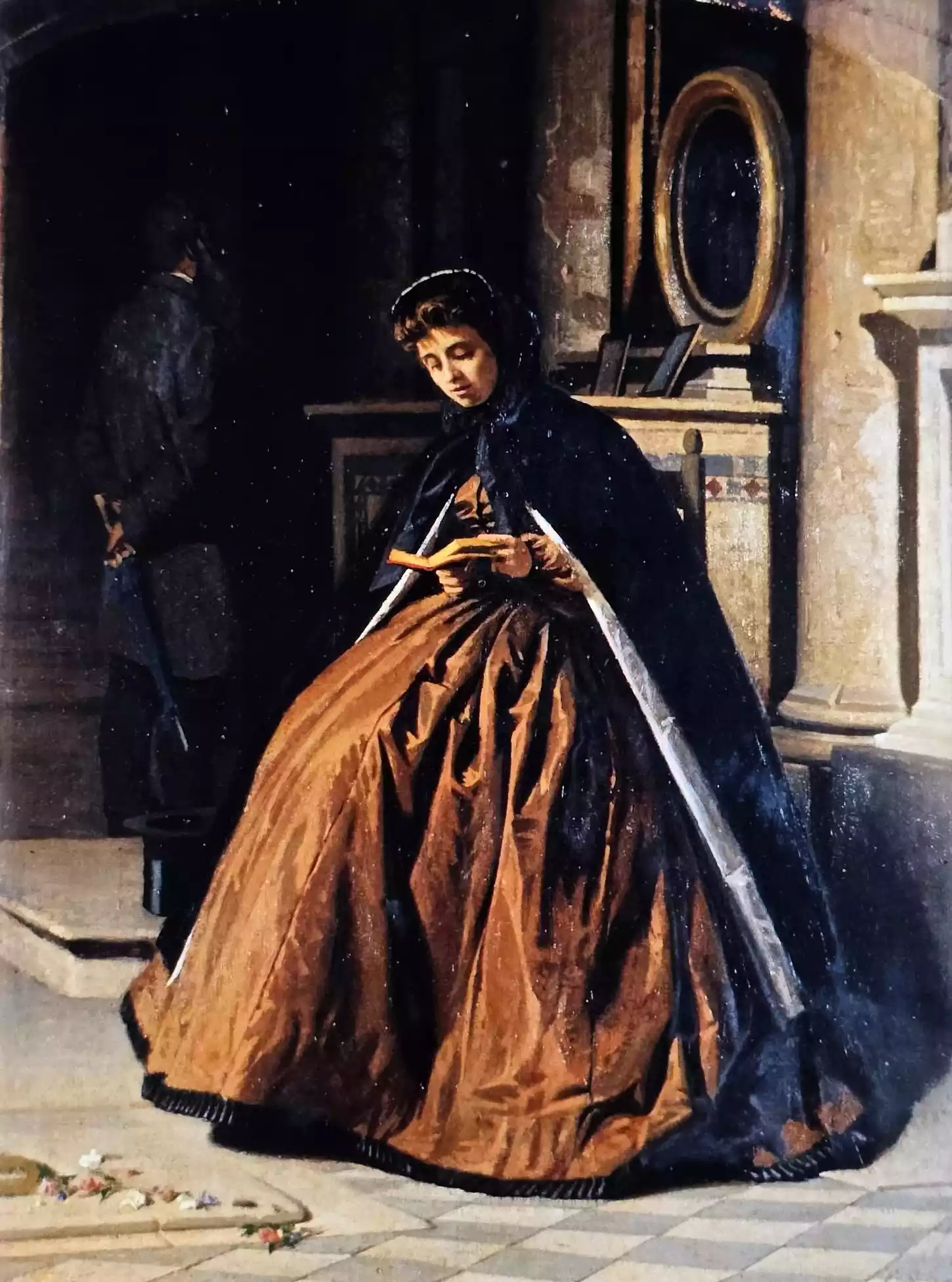
“The Prayer” (Oration, 1866) by Giuseppe Abbati. This piece, displayed at the Palazzo Pitti, is a prime example of the Macchiaioli style.
Often, our aim is to focus on the elements illuminated by light, transcending the light itself. However, in this painting created by Giuseppe Abbati in 1866, something different occurs. The work, titled “The Prayer” (or Oration), is an oil on canvas (fifty-seven by forty-two centimeters) currently housed in the Gallery of Modern Art at the Palazzo Pitti in Florence. Its true subject is tranquility, and the light that shapes this tranquility goes beyond merely depicting a woman seated in a sacred space. The woman is engrossed in a book, possibly prayers, with her head bowed. Her attire—a large gray robe and a black cloak—appears heavy, as she sits almost like a statue. In the darkness behind her stands an indistinct man. Everything is enveloped in silence, except for a beam of light from the right, which reveals the woman’s skin, the folds of her dress, and that small book. The nature of this book should be considered as a handcrafted object—an historical artifact—transcending its simple view as a religious symbol.
Analyzing the Scene: Light and Shadow
Light as an Active Element
The light here is natural, surpassing the divine or mystical quality one might find in Caravaggio’s work. It is harsh, natural light, possibly streaming in from a high window. Abbati, as a member of the Macchiaioli, engages with visual forms, moving beyond discussions of souls. This light creates the objects. The right side of the woman’s face is illuminated, while the left is cast in deep shadow—and this division, this cross-section, is the focal point of the painting. The book held in her hands appears almost white, reflecting against the black cloak, and this light exists for us to see the surface of the page, transcending the need to read the letters. This reading is an internal act, while painting is an external one. This light only indicates the external surface.
The Ambiguity of Shadow
And then there is the shadow. What is that man in the background doing? This question is often asked. To me, it seems he is doing nothing. He simply stands there. The painter used him as a contrast to the radiant figure of the woman, as a living shadow, to measure the depth of the space. The scene focuses on something beyond drama, avoiding the pursuit of a love story or danger. Abbati painted moments of light, transcending mere storytelling. This man is part of the architecture of the sacred space, like the column on the right, like the dark corner. His presence is heavy yet indifferent. Perhaps this indifference is the most terrifying aspect of all.

And what about the woman? The posture of her body, the weight of her dress—this gray fabric, which Abbati painted with such care in its folds—seems almost to trap her, like a heavy bronze shell, and the black cloak separates her from her surroundings, except for that brilliant line of the white lining or undergarment. All of this relates to weight. The weight of her clothing, the weight of silence, the weight of reading within the sacred space. Reading, of course, can be an escape, but here it is an act of concentration, almost laborious. The book is small, and her hands press it firmly.
Down by her feet, on the floor, we see a few scattered flowers. Remnants of a celebration? Or symbols of decay? It’s hard to say. Abbati rarely makes symbols clear. These flowers are merely color on the cold floor. Nothing more.


