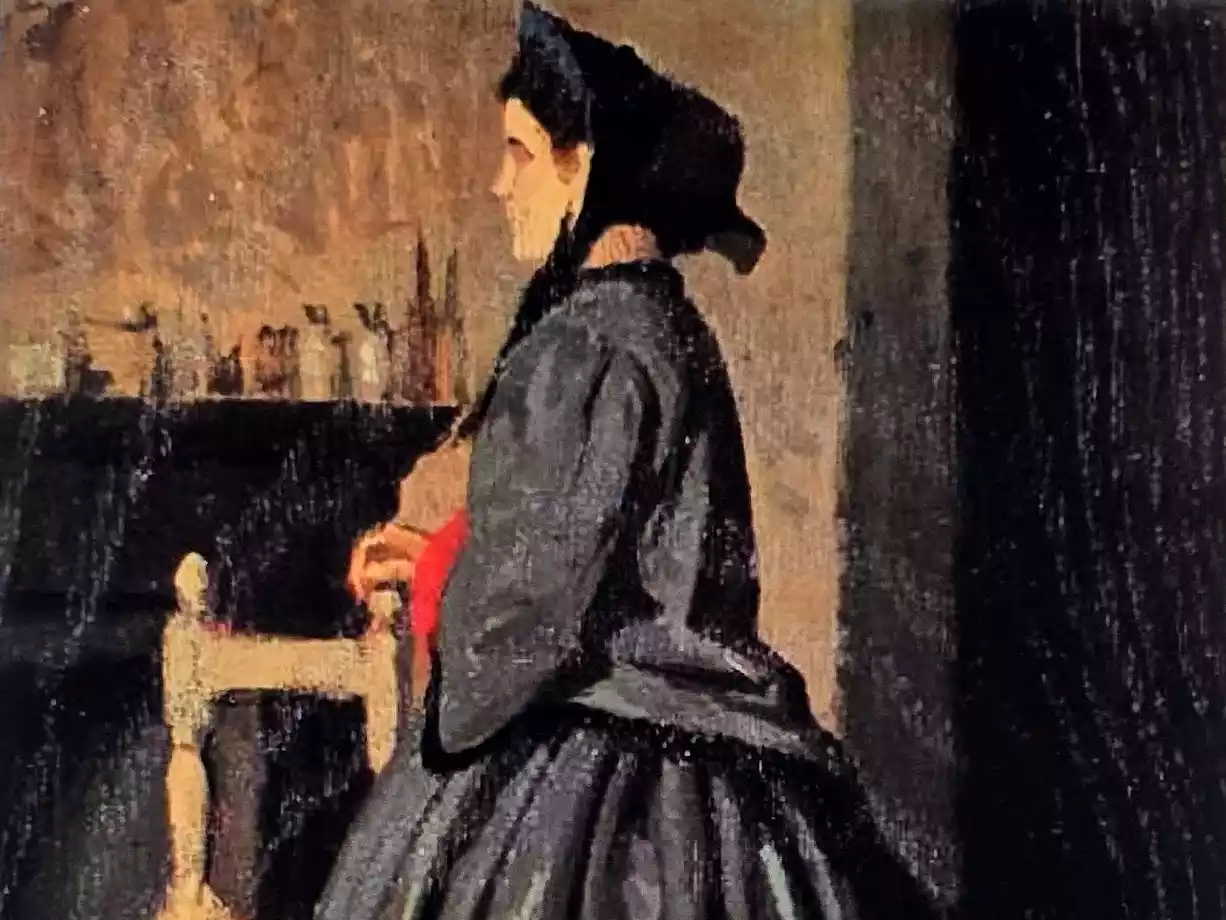
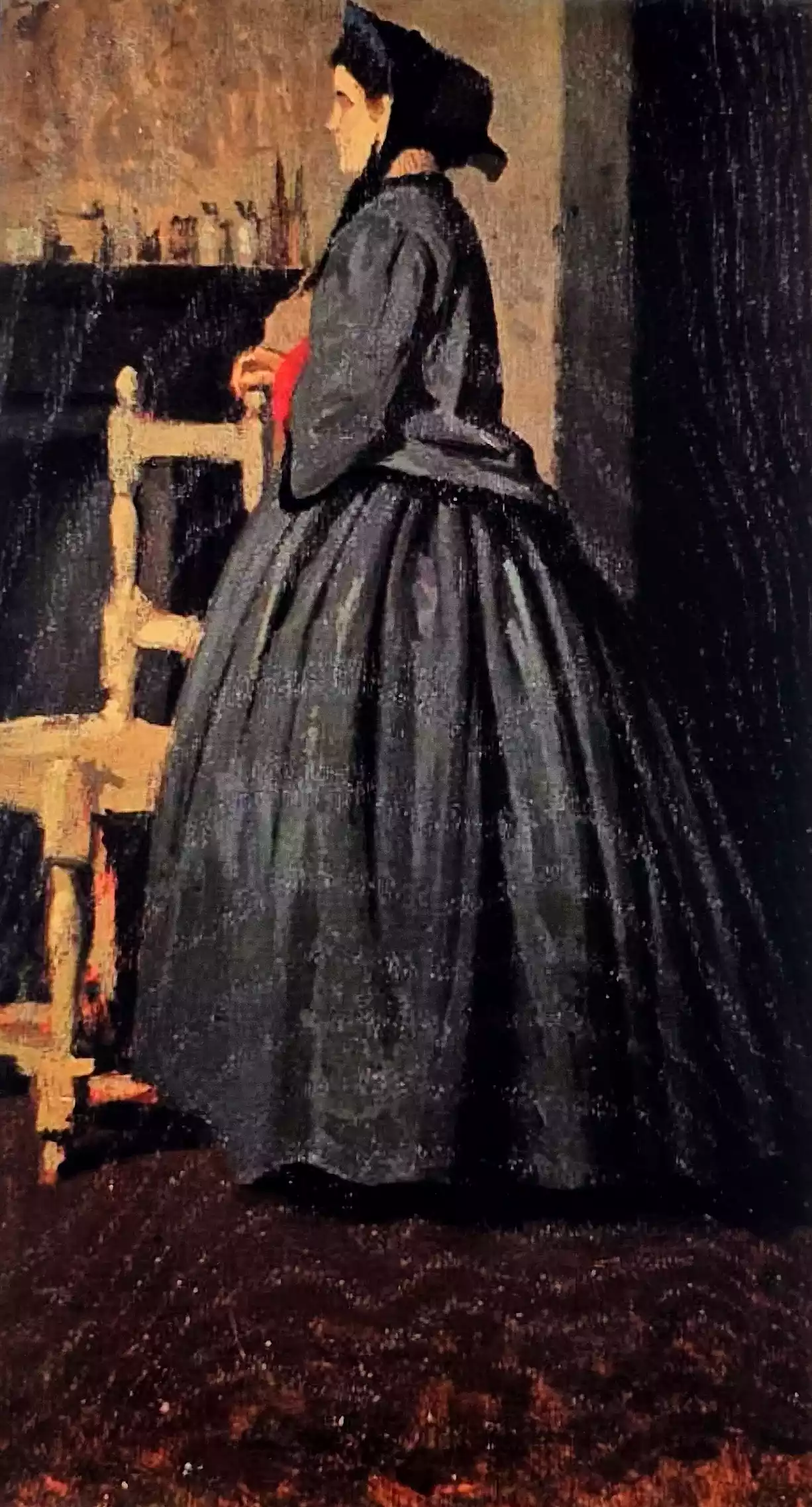
“Portrait of a Woman” (1865-66) by Giuseppe Abbati. The painting, displayed at the Palazzo Pitti, is a notable example of the Macchiaioli movement.
This painting, created by Giuseppe Abbati—oil on wood panel, as they say—can be found in Florence, at the Palazzo Pitti. It was likely painted between the years 1865 and 1866. A woman stands, gazing to the left. Often, we encounter such works and assume the artist is merely in pursuit of beauty. However, it seems to me that this piece focuses, beyond beauty, primarily on… how should I put it… the necessity of form. It serves as a testament, much like an ancient manuscript or a shell that has been discovered, a testament to the laws that governed women’s lives at that time. The black garment. The posture. The silence. These elements tell a story that transcends mere art.
The Dominance of the Black Garment: A Symbol of Virtue?
Is this woman in mourning? Or was it customary for all bourgeois women to dress this way every day? Her attire occupies nearly half of the canvas, and Abbati rendered it heavily, almost solid, resembling a statue made of black stone, surpassing the sensation of a delicate or light fabric. Light does not penetrate it. The men of that era, known as the Macchiaioli, sought the truth of the moment—the “stain” (macchia) of light and shadow. Yet here, the stain becomes a prison. The head appears small, while the body looms large beneath the fabric, as if concealed. That red object she holds, a small color, perhaps a book or a piece of cloth. It makes little difference. Black prevails.

The Chair and Domestic Objects
Next to her stands a chair. A simple wooden chair. The woman remains upright beside it. This chair, with its pale color, contrasts sharply with the deep black of her dress, and this contrast… perhaps signifies the difference between public persona and private life. The chair is a humble, practical household item, while the woman, in her gown, resembles a public monument standing within the home. In the background, a few small utensils rest on a hearth. The tools of domesticity. Yet the woman does not gaze towards them. Her eyes are directed elsewhere.