
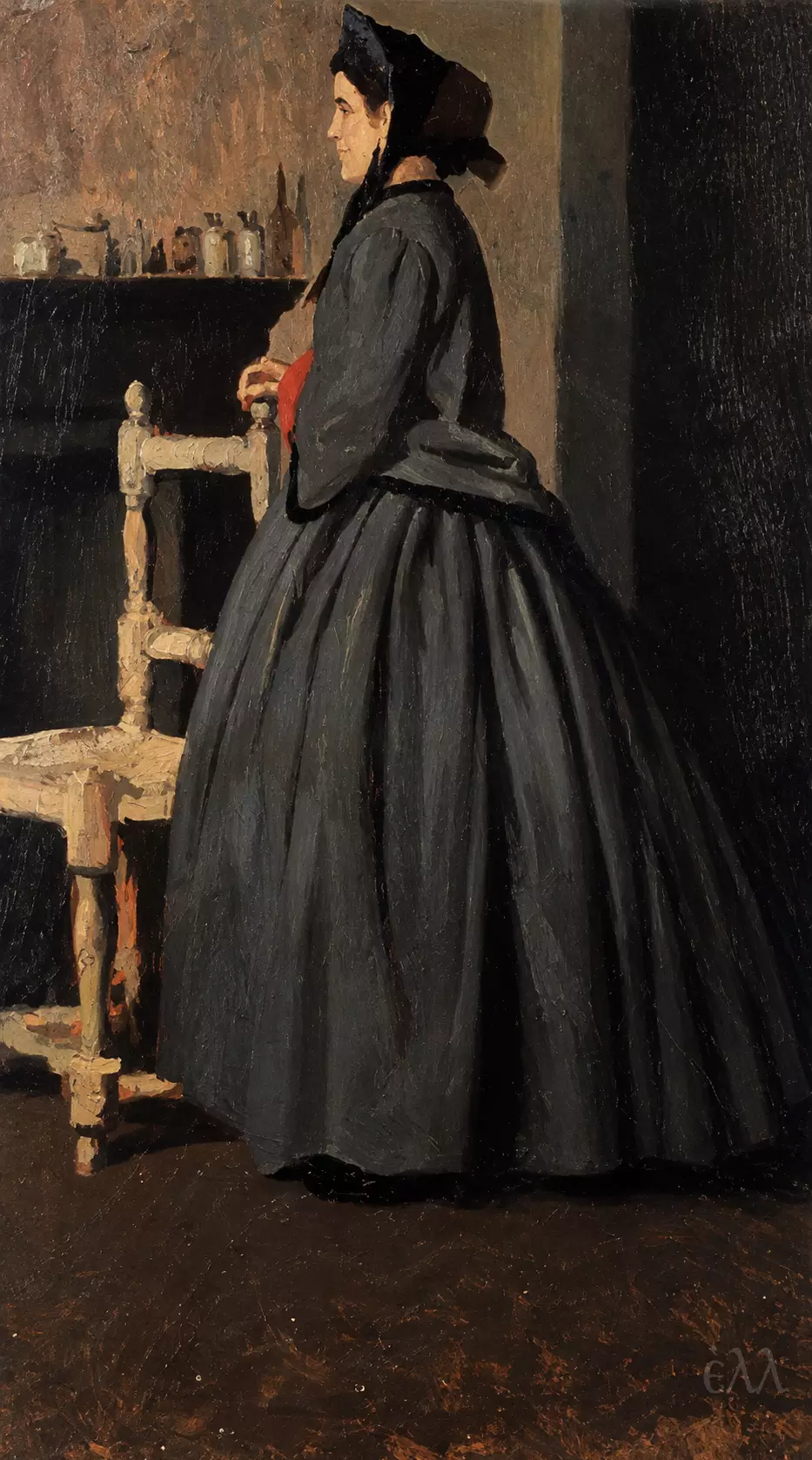
Against a wall of ochre plaster, roughly textured and unevenly lit, a woman stands in strict profile, one hand resting along the top rail of a straw-seated chair. The painting is Giuseppe Abbati’s Portrait of a Woman, executed in oil on a small wooden panel measuring only twenty-six by fourteen centimetres and dated to 1865–66, the years in which Abbati worked closely with the circle of Florentine painters known as the Macchiaioli. It now belongs to the Galleria d’Arte Moderna at the Palazzo Pitti, a museum built substantially around the achievements of that generation of Tuscan Realists.
The narrow, elongated format of the panel suits its subject. The sitter, dressed in a dark grey-blue gown with the full, bell-shaped skirt characteristic of the eighteen-sixties, wears a short jacket edged in black velvet; beneath it, at the waist, a small passage of red — perhaps a ribbon, perhaps the visible edge of an inner bodice — interrupts the otherwise sombre palette of her dress. A dark bonnet, tied beneath the chin, frames a face turned fully to one side, the hair drawn back smoothly from a centre parting. She does not look toward the viewer. Her attention, insofar as the pose suggests any, remains fixed somewhere beyond the edge of the panel, and the effect is closer to a study of stance and silhouette than to a formal likeness meant to engage its audience directly.
Behind her, a pale rush-seated chair of provincial type — plain, ladder-backed, its wood left unstained — stands at an angle that echoes the diagonal thrust of her skirt. Further back, a mantelpiece carries a row of small glass jars and stoppered bottles, arranged with the unglamorous regularity of household or studio objects rather than decorative ornament. The wall above is built up in warm, broken strokes of ochre and umber, while a dark vertical band to one side, most likely a doorway or a section of darkened panelling, closes the composition and throws the lit wall into sharper relief.
Colour and the Macchia: Reading the Surface
Abbati organises the panel through a small number of large tonal masses rather than through descriptive incident. The near-black expanse of the skirt, the pale ground of the wall, the warm neutral of the floor, and the pale wood of the chair are laid in as distinct fields of colour, their edges kept firm and their internal modelling kept minimal. This is the working method associated with the macchia — the patch or stain of unmodulated tone from which the Macchiaioli took their name — and it treats the picture surface as an arrangement of light and dark blocks whose contrasts, rather than any accumulation of fine detail, carry the composition. The brushwork on the wall is loose and visibly worked, built from short, overlapping touches; on the skirt it flattens into broader, more continuous passages, so that the garment reads first as a silhouette and only secondarily as fabric.
Giuseppe Abbati’s Portrait of a Woman and the Macchiaioli Circle
Giuseppe Abbati was born in Naples in 1836 and trained initially within an academic tradition before moving toward the more experimental painting culture then forming in Florence. He served in the Risorgimento campaigns and lost the sight of one eye at the Battle of Custoza in 1866 — a date that falls, notably, within the very period to which this panel is assigned. In Florence he associated with Telemaco Signorini, Giovanni Fattori, and the critic Diego Martelli, and became known above all for interiors: courtyards, cloisters, doorways, and domestic rooms studied for their play of architectural line and raking light. His career ended prematurely in 1868, when he died from rabies contracted from a dog bite, at the age of thirty-two.
The domestic, unglamorous character of Portrait of a Woman belongs squarely within this preoccupation. Rather than commissioning the sitter’s presence for a public or ceremonial function, Abbati appears to have treated her much as he treated an empty room or a shuttered courtyard — as an occasion for structuring tone, silhouette, and the geometry of a confined interior. The profile format removes any suggestion of psychological address; nothing in the sitter’s bearing solicits the viewer’s engagement. What remains is closer to a private, almost incidental observation of a figure caught within her own surroundings than to a portrait in the conventional, representational sense of the term.
In the Galleria d’Arte Moderna
The Galleria d’Arte Moderna at Palazzo Pitti holds one of the principal public collections of Macchiaioli painting, assembled largely from Tuscan holdings formed during and after the artists’ own lifetimes. Within that context, a panel of this modest scale sits comfortably alongside the small, densely worked studies through which Abbati and his contemporaries tested their ideas about tone and structure, works generally produced for private circulation among fellow painters and collectors rather than for exhibition on any grand scale. The intimacy of the format, no less than its handling, marks the panel as a characteristic product of that milieu.