
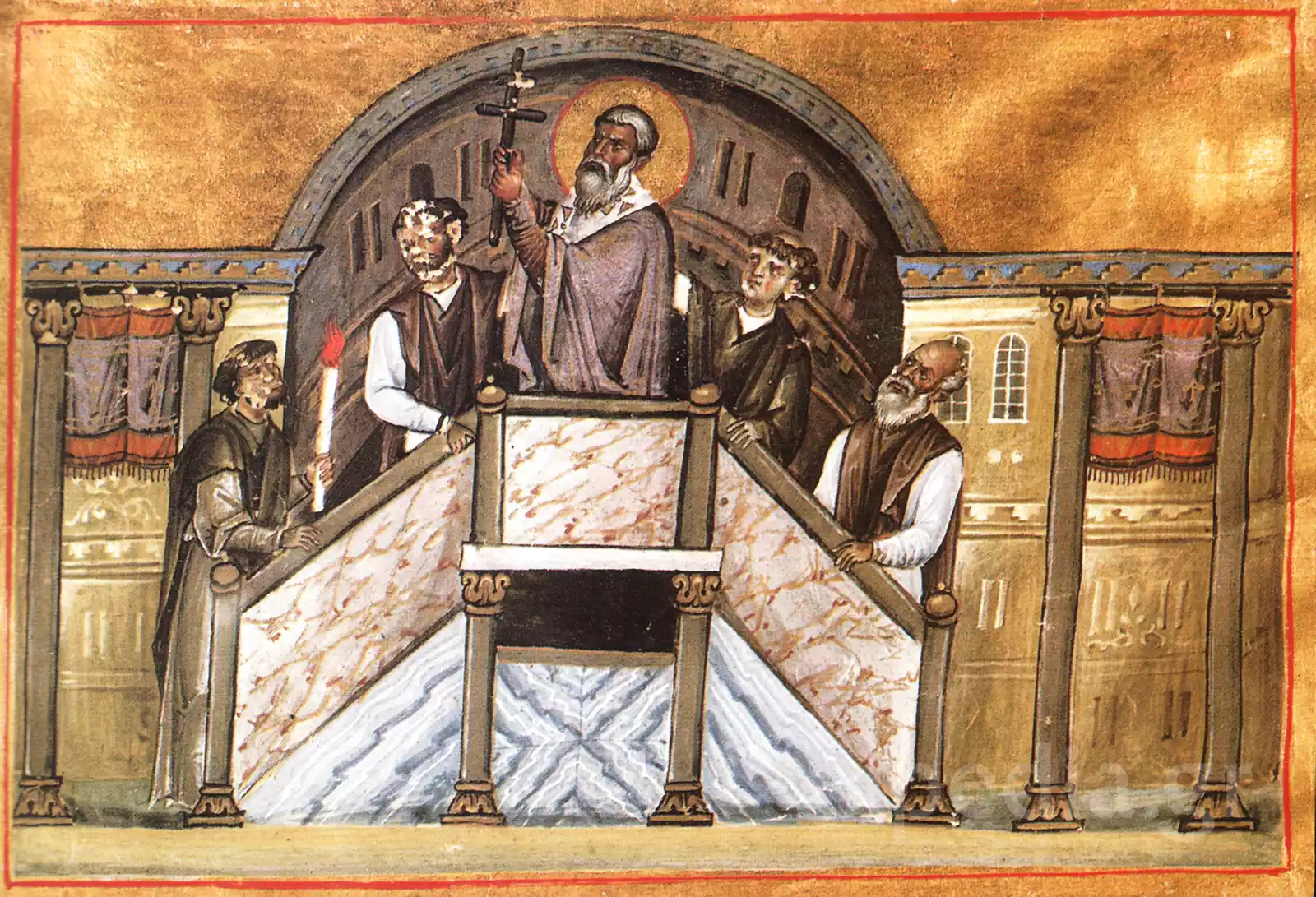
The Exaltation of the Holy Cross, a detailed miniature from the Menologion of Basil II, dating around 985.
A work of art encapsulates an entire era. We refer to the miniature of the Exaltation of the Holy Cross, a masterpiece created around 985 in Constantinople, currently housed in the Apostolic Library of the Vatican, and an integral part of the renowned Menologion of Basil II (Cod. Vat. Gr. 1613 f. 35). This scene, depicting a significant religious ceremony, transports us to the heart of Byzantine imperial ideology and the artistic production of the Macedonian dynasty. How did a 10th-century artist manage to convey such vibrancy and theatricality in portraying such an important event? The answer lies in the details of the composition, which, despite its small size, reveals a monumental understanding of space and human presence, characteristic of the finest illuminated manuscripts of the period (Kastrinakis). This work is not merely an image; it is a window into the soul of an empire.
Composition and Characters
The composition is rigorously structured. At the center, atop an imposing marble pulpit, stands the figure of the Patriarch, who raises an ornate cross with both hands, the focal point of the entire scene. This central figure, likely Patriarch Tryphon or Nicholas II of the Chrysoverges, is not just a person but the axis around which all action revolves, the spiritual and visual focal point guiding the viewer’s gaze through the architectural curves of the background depicting the interior of a church. The grandeur of the moment is almost palpable.
The Central Axis: The Patriarch and the Cross
The Patriarch, adorned in a precious, simple garment with a serious, bearded visage, gazes towards the heavens, lifting the cross in a gesture filled with reverence and strength. The cross itself, though small in size, is rendered with exceptional detail, signifying its value as a precious relic. His entire body posture, slightly turned to the right, imparts a sense of dynamism to the otherwise static structure of the image, transforming a ritual act into a vivid event unfolding before us. It is the moment of revelation.
The Participation of the Clergy and the People
The figures surrounding the central axis express intense emotions, ranging from awe and reverence to surprise, capturing the psychological impact of the event on the attendees (Cantone). To the left and right of the pulpit, clergy in white sticharia and dark chasubles participate in the action; one holds a candle, while others gaze at the cross with hands in a posture of supplication or admiration, their expressions uniquely rendered by the artist. This variety of reactions creates a theatrical atmosphere, as if we are witnessing a scene from ancient drama, where each character plays their own distinct role in the overall narrative. The human-centered approach is evident.
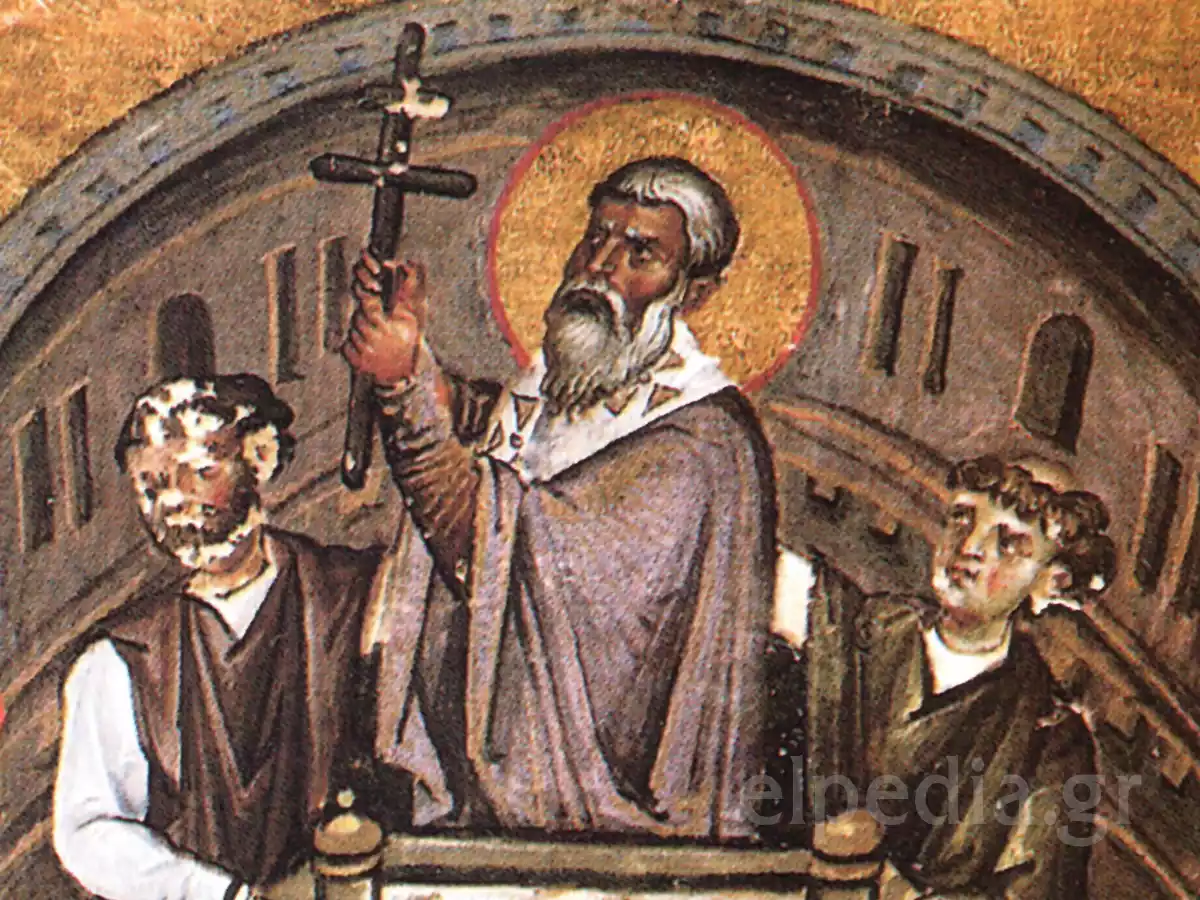
The expressions of admiration on the faces of the clergy testify to the artist’s skill in conveying emotions.
Artistic Identity and Symbolism of the Work
Who is behind this creation? Although the Menologion is a collective work, with at least eight different artists working under imperial guidance, this particular miniature reveals a hand with exceptional skill in theatricality and the depiction of architectural complexity, as noted in a related [suspicious link removed] regarding the artists of the work (Ševčenko). The Macedonian Renaissance is present. The classical heritage, emphasizing the plasticity of forms and the sense of depth, harmoniously coexists with Byzantine spirituality, creating an effect that is both realistic and transcendent, an artistic balance that characterizes the Byzantine poetry and art of the era of Basil II (Lauxtermann).
The Art of Basil II’s Miniatures
The use of color is masterful. The warm tones of the golden background contrast with the cooler colors of the garments and the marble pulpit, creating a visual tension that emphasizes the drama of the scene. The folds of the clothing are rendered with swift, nervous brushstrokes that give volume and movement to the figures, while the architecture of the temple in the background, though schematic, provides the necessary sense of space, situating the event in a specific, recognizable context. This technique not only showcases the artist’s ability but fundamentally serves the narrative.
The Symbolism of the Golden Background
The golden background is not merely a decorative element; it serves as a powerful symbol of divine light and eternity, isolating the scene from earthly time and space and imparting a transcendent dimension. Thus, the cross is not merely presented as a historical relic but transforms into a symbol of triumph and spiritual authority that radiates within the space, a theme extensively explored in Byzantine iconography and the significance of the Cross (Janocha). The work, therefore, becomes a visual sermon, a timeless declaration of the spiritual and worldly power of the Byzantine Empire, condensed into a small yet incredibly rich in meaning image.
Bibliography
Cantone, Valentina, ‘Emotions on Stage: The ‘Manly’ Woman Martyr in the Menologion of Basil II (Vat. Gr. 1613)’, in Emotions and Gender in Byzantine Culture (Cham: Springer, 2018).
Janocha, Michaił, ‘The Exaltation of the Cross in Byzantine Iconography (Podwyższenie Krzyża Świętego w ikonografii bizantyńskiej)’, Ikonotheka, 21 (2008).
Kastrinakis, Nikolaos, ‘The revival of the Byzantine tradition in 16th century illustrated manuscripts OF ORACLE WRITINGS’, Δελτίον της Χριστιανικής Αρχαιολογικής Εταιρείας, 33 (2012).
Lauxtermann, Marc, ‘Byzantine poetry and the paradox of Basil II’s reign’, in Byzantium in the Year 1000, ed. by Paul Magdalino (Leiden: Brill, 2003).
Van Tongeren, L. A. M., Exaltation of the Cross: Toward the Origins of the Feast of the Cross and the Meaning of the Cross in Early Medieval Liturgy (Leuven: Peeters Publishers, 2000).


