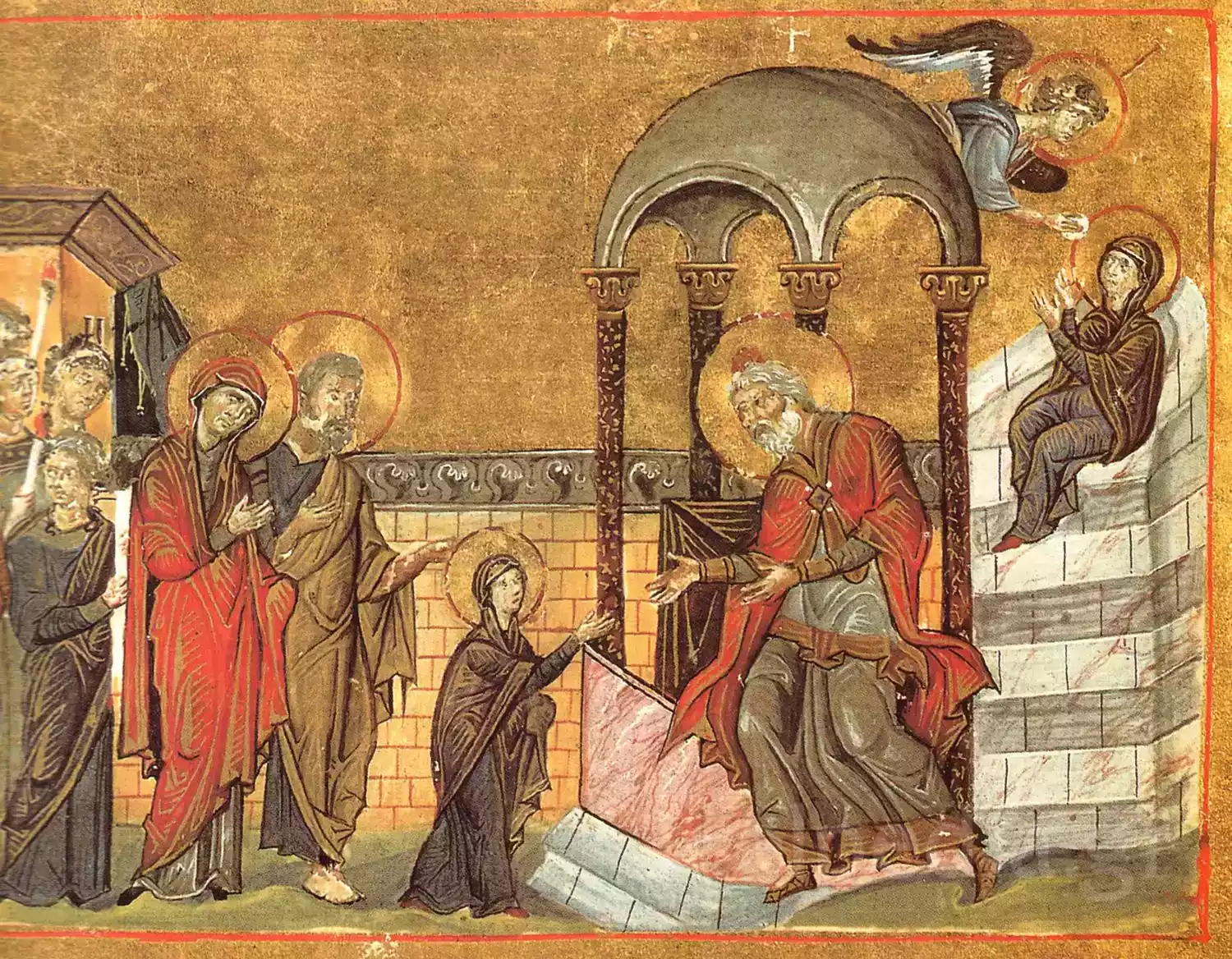
The Entry of the Theotokos into the Temple, a masterpiece miniature from the Menologion of Basil II (985 AD), preserved in the Vatican Library.
You stand before this small square of history. It is a miniature. Nothing more than color on parchment, yet… how much weight can matter bear? The gaze falls directly on the gold. Not on the face. On the golden background. It’s almost terrifying. It leaves you suspended. There is no horizon here, no escape for the viewer’s eye accustomed to the perspective of the West, to the illusion of three-dimensional space. Here, space is abolished. Or rather… it transforms into time.
We find ourselves around the year 985. In Constantinople. The Menologion of Basil II, this colossus of the Macedonian Renaissance preserved today in the Vatican Library (Vat. gr. 1613), is not just a book. It is a monument. And this particular depiction, the Entry of the Theotokos into the Temple, carries all the signs of an era desperately seeking balance between the classical and the spiritual. Between the body that suffers and the spirit that is saved.
You look at the composition. There is a disorder in its order. One would expect strict symmetry, but no… The painter –who knows which of the eight hands worked on the manuscript– breaks the monotony. The building looms large. It weighs heavily. Is it the institutional church? Is it the Law of the Old Testament? The walls seem impenetrable. And in front? A procession. Women. Many women. If you think about it, this Menologion is filled with them. About 60% of the depictions concern female martyr figures standing there, often with a masculine bravery, enigmatic. Yet here we do not have martyrs in the sense of blood. We have witnesses of light. They hold torches. Does the flame flicker? No. It is steady. Like faith that does not seek proof but experience.
You wonder while observing the work: Where does art end and theology begin? Or is this separation our own invention, a modern pathology that fragments the unity of life? The Byzantine craftsman had no such dilemmas. He painted while praying. Or perhaps, he painted to avoid being overwhelmed by awe. This image is a proposal for life. A proposal for a community of persons moving towards the center, towards the sacred.
Divine Architecture and Human Movement
The scene is organized in a way reminiscent of a theatrical stage, but without an audience. We are the intruders. We look through a keyhole of time. To the left, the building complex. It is not realistic, let’s not kid ourselves. No temple looked exactly like this. It is an ideogram of a temple. A dome –or perhaps a ciborium?– supported by columns. The classical education of the artist shouts here. You see the sense of proportion, the effort to convey the third dimension in the step, in the stair leading to the Holy of Holies. But then… the depth disappears.
The Young Mary and Zechariah
And at the center of attention, though not geometrically in the center, is the Virgin. A young girl of three. She is small. Very small compared to the imposing figure of the high priest Zechariah who welcomes her. Yet, look at her posture. There is no fear. There is no shyness one would expect from a child parting from her parents. There is a maturity that is unsettling. She wears the maphorion, the color of earth and blood, in contrast to the bright garments of the other virgins. It is as if she already carries both mourning and glory.
Zechariah bends down. This inclination of the body… Is it a gesture of humility? Or perhaps a gesture of affection? His hand extends to receive her. It is the moment when the Old Testament hands over the baton to the New. But let’s not dwell on symbolism. Let’s look at the line. The shaping of the priest’s form is robust. The folds in his garment follow a logic, a naturalistic flow reminiscent of Hellenistic models. There is a body beneath the garment. It is not an ethereal ghost. It is a man of flesh and blood experiencing the miracle.
And here precisely lies a “crack” in our logic. How can an art that seeks to speak of the heavenly insist so much on the material existence of things? Perhaps because salvation is not an escape from matter, but its transformation. The artist of Basil II knows this. He does not disdain the body. He glorifies it.
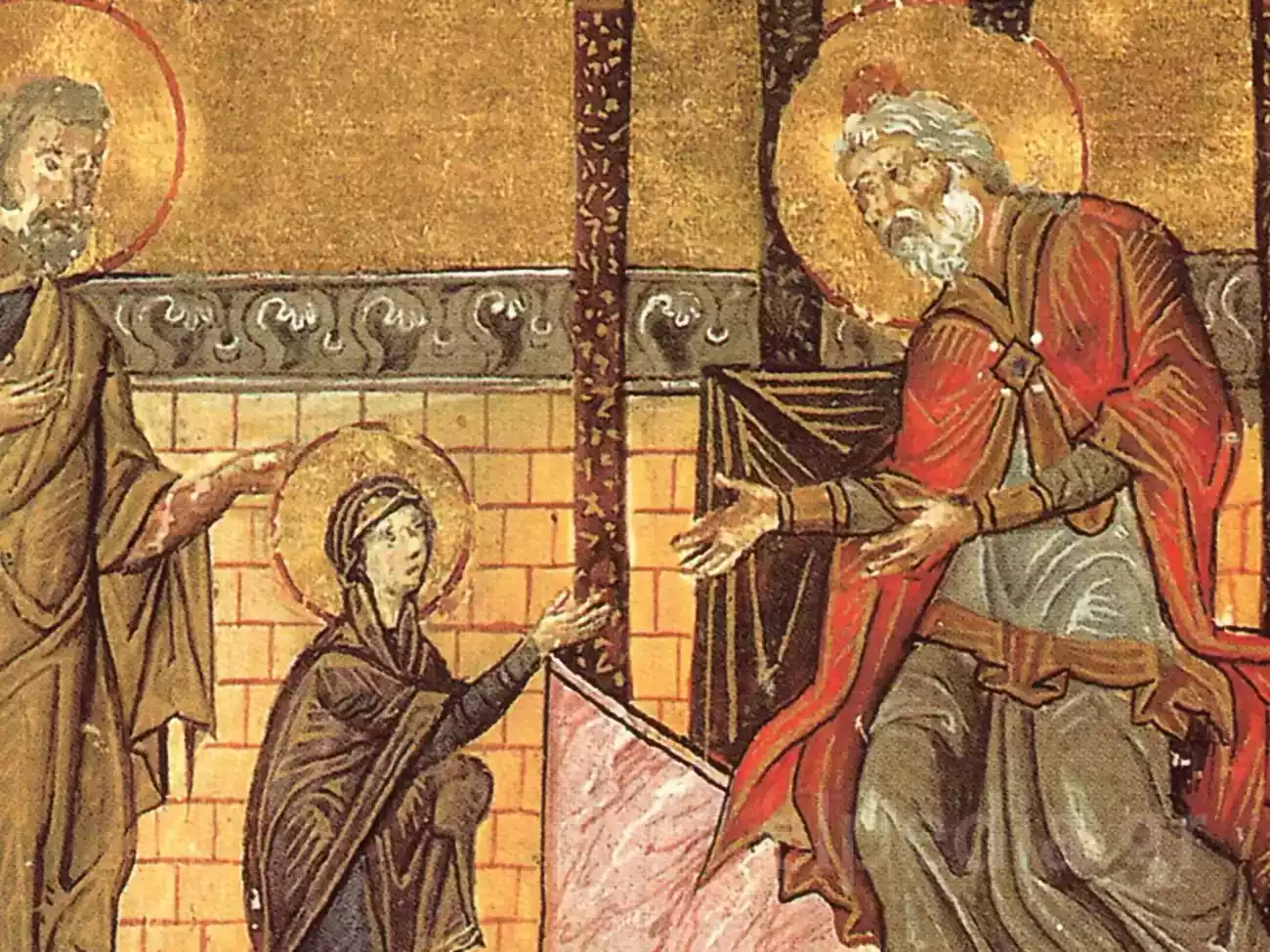
The three-year-old Mary stands maturely before Zechariah, in a scene from the Entry of the Theotokos that combines the divine with the human element.
The Procession of Torchbearers
Behind Mary, the young women. A group, a body. A community of persons once again. They are not isolated individuals, lost in their egos or private religiosity. They are a community. They hold their torches lit. This light does not illuminate the space –the space is already light due to the golden field– but it illuminates their faces.
Notice the variety in their postures. They are not motionless little soldiers. Some turn their heads, are they conversing? Perhaps. There is an immediacy, a liveliness that breaks the priestly stillness. Their garments are in vibrant colors –blue, red, green– creating a rhythm, a musicality to the eye. Like notes on a staff. This rhythm guides our gaze to the right, towards the entrance, gently pushing young Mary towards her destiny.
The technique here is unparalleled. The “painterly style” of the time, with soft transitions of tones, gives volume and breath. We do not have the harsh linearity of later periods. Here, the memory of ancient painting still exists. The faces have rosy cheeks. They are alive. They breathe. And you wonder… why have we lost this sense of liveliness today? Why has our religiosity often become so morose, so gray, while here, in the 10th century, it overflows with color and light? Perhaps it is our own internal misery that prevents us from seeing beauty?
The architecture in the background, behind the girls, a wall with openings, seems to protect them but also to confine them. It is the space of history. They move within it. But the golden background above… ah, that gold. It is eternity invading history. There is no ceiling. The temple is open above. The communication is vertical.
Ultimately, what do we see? A historical event? A visual exercise of high technique? Or perhaps the human anxiety to find one’s place within a design that transcends them? This miniature does not provide answers. It raises questions. It invites you to join the procession. To hold your own torch. Not as a spectator in a museum, but as a participant in a mystery that is happening now, as you look at the image. The art of the Menologion is not just to please the eye. It is to awaken. And perhaps, I say perhaps, this awakening is more necessary today than ever, in a world that has forgotten how to stand in awe before the sacred, whether it is God, or man, or simply a bit of color on old parchment.


