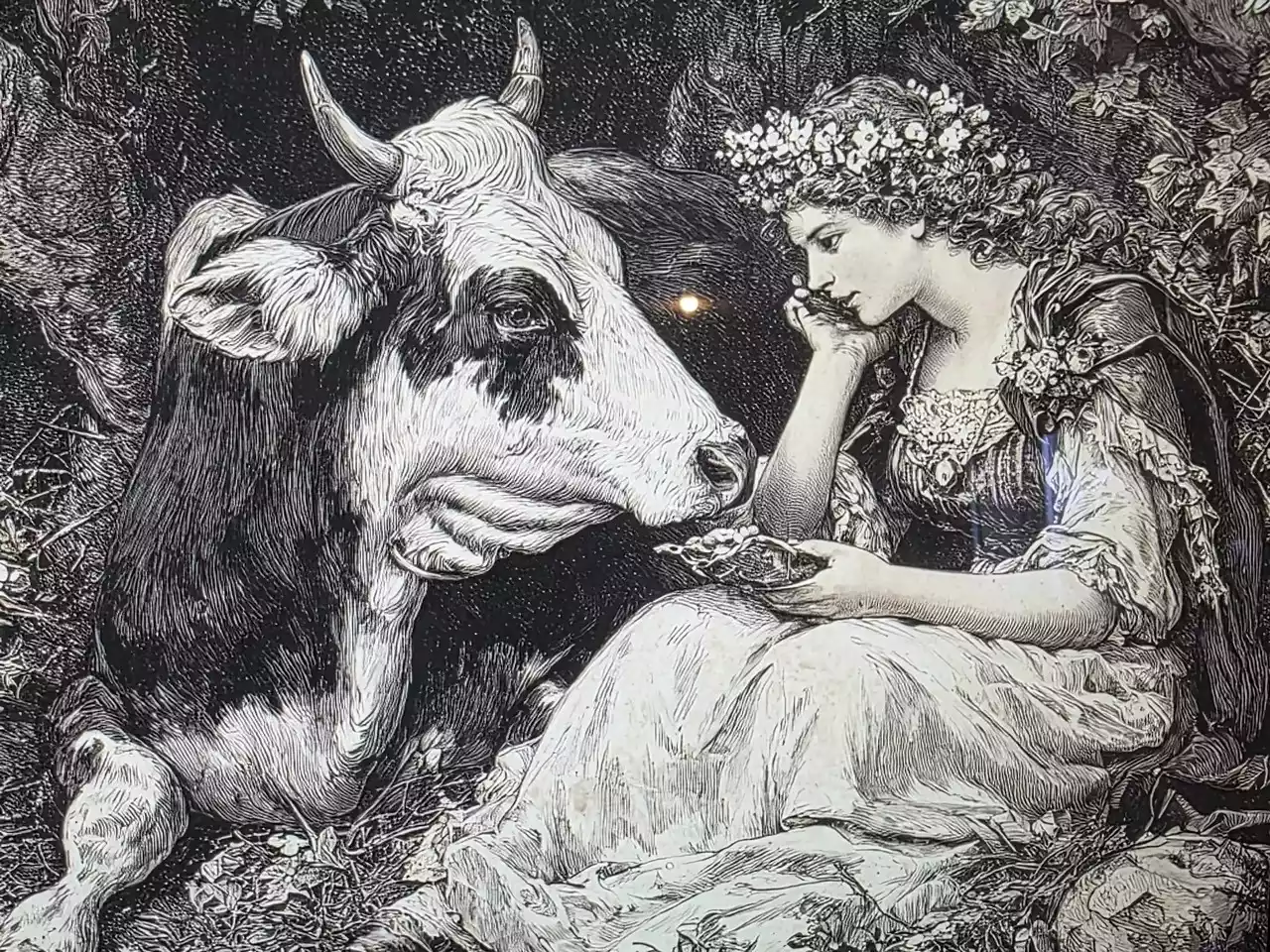
A figure shrouded in the mists of time. Who was Io? A priestess, one might hastily reply, the daughter of the river god Inachus, whose fate was sealed by the gaze of a god, a father of gods and men, Zeus. Her story, a tale woven of divine whim, of a woman’s jealousy that becomes a scourge, and of an unspeakable, almost incomprehensible transformation, is not simply a parable of ancient Argos but a mirror reflecting the darkest facets of power and desire, a narrative about the loss of identity and the painful, endless path to redemption. Io, and her transformation into a cow, is not a mere episode in the vast gallery of Greek religion; it is a trauma turned journey, a myth that gave birth to geography and marked collective memory. A tragedy. Perhaps. Her adventure, this ancient story whispered from Aeschylus to Ovid, remains an open question for interpretation, a wound that never fully closes (Gardner, Wills, and Goodwin). Her journey from the temple of Hera in Argos to the muddy banks of the Nile is an odyssey of pain, a testament to resilience in the face of the incomprehensible.
Divine Desire and a Jealous Punishment
It all begins with a look. The look of Zeus. A look that does not ask, but demands. Io, priestess of Hera at the Heraion of Argos, becomes the object of the supreme god’s desire, a desire that knows no bounds, does not recognize human will, does not calculate consequences. Zeus, to approach her and hide his act from the omnipresent and watchful eyes of his wife, Hera, covers the earth with a dense, dark cloud. A cloud. Not a random cloud, but an artifice, a screen for his rapacity. But Hera suspects. She always suspects. Her jealousy, very acute, legendary, leads her to disperse the mist, revealing her husband not next to a mortal maiden, but next to a dazzling white heifer. A cow.
Was this metamorphosis a desperate and momentary attempt by Zeus to save Io from Hera’s wrath? Or was it Hera herself who, with a gesture of divine irony and cruelty, transformed her rival into the animal consecrated to her, condemning her to a life deprived of speech and human form? Sources diverge, but the result remains the same, irrevocable. Io, trapped in a foreign body, loses her voice, her identity. She can only bellow her pain. Hera, not satisfied with this, demands the cow as a gift, a demand Zeus cannot refuse without revealing his guilt. And so, Io is delivered to her own tormentor. The punishment, however, is not over. It is far from its end. Hera entrusts the guard of the heifer to Argos Panoptes. A monster. A giant with a hundred eyes, scattered all over his body, which always slept in turn, thus ensuring incessant, nightmarish, perpetual surveillance.
Bound, imprisoned under a hundred sleepless gazes. With no escape. Her father, Inachus, and her sisters search for her, lamenting her disappearance, until she, finding her way to the banks of her paternal river, carves her name in the mud with her hoof. The revelation brings agony, not deliverance. Their mourning is silent, filled with despair. The situation seems hopeless, until Zeus, witnessing the torment of his beloved (or perhaps seized by remorse?), charges Hermes, the cunning and swift messenger, to free her. Hermes, with the music of his syrinx and his monotonous tales, manages to lull the hundred eyes of Argos to sleep, then, with a swift movement, he decapitates him. Argeiphontes. This epithet will accompany him forever. Io is freed from her guardian. But not from Hera’s wrath. The goddess, furious, takes the eyes of her faithful servant and places them on the tail of the peacock, her sacred bird, as an eternal reminder. And for Io? For Io, she sends a gadfly, which with its incessant and torturous stings, would drive her to madness and a frantic, endless flight across the known and unknown world, under a zoomorphic form of infinite pain (Konstantinou). The prison of a hundred eyes was replaced by the hell of perpetual motion.
The Endless Odyssey and the Prophecy
The journey begins. A path without a map, without a destination, dictated only by the pain and paranoia caused by the gadfly’s incessant sting. She runs. Ceaselessly. The pain, the gadfly, burns her. She crosses Greece, plunges into the sea that will bear her name, the Ionian Sea, and passes into Asia through the Bosphorus, the “passage of the cow,” a name that forever seals the geography of her martyrdom. Her wandering is cosmic, an odyssey that leads her to the ends of the earth, through wild lands and inhospitable peoples. Scythians, Cimmerians, the mythical Arimaspians. The world becomes a labyrinth of pain. One might say that the geography of Io’s wandering, as W.F. Warren might have noted in his research, acquires an almost cosmic dimension, defined not by human measures but by divine fury (Warren). It is not simply a journey on earth; it is a fall through space itself, an exile from civilization, from humanity, from her own being.
At the farthest and coldest edge of the world, in the ravines of the Caucasus, her fate crosses that of another great sufferer, another titanic rebel punished by Zeus: Prometheus. Chained to the rock, with the eagle eternally devouring his liver, Prometheus recognizes in the tormented heifer the daughter of Inachus. There, in this setting of absolute despair, two victims of the same divine tyranny briefly share their pain. Io, through bellows, tells him her story, and Prometheus, with the power of prophecy, reveals her future. He predicts the rest of her tortuous journey, the lands she must cross, the Amazons she will encounter, until she finally reaches the land of salvation. Egypt. There, on the banks of the Nile, he promises her, Zeus himself, with a gentle touch of his hand — no longer with violence, but with a healing touch — will restore her human form and simultaneously make her pregnant. The child who will be born, Epaphus, whose name will mean “he who is born of a touch,” will become king of Egypt.
And the prophecy does not stop there. Prometheus reveals something even more startling. From her own lineage, from the descendants of Epaphus, after thirteen generations, a hero will be born, the greatest of heroes. Heracles. And it will be this distant descendant who will travel to the Caucasus and free him, breaking his own chains. The journey of Io, therefore, suddenly acquires meaning, a teleology (Davison). Her own pain, her own exile, becomes the prerequisite for the salvation of the other great martyr. Her personal tragedy fits into a larger, cosmic plan of redemption. With this hope, with this promise of an end and a new beginning, Io finds the courage to continue her path, to endure the gadfly, to cross the last deserts of her pain…
The Restoration and Legacy of Io
And she arrives. Exhausted, tormented, she finally reaches Egypt, the land promised by Prometheus. She falls on the banks of the Nile, imploring Zeus to end her martyrdom. The god, this time, listens. With a touch, a caress, the transformation is reversed. The animal’s skin withdraws, her human form returns, speech returns to her lips. Io becomes herself again. And from this contact, Epaphus is born. The prophecy is fulfilled. Io, the former priestess, the tormented heifer, finally finds peace. In Egypt, she is no longer a stranger, a fugitive. She is honored, identified with their great goddess, Isis, the goddess of motherhood and fertility. The priestess of Argos transforms into a deity in a foreign land, closing a cycle of incredible pain and final apotheosis.
What remains, in the end, of Io? Is her story simply a warning about the consequences of divine whim? An allegory of the agony caused by unbridled jealousy? Or is it something deeper? Her story is the story of a violent alienation from her own body, her own identity. It is the chronicle of a wandering that is not only geographical but existential. It is proof that even when voice, form, and reason are lost, a spark of endurance remains, an indomitable impulse of survival that leads to the fulfillment of a distant, almost incomprehensible promise. These myths, in the end, are not mere stories; they are maps of the human soul (Pratt and Bonaccio). Io, through the silence of the beast, cries for vindication, for restoration, and her legacy is not only her son Epaphus or her distant descendant Heracles, but also the very toponyms, the Ionian and the Bosphorus, which were engraved on the surface of the earth by her hooves, eternal witnesses of a pain that became a path and a tragedy that concluded, strangely, in redemption…
Frequently Asked Questions
What is the reason for Io’s transformation into a cow?
In Greek mythology, the direct cause is often ambiguous. Zeus, desiring the priestess, hid her under a cloud to escape Hera. At the approach of his wife, Zeus, in an act of panic, completed Io’s transformation into a cow. Therefore, this divine metamorphosis was the consequence of his attempt to conceal an infidelity, a desperate act with tragic consequences.
What role did Hera play in Io’s ordeal?
Hera was the ruthless executor of the punishment. After Io was transformed into a cow, Hera demanded her as a gift and placed her under the incessant guard of Argos Panoptes. After Argos’s death, Hera’s vengeance continued; she sent a gadfly to torture Io, forcing her into a frantic flight across the world. This torment solidifies the myth as a symbol of divine jealousy in Greek mythology.
How is Io’s myth connected to that of Prometheus?
During her anguished journey as a heifer, Io reached the Caucasus Mountains, where she encountered the titan Prometheus, chained for his defiance of Zeus. As a fellow victim of the same divine tyranny, he predicted the end of her ordeal. He prophesied that her journey would end in Egypt, where she would be restored and give birth to a son, from whose lineage Heracles, the future liberator of Prometheus himself, would descend.
How was Io’s transformation into a cow eventually reversed?
The long torment of the priestess, after Io was transformed into a cow, ended in Egypt, as Prometheus had prophesied. There, on the banks of the Nile, Zeus approached her not with force, but with a gentle hand. By his divine touch, the curse was lifted, her human form was restored, and she conceived their son, Epaphus, thus ending her painful metamorphosis and journey.
What is the symbolic significance of Io’s story?
This tale from Greek mythology is deeply symbolic. Io’s transformation into a cow represents the ultimate loss of identity, voice, and agency under the weight of divine power and desire. Her subsequent suffering and wandering explore themes of endurance and despair, while her final restoration and deification as the goddess Isis in Egypt symbolize hope and ultimate redemption against all odds.
Bibliography
Davison, J.M. “Myth and the Periphery”. Myth and the Polis, edited by Dora C. Pozzi and John M. Wickersham, Cornell University Press, 1991, pp. 49–63.
Gardner, R., et al. “The Io myth: Origins and use of a narrative of sexual abuse”. The Journal of Psychohistory, vol. 22, no. 3, 1995, pp. 312–325.
Konstantinou, A. “Reconsidering the metamorphosis of Io: On texts, images and dates”. Symbolae Osloenses, vol. 90, no. 1, 2015, pp. 28–50.
Pratt, M.G., and S. Bonaccio. “Qualitative research in IO psychology: Maps, myths, and moving forward”. Industrial and Organizational Psychology, vol. 9, no. 4, 2016, pp. 719–740.
Provenza, A. “The Myth of Io and Female Cyborgic Identity”. Classical Myths in Present-Day Objects, edited by Susanna Chesi and Francesca Spiegel, Brill, 2019, pp. 211–226.


