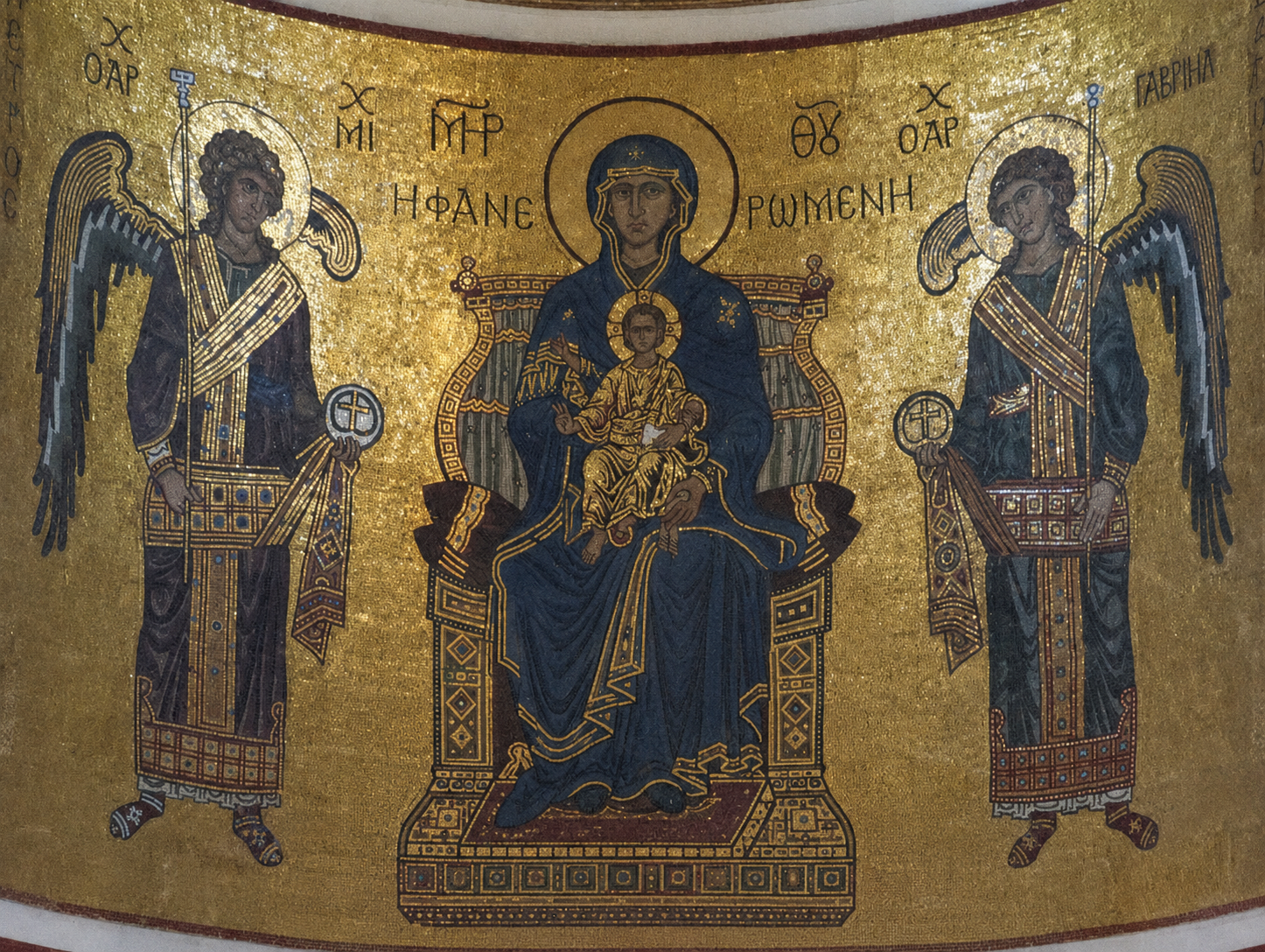
El Panagia Faneromeni mosaic in the sanctuary apse of the Church of Panagia Faneromeni at Xylokastro presents the Theotokos enthroned with the Christ Child between the Archangels Michael and Gabriel, all set against an expansive gold ground. Its immediate effect comes from order: a strong central axis, bilateral balance, frontal figures and a restricted chromatic range in which deep blue, purple, green and gold carry almost the entire composition. The church itself is a modern building conceived in deliberate dialogue with Early Christian basilican architecture. Its founder and long-serving priest, Nikon Kotsovolos, when developing the project, studied the plans and reconstructions of Early Christian churches published by the archaeologist and architect Anastasios Orlandos, according to local municipal history.
The mosaic belongs to the same historicising ambition. It openly acknowledges its modern setting while reconstructing the visual grammar of monumental Byzantine sanctuary decoration through the enthroned Virgen y niño, angelic attendants, Greek inscriptions, jewelled ornament and a tessellated golden field. No secure documentation identifying the mosaicist or the precise date of this particular apse composition has been supplied in the available material, and these details should therefore remain open. What can be studied with confidence is the work itself: its iconographic structure, its handling of hierarchy and scale, the relationship between the figures, the way the curved sanctuary surface is converted into a luminous, almost immaterial pictorial field.
The Panagia Faneromeni Mosaic: Theotokos, Christ and the Archangels
At the centre, the Theotokos sits frontally on a high-backed throne whose architecture is rendered almost as carefully as the figures. The seat is built from bands of geometric ornament, pearl-like dots, rectangular compartments and diamond motifs, while a dark cushion spreads beneath her and across the lower part of the throne. Her dark blue maphorion forms the largest single chromatic mass in the composition. Gold edging follows its contours, and small star-like ornaments appear on the veil and shoulder, interrupting the blue without weakening its gravity. The Virgin’s face is elongated and still, the eyes large and directed outward, the mouth narrow. Against the brightness surrounding her, the dark garment gives the central figure exceptional visual weight.
The Christ Child sits upright on her lap, his body and gaze directed frontally towards the viewer. His mano derecha is raised in a gesture of blessing; in his left he holds a light-coloured closed scroll across the body. The small figure is clothed almost entirely in gold, articulated by dark linear folds and highlights that make the garment seem to flicker against the deeper blue of the Virgin. His cruciform halo distinguishes him immediately from the surrounding haloes. Important here is the contrast in scale. Although physically a child, Christ is presented with a solemn frontal bearing and a mature physiognomic gravity familiar from Byzantine representations in which childhood does not diminish divine authority.
Above the Virgin appear the abbreviated Greek letters MR ΘY, the conventional nombre sacro por la Μήτηρ Θεοῦ, “Mother of God”. Across the gold field the larger inscription Η ΦΑΝΕΡΩΜΕΝΗ identifies the local Marian dedication. This distinction matters. “Faneromeni” is the named identity of the image within the church and its devotional context, while the visible iconographic structure belongs more broadly to the family of representations of the enthroned Theotokos and Child. Affinities with the majestic, frontal language often associated with the Nikopoios tradition are evident, although the inscription should remain primary when naming this particular work rather than a modern typological label. For the wider history of Marian imagery in Byzantium, Maria Vassilaki’s edited volume Madre de Dios: Representations of the Virgin in Byzantine Art provides a useful scholarly frame.
The arrangement of the archangels creates a disciplined equilibrium around this central group. On the left side of the image stands Michael, placing him at the Virgin’s right; Gabriel occupies the right side of the image, at the Virgin’s left. The Greek identifying inscriptions above them remove ambiguity. Both figures are full-length, winged and haloed, their bodies inclined only slightly towards the centre while their faces turn more clearly towards the Virgin and Child. Each carries a long ceremonial staff in the outer hand and a circular, cross-marked emblem in the hand nearer the central axis. Almost mirror-like is their placement; small differences in stance, drapery and facial inclination keep the arrangement from becoming mechanical.
Their garments deserve close attention. The archangels are dressed in richly ornamented courtly costume, crossed by broad decorated bands and bordered with repeated squares, dots and jewel-like tesseral accents. Michael’s clothing moves through deep purples and blue-black tones; Gabriel’s, through dark blue-green and brownish purple. The wings are strongly linear. Long dark feathers are edged and subdivided by pale blue-grey tesserae, turning each wing into a patterned, stylised surface. Figure, garment, wing, halo, inscription: each element remains clearly bounded within the formal logic of the ensemble, immediately legible even at some distance.
The gold ground unifies everything. It removes ordinary landscape or architectural depth behind the figures and makes the throne itself the only substantial spatial structure. The gold, however, resists visual flatness. Individual tesserae catch light unevenly, so the background changes as illumination and viewpoint change; slight variations of alignment produce a surface capable of shimmering like neither paint nor a continuous sheet of metallic colour. One of the essential resources of monumental mosaic lies precisely in this behaviour of light. Otto Demus, in Byzantine Decoración de mosaico: Aspects of Monumental Art in Byzantium, treated Byzantine mosaic as an art inseparable from architectural space, a point particularly relevant to an apse image designed to be seen across the liturgical interior rather than as an autonomous panel.
Seen across the curved sanctuary setting, the axial composition becomes still more pronounced. The throne rises from a broad decorated base and occupies the exact middle of the field, while the archangels extend vertically on either side, their staffs strengthening the flanking axes. Above, the inscriptions occupy the open gold without forming a heavy border. Below, the Virgin’s dark drapery widens across the throne and narrows again at the feet. The composition consequently moves in two directions at once: upward through faces, haloes, staffs; inward through the archangels’ glances and the converging disposition of their bodies. Dominant, nevertheless, is the seated Theotokos.
A comparison with the Middle Byzantine sanctuary tradition clarifies the artistic choice without requiring a claim of direct copying. In Hagia Sophia at Constantinople, the apse presents the enthroned Virgin and Child against gold, while standing archangels were associated with the adjoining bema arch. The Xylokastro mosaic gathers the central Marian image and the two archangels into a single, immediately readable field. Its effect therefore recalls Byzantine hierarchical programmes while reorganising their components for this particular sanctuary surface. Central sacred figure, golden ground, angelic attendance, monumental frontality: in this visual grammar lies the resemblance, rather than in a one-to-one reproduction of a specific medieval mosaic.
This distinction is especially useful because the Church of Panagia Faneromeni was itself conceived as a revival of Early Christian architectural forms. The mosaic participates in that programme through another historical layer, drawing on Byzantine monumental vocabulary as the building draws on the basilican past. Architecture and decoration quote different historical moments, meeting across centuries. The basilican conception establishes a deliberately archaic ecclesiastical space; the mosaic enriches that space with a visual language that became central to later Byzantine church decoration.
Several small details keep the work from dissolving into archaeological pastiche. The severe graphic contouring of the faces, the highly patterned throne, the emphatic dark outlines around garments and wings, the exceptionally regular decorative borders reveal a modern act of synthesis. The artist or workshop has looked backwards through a modern understanding of what Byzantine monumentality signifies: frontal authority, clarity of type, chromatic concentration, gold as an active field, ornament subordinated to hierarchy. From a distance the result is intentionally legible. At close range another experience emerges — minute tesserae, abrupt colour changes, tiny facial highlights, discrete ornamental units.
Most compelling is the relation between stillness and brilliance. The figures themselves scarcely move. The Virgin remains rigidly enthroned, Christ compact and frontal, the archangels ceremonially poised. Across the surface, meanwhile, movement persists in another form: gold catching light, patterned bands breaking into small reflections, pale accents running along wings and garments. That division gives the apse its distinctive presence. Iconographic authority is carried by stillness; visual animation, by mosaic itself.
(La traducción fue editada por N. Jones.)