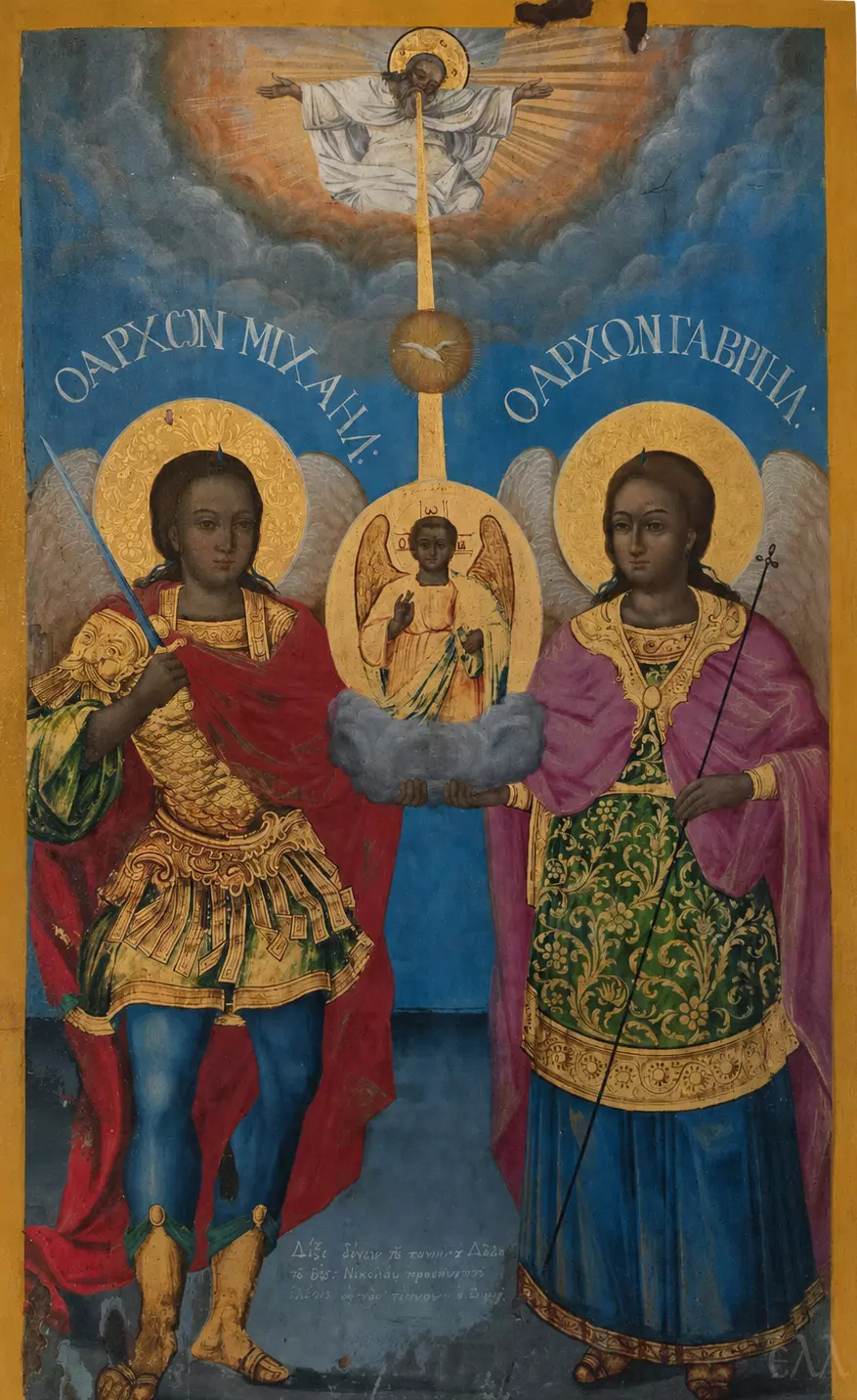
Michael and Gabriel icon preserved in the Church of the Panagia Kapnikarea in Athens presents a composition whose first impression is comparatively familiar—two monumental archangels, Michael and Gabriel, flank a smaller sacred figure—but whose centre introduces an iconographic problem of unusual interest. Between them stands a youthful figure with wings. His halo, however, is unmistakably cruciform and bears the Greek letters Ο ΩΝ, while his right hand is raised in blessing and his left holds a closed scroll. These details resolve the apparent contradiction. The figure is Christ, represented in the distinctive iconographic guise of the Angel of Great Counsel.
The panel belongs to an ecclesiastical setting of considerable historical importance. Kapnikarea, dedicated principally to the Presentation of the Virgin in the Temple, was constructed shortly after the middle of the eleventh century and forms one of the best-preserved Middle Byzantine monuments of Athens. The church, when it passed into the ownership of the National and Kapodistrian University of Athens in the early 1930s, entered another phase of its modern history and remains connected with the University today. The specific portable icon, however, does not appear in the accessible documentation consulted with a secure catalogue attribution or date. Its painter should therefore remain unnamed, and any chronological assessment based on style alone must remain provisional.
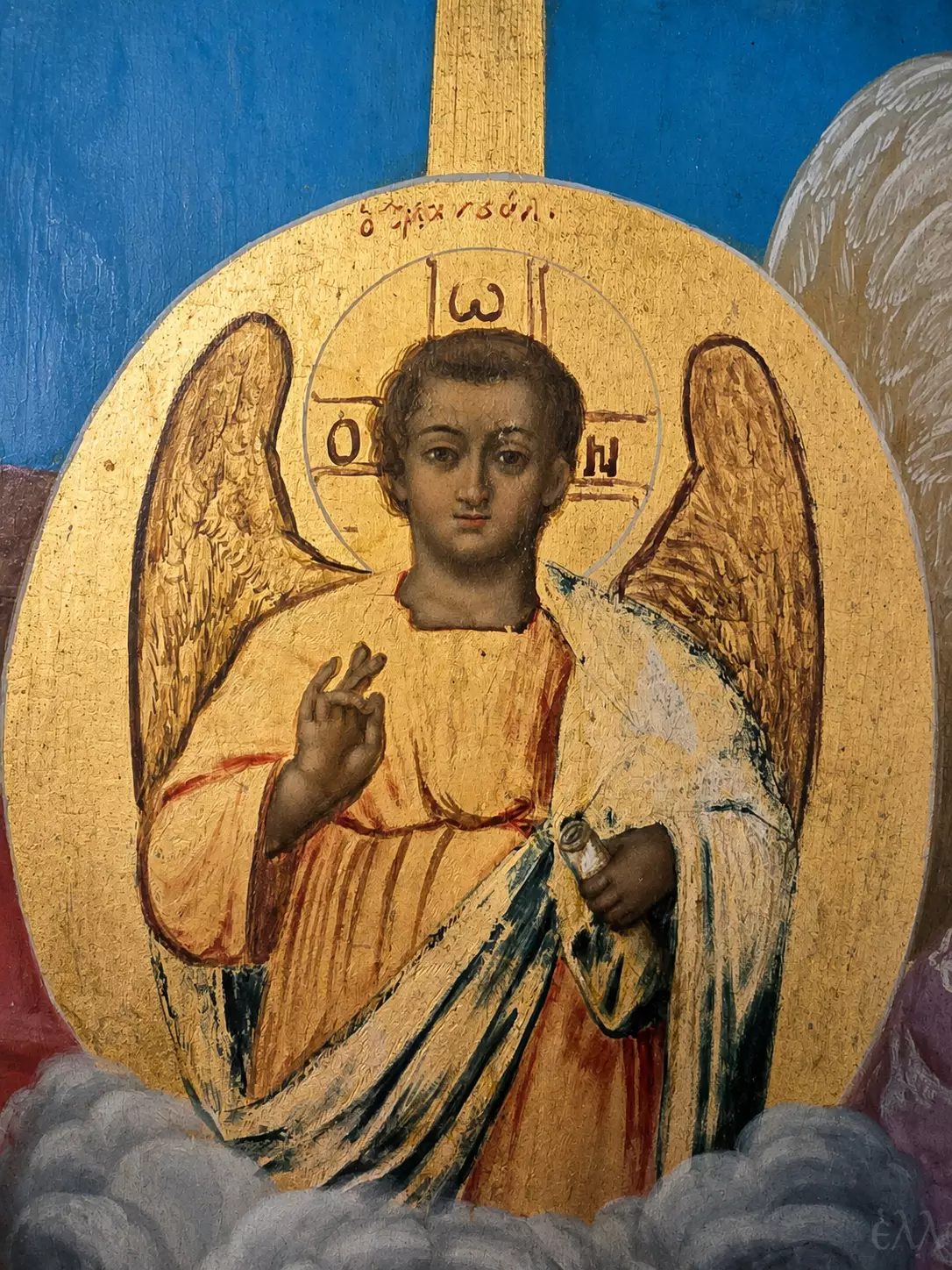
Michael and Gabriel Icon: the winged Christ at the centre
Dominant in the lower part of the composition are the two archangels, identified by the large Greek inscriptions Ο ΑΡΧΩΝ ΜΙΧΑΗΛ и Ο ΑΡΧΩΝ ΓΑΒΡΙΗΛ. Their bodies establish an almost heraldic bilateral symmetry, yet the painter deliberately differentiates them through costume and attributes. Michael, occupying the left side of the image, appears as a celestial military commander. Elaborate armour beneath a brilliant red mantle, a long blue sword in his правая рука, a breastplate covered with gold: these define the martial character of the figure. The complex military ornament includes a conspicuous mask-like head motif near the shoulder, while blue leggings and high golden footwear extend the colour scheme towards the lower edge. Behind the shoulders rise his grey wings, without disturbing the strong verticality of the figure.
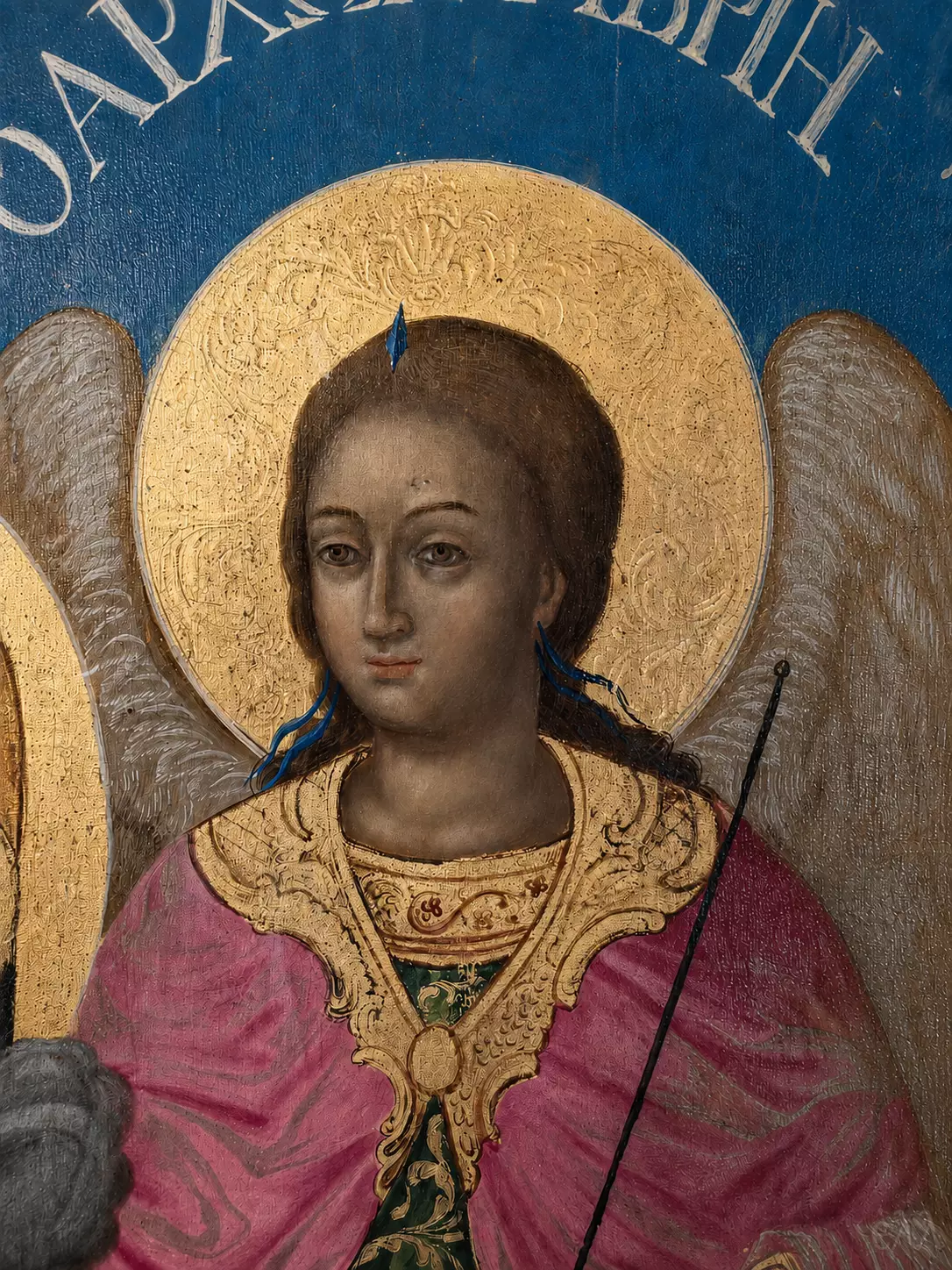
Gabriel answers him from the opposite side, his appearance less martial and more courtly. A purple-pink mantle spreads across the shoulders and arms, while beneath it a green garment is densely covered with gold vegetal ornament. The broad ornamental collar, cuffs and central medallion increase the ceremonial character of his dress. In his левая рука he carries a slender dark staff terminating in a small cross-shaped finial; his правая рука, nearer the centre, supports the cloud. The visual distinction is deliberate: weapon and armour for Michael, ceremonial staff and sumptuous court dress for Gabriel. Similar use of imperial costume and insignia for archangels belongs to a long Eastern Christian tradition in which the heavenly powers are represented through the visual vocabulary of imperial attendance and authority. Kapnikarea’s twentieth-century mural programme likewise depicts Michael and Gabriel in explicitly courtly or imperial dress, although those wall paintings constitute a separate artistic campaign from the portable panel.
Between them, supported by their inward hands, rests a dense blue-grey cloud. Above it rises a circular golden field containing the youthful winged figure. The arrangement deserves attention because the two large archangels do more than stand beside Christ: they present him. Their bodies become the lateral supports of a composition whose visual pressure moves, steadily and unmistakably, towards the centre.
The identity of the central figure is indicated first by the halo. Ordinary angels may be haloed, but the nimbus surrounding this youth contains a cross. Within its arms appear Ο, Ω, Ν, Образуя Ὁ ὬΝ, “He Who Is” or “The One Who Is”. The formula recalls the Greek wording associated with Exodus 3:14 and became one of the most recognisable Christological inscriptions in Eastern Christian art. A third archangel placed between Michael and Gabriel would not carry this Christological sign. His blessing gesture and scroll reinforce the identification; decisive, nevertheless, remain the cruciform halo and its inscription.
Why, then, the wings?
They belong to the iconographic type known as Christ the Angel of Great Counsel. The title derives from the Septuagint version of Isaiah 9:6—9:5 according to Greek verse numbering—where the promised child receives the designation Μεγάλης Βουλῆς Ἄγγελος, conventionally translated “Angel” or “Messenger of Great Counsel”. The Greek word Ангелос fundamentally denotes a messenger. In Christian interpretation the title came to be applied to the Logos, and eventually painters made the metaphor visible: Christ could appear youthful and winged, while retaining the unmistakable insignia of his own identity.
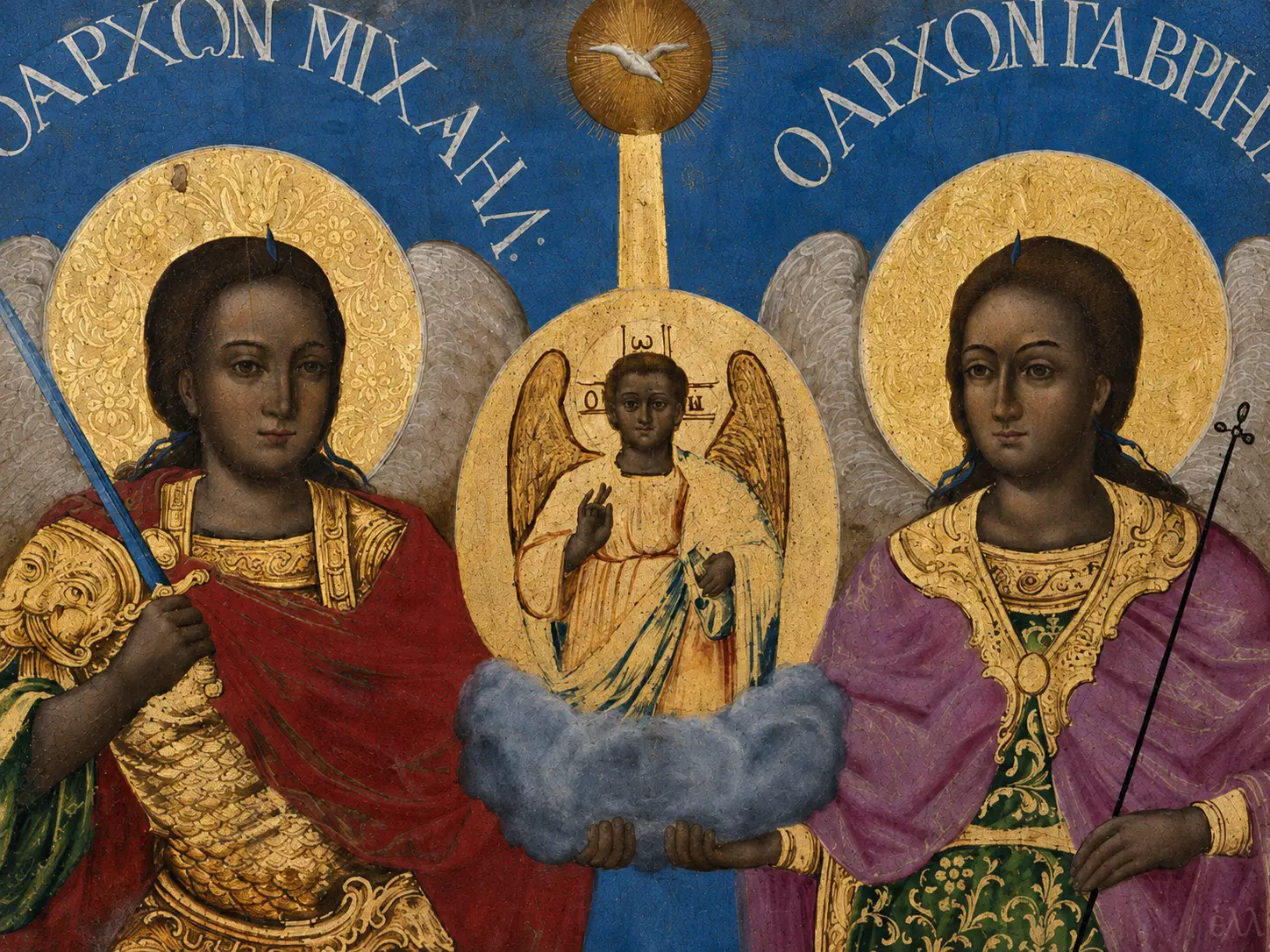
The wings, accordingly, visualise the prophetic title rather than placing Christ among the created angels represented beside him. Particularly clear in this panel is the distinction, both visual and theological: Michael and Gabriel possess ordinary circular haloes, whereas the central winged Christ carries the cross-inscribed nimbus and Ο ΩΝ. The icon itself therefore explains the difference through form. For the broader theological history of the designation, Joseph W. Trigg’s study The Angel of Great Counsel traces its early Christian interpretation, while Constantine Cavarnos’s Guide to Byzantine Iconography provides a wider framework for reading the established signs by which Christ, angels and other sacred figures are differentiated in Orthodox imagery.
The painter has made this Christ strikingly young. His face is small and oval, almost childlike, the short brown hair carefully arranged close to the skull. The modelling is gentle: a narrow shadow descends beside the nose, the cheeks pass gradually from darker flesh tones into light, the mouth is minute and reddish. His golden wings curve upwards on either side, enclosing the body and creating within the larger composition a second, smaller symmetry. He blesses with his правая рука, visible on the left side of the image from the viewer’s perspective, while the closed scroll is held in his оставил. These anatomical assignments matter because the frontal orientation reverses the apparent sides when the figure is viewed from outside the image.
Above this central figure the composition continues vertically. A broad gold shaft rises from Christ’s aureole towards a radiant circular medallion containing a white dove. The dove identifies the Holy Spirit. Higher still, emerging from banks of cloud, an elderly bearded figure opens both arms and functions within this arrangement as God the Father. More complex, therefore, than a conventional image of the Synaxis of the Archangels is the resulting scheme. Michael and Gabriel frame a Trinitarian vertical axis: the Son below in the form of the Angel of Great Counsel, the Holy Spirit as the dove, the Father above. Across the deep blue field, the broad golden ray binds the three representations into a single ascending structure.
This upper section changes the meaning of the whole panel. The two archangels are monumental, but neither becomes its theological centre. Centre belongs to the Son. Above him, Spirit and Father continue the same axis; around him, Michael and Gabriel act as attendants. Hierarchy is expressed without a strict hierarchy of physical size, since Christ is markedly smaller than the archangels. Position, halo, gesture, gold, vertical alignment—these perform the work that scale alone might otherwise have done.
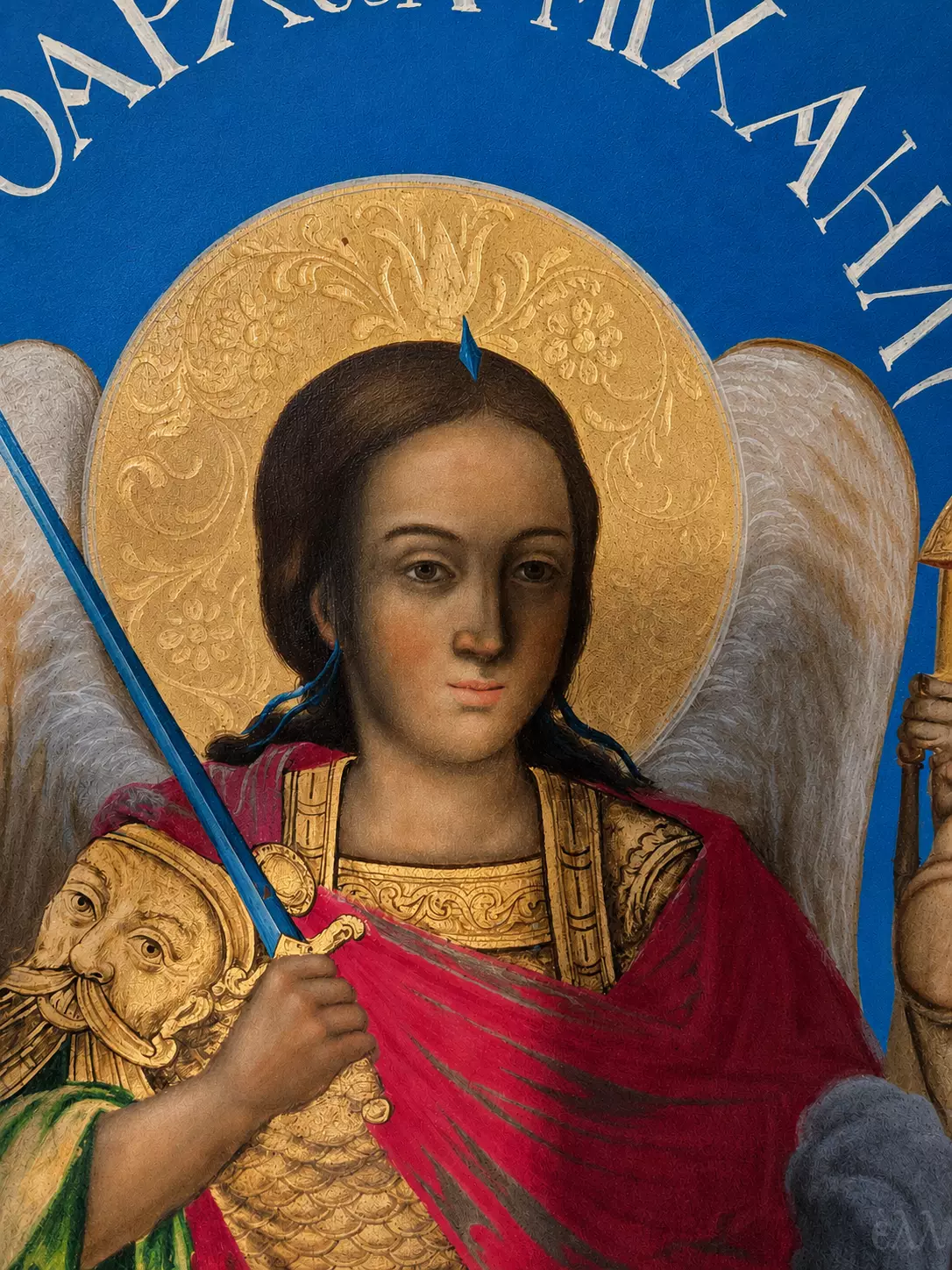
The colour structure reinforces that organisation. A saturated blue background covers much of the panel, broken by the gold haloes and the long golden vertical band. Against it, Michael’s vermilion-red mantle and Gabriel’s pink-purple cloak establish a pair of strong chromatic masses. Green appears in both figures, though in different roles: as a subsidiary accent in Michael’s military costume, as an expansive brocaded field in Gabriel’s. Gold is abundant without being confined to the sacred haloes. It passes through armour, collars, patterned cloth, footwear, the central circular field and the descending celestial ray, joining ornament to hierarchy.
The treatment of the faces is noticeably soft and naturalistic. Michael and Gabriel have rounded features, shaded necks, smoothly modelled cheeks, large grey-brown eyes and small closed mouths. Their resemblance is sufficiently close to suggest a common facial formula. At the same time, the extensive brocade, elaborate armour, decorative haloes and strong modelling belong to a later artistic language in which inherited Byzantine iconographic structures coexist with a taste for greater corporeality and surface splendour. Stylistically, the panel is compatible with the later Post-Byzantine tradition, perhaps in an environment already receptive to Westernising modes of modelling, though no precise century should be assigned without documentary or technical evidence.
The painted surface has also acquired its own history. Fine craquelure crosses several passages, while localised losses and abrasions interrupt parts of the gold and coloured paint. Around some haloes and along peripheral areas are these changes especially visible. They do not obscure the principal iconography. The surviving inscriptions remain unusually valuable: the names of Michael and Gabriel establish the lateral figures beyond doubt, while Ο ΩΝ secures the Christological identity of the winged youth.
A pale dedicatory inscription survives near the lower centre of the panel. Parts of its lettering can be distinguished, including a reference to a Николаос, but the complete text should not be reconstructed without a clearer epigraphic reading. What it may eventually disclose—donation, patronage, chronology—cannot yet be stated securely. For the moment, its presence is evidence enough that the icon possessed a dedicatory history now only partly recoverable.
Within Kapnikarea, a church whose eleventh-century fabric survived later alteration and nineteenth-century plans that threatened the monument, the panel preserves another historical layer, considerably later than the Byzantine building that houses it. Its most unusual element is also its most precise. The wings at the centre accord with the youthful physiognomy and form the visual language of the Angel of Great Counsel; the cruciform halo, the blessing, the scroll and especially the inscription Ο ΩΝ leave the identification remarkably firm.
(Перевод отредактировала Э. Александраки.)