
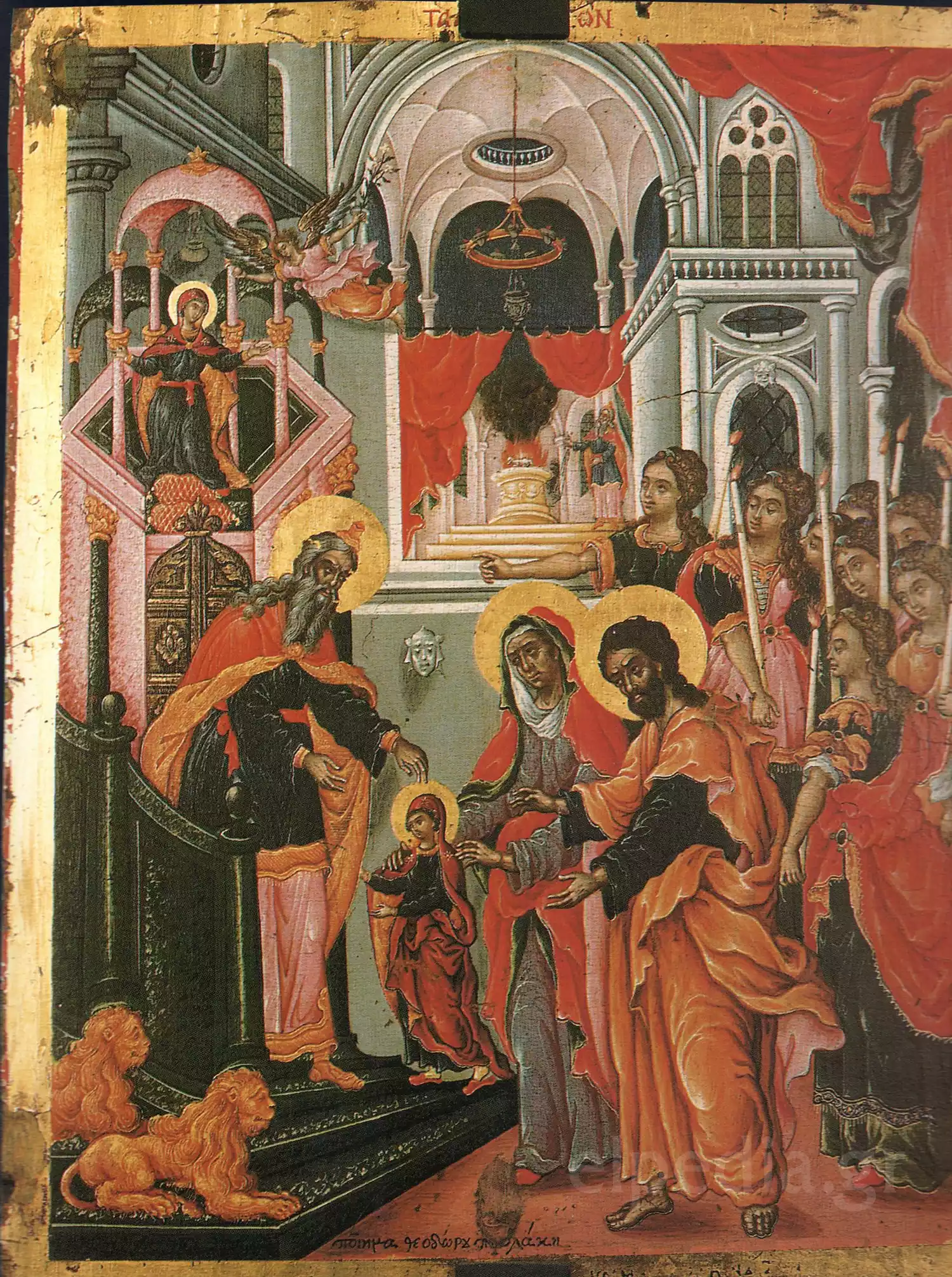
The monumental iconography of the Ottoman period serves as a visual treasury of Orthodox self-awareness, not merely repeating earlier models but sensitively capturing the aesthetic and spiritual vibrations of its time. Originating from the Church of Saint Nicholas in Korçë and currently housed in the Museum of Art and Architecture in Tirana, this work, associated with the circle of the distinguished painter David Selenicasi, vividly records the transition and merging of the iconographic currents of the era. In a time when the elements of painting practice are clearly diversifying, influenced by both the sources of the models and the prevailing conditions, the representation transcends its strictly liturgical character. It transforms, in a sense, into a mirror of its time, capturing the formal inclusion of the three-year-old Virgin in the Temple not just as a sacred narrative, but as a staged, monumental composition that responds to the aesthetic demands of the 18th century.
The icon incorporates diverse elements of late post-Byzantine art with Western references, affirming that the preservation of the Byzantine tradition is an inherent demand, which is now dynamically intertwined with new aesthetic explorations.
Spatial Composition and Architectural Depth
The immediate object of visual observation, the composition of space, is organized with a classicizing geometric stability that guides the gaze from the lower, earthly levels to the realm of the sacred. Forming the scenic backdrop, complex architectural elements with arches, columns, and a prominent tabernacle rise in the background, providing the necessary impression of depth in the representational space. At the base of the scale, intricately carved lions, a direct reference to Solomon’s throne, emphasize the royal and messianic lineage of the Virgin, simultaneously serving as robust decorative elements that anchor the composition.
As often observed in the painting of the period, the architectural landscape is not merely a passive background but participates organically in the event. The section of the composition at the upper left, where the Virgin is depicted in a smaller scale being nourished by the angel (“nourished by an angel”), harmoniously integrates the simultaneous and sequential time of the narrative. This parallel depiction offers the viewer a clear example of how the space is meaningfully segmented, without disrupting the unified visual impression of the work.
The Priestly Presence: Zacharias, Joachim, and Anna
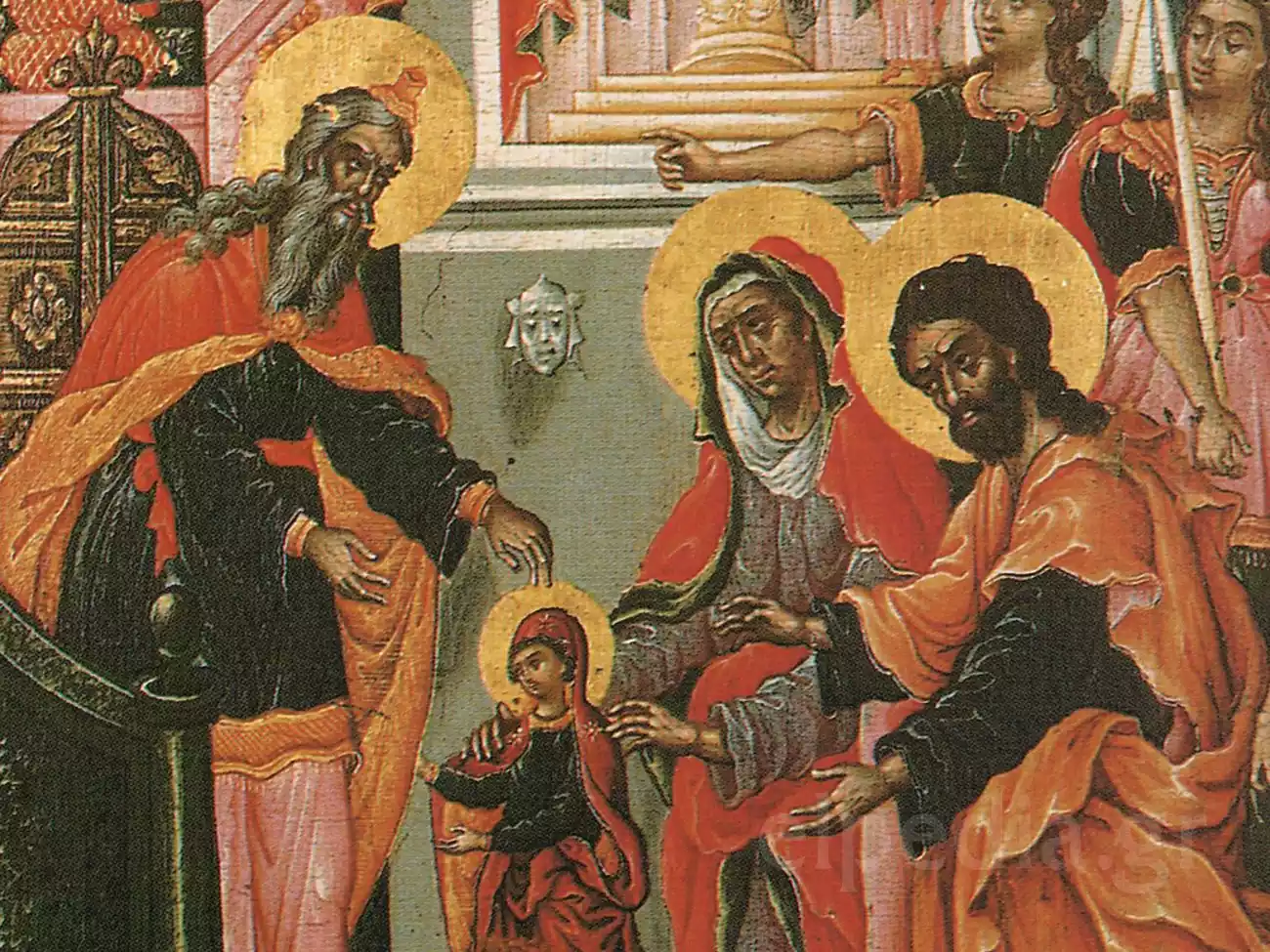
Focusing on the central core of the event, the high priest Zacharias, adorned in his precious vestments, bends with priestly grace to welcome the Virgin. The plastic clarity and weight that characterize his form are evident, especially in the way the golden embroidery traverses his garment, reflecting the symbolic, uncreated light that defines the Macedonian and Cretan heritage. The figures exude tranquility, and their bodily proportions, posture, and gestures strive for realistic truth while maintaining a strict, timeless solemnity.
Behind the small Virgin, Joachim and Anna, with an almost regal bearing, present their child. Their faces are stern, their bodies warm, and their garments feature deep, dark folds. The modeling of their faces, with skillful chiaroscuro that articulates soft volumes on the cheekbones and foreheads, reveals a painter familiar with the breadth of monumental style. The linear clarity and organic structure of their limbs introduce the observer to a climate of restrained emotion, where the human sentiment of separation merges with the profound doctrinal consciousness of dedication.
Torchbearer Virgins and Color Rhythm
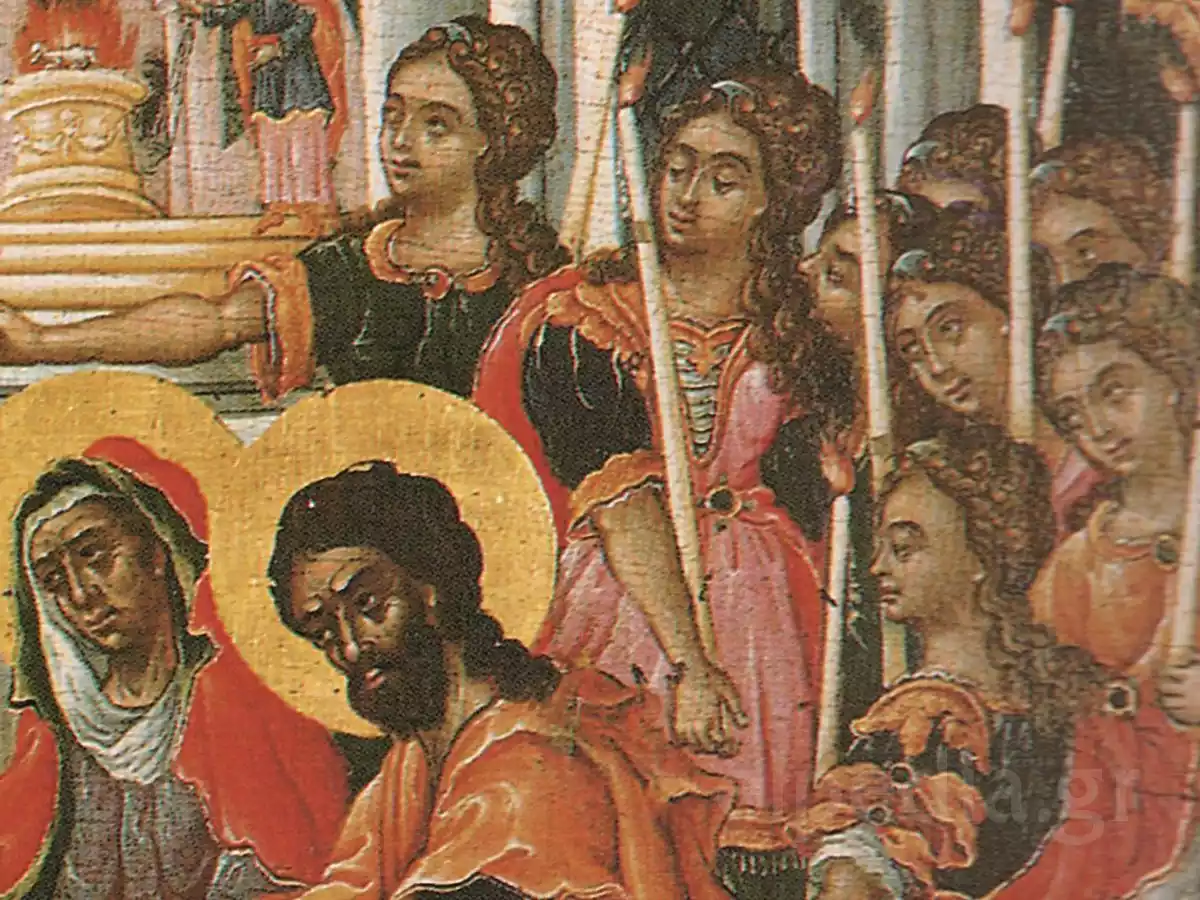
Following the holy parents, the group of young girls on the right side of the scene introduces a completely different, purely lyrical breath into the strict ensemble, affirming the prophetic word: “They shall be brought to the king, virgins behind her, those near her shall be brought to you” (Psalm 44:15). These torchbearer virgins, dressed in light, Western-style garments in shades of pink, warm orange, and earthy green, testify to the strong Renaissance and Baroque influences that have permeated the mainland and Albanian hinterland of the 18th century.
Heads turned gracefully, radiant necks, elaborate hairstyles adorned with ribbons. The painting of the artist, infused here with humanism and decorative exuberance, allows the figures to acquire a fluid motion, breaking the frontal rigidity. The rhythm created by the straight, vertical lines of the lit torches they hold, contrasted with the gentle curves of their bodies, produces a visual polyphony. The color, being one of the most alluring elements due to its masterful handling and richness, softens the strict lines and alleviates the doctrinal weight of the scene. Indeed, through this very composition of heterogeneous stylistic elements, the Byzantine structure and modern color sensitivity, the Icon of the Presentation of the Virgin emerges as a supreme artifact, demonstrating the enduring ability of art to engage with History without losing its spiritual compass.
Bibliography
-
Palushi, A., David Selenicasi: painter of post-Byzantine revival in the 18th century, Tirana: OMBRA GVG, 2018.

-
Pavlidou, E., et al., Study of painting materials and techniques in the 18th-century St. Athanasius Church in Moschopolis, Albania, Cambridge: Cambridge University Press, 2007.
-
Post-Byzantine Painting in the Balkans, Frankfurt: CEEOL, 2000.
-
Schwartz, Ellen C., The Oxford Handbook of Byzantine Art and Architecture, Oxford: Oxford University Press, 2021.
-
Dachev, Miroslav, The Iconography of the Theotokos, Academia.edu, 2022.


