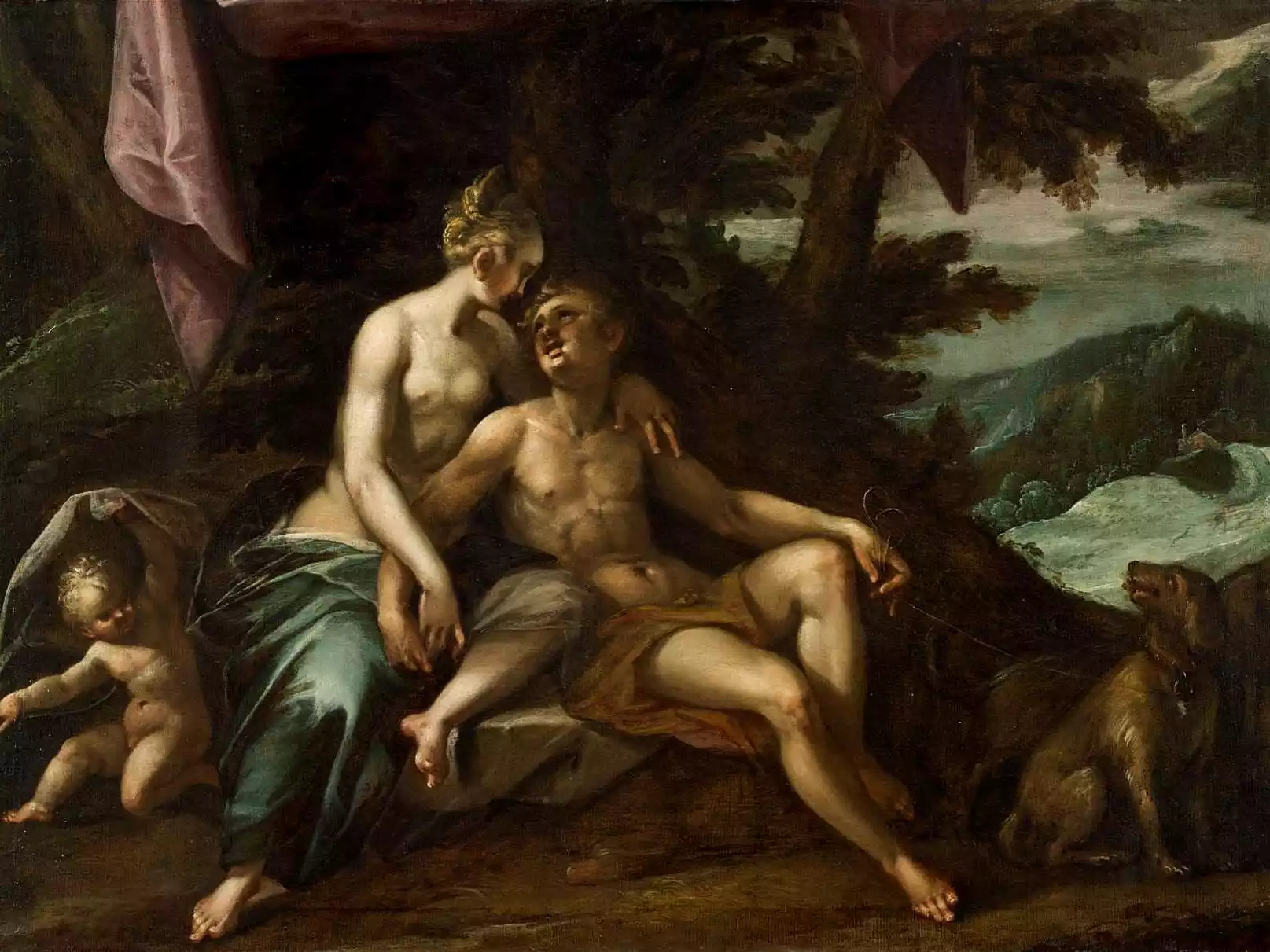
Aphrodite and Adonis, oil painting on canvas by Hans von Aachen, created between 1574 and 1588. Housed at the Fogg Art Museum, Harvard University.
The myth of Adonis and Aphrodite is one of the most moving and deeply human narratives of antiquity, describing the tragic love between a goddess and a mortal. Adonis, a youth of unparalleled beauty, was born from the trunk of his mother, Myrrha, who had been transformed into a tree to escape from her father. The goddess of love, Aphrodite, was so enchanted by the beauty of the newborn that she hid him in a chest and entrusted him to Persephone, queen of the Underworld, to raise him. But when the child came of age, Persephone refused to return him, leading to a fierce dispute between the two goddesses. Zeus decided that the youth would divide his time between the upper and the lower world. Unfortunately, Adonis’s life was cut short when, during a hunt, a wild boar fatally wounded him. From his blood, which soaked the earth, sprang the anemone, while Aphrodite’s tears became white roses, sealing the eternal connection of love with loss and the rebirth of nature.
The Aesthetic of Pain and the Perishable Beauty
It seems that beauty in mythological tradition often functions as a harbinger of inevitable death. For the scholar of art and myth who delves into the gods and deities, the figure of the tragic youth is strongly imprinted in collective memory through a color scale of pain. Crimson blood, thirsty earth, fragile flowers, all compose the scene of absence. We see the tragedy of human fate reflected in the eyes of a goddess who, despite her immortality, stands powerless.
The human existence, with all its fragility, is celebrated by this narrative. That mortal, burdened with the weight of a beauty that does not entirely belong to him, is called to play a game with a predetermined end. Perhaps it was simply a consolation for the people of the time, who saw youth lost in war or illness. Fresh soil under the hunter’s feet, the youth alone. Death comes violently – a fact that highlights the inability of the natural man to maintain his dominion over creation when divine grace is absent.
The Body as Vessel and the Silence of Mourning
Torn body, pale lips, empty gaze. That dissatisfaction of mortal nature turns into an artistic model in the representations of late antiquity, imparting the truth of the supersensible through the absolutely sensible. Mourning silence absence. The goddess’s collapse in the forest and the soul’s descent to Hades confirm the tragic end of every beauty that does not partake in eternity.
In Persephone’s embrace, under the earth – who truly can escape this law of decay? – the youth finds a temporary, cold refuge. The cycle of the seasons is thus opened by death itself. Nature mourns him, incorporates him. And not only that. If life is lost in the earth, then life returns as a flower. Or maybe not;
From Mythical Alternation to Eschatological Expectation
On the occasion of theological inquiry, the ancient myth is not simply an observation of agricultural cycles, but a deep cry of humanity. Despair before the void of death, people expressed it early on. Adonis, weak, surrenders to darkness. The answer to the mystery of existence is not an endless cycle of decay, but a straight path toward salvation. Neither natural beauty, nor ephemeral love, nor even the tear of a goddess can prevent death.
The true bridegroom of the soul is sought by man in every manifestation of his culture. The beyond invades the now, seeking not simply a beautiful youth, but God himself. Darkness covers the eyelids, while life continues to flow in the rivers and bloom in the meadows.
Man’s need – I do not know exactly how we realize it today amid the city’s noise – to unite with the divine remains unextinguished. Futility claims dominion. As happens with the alternation of the seasons, the waiting for spring hides within it a small, insufficient reflection of resurrection.
The Transcendence of Decay in Everyday Life
Vulnerable stands man before the mystery of the beyond. Which testifies to the fall of creation. The understanding of the human face gradually reveals, through the centuries. This, the pain of separation, we all experience. The sorrow of separation – unbearable, dark, silent. Millennia sculpt hope within the human heart. And this is clearly proven by the way ancient myths, like whispers in the dark, desperately sought a power capable of truly ruling life and death.
These shape our spiritual background. It is the longing for something that transcends biological law. Expectation born from the realization of decay. Everyday life, naturally, turns into a field of practice and ministry. The events of life are connected paratactically, omitting the essential. A continuous effort. A journey toward the light.

Love ends in a lament over a lifeless body. But I think that there lies all the meaning. In the acceptance that we are not made for death, but for life.
Bibliography
Cyrino, M. S., Aphrodite, London: Routledge, 2012.
Tuzet, Hélène., Adonis, London: Routledge, 2016.
The Myth of Aphrodite and Adonis, Ankara: Journal of Mosaic Research, 2020.
Aphrodite and Adonis, California: Classical Antiquity, 1995.
Adonis, The Myth, Berlin: Springer, 1980.


