The legendary friendship of Patroclus and Achilles: a story of devotion and tragedy at the heart of the Iliad. Greek mythology.
GREEK MYTHOLOGY
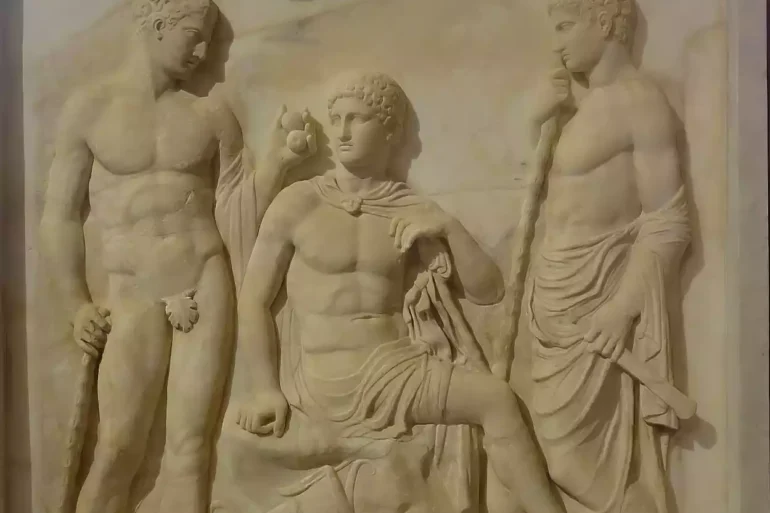
The story of Pirithous, the demigod king of the Lapiths, the legendary battle with the Centaurs, and his eternal friendship with Theseus.
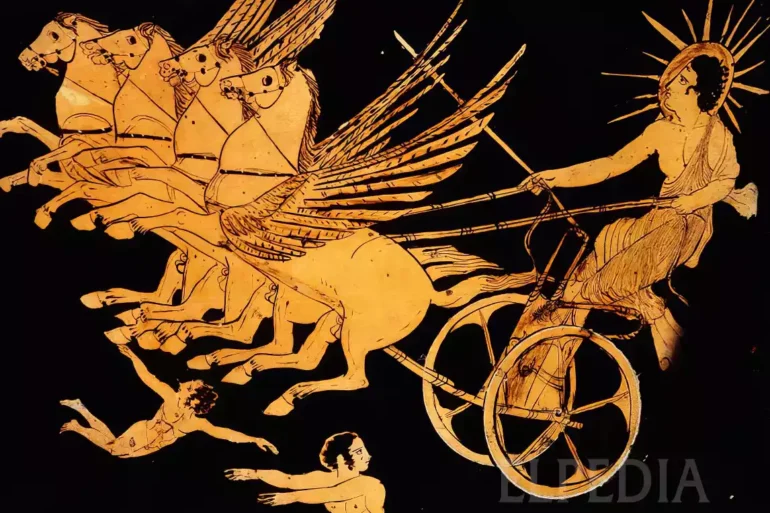
The tragic story of Phaethon who asked to drive the chariot of the Sun and caused cosmic destruction.
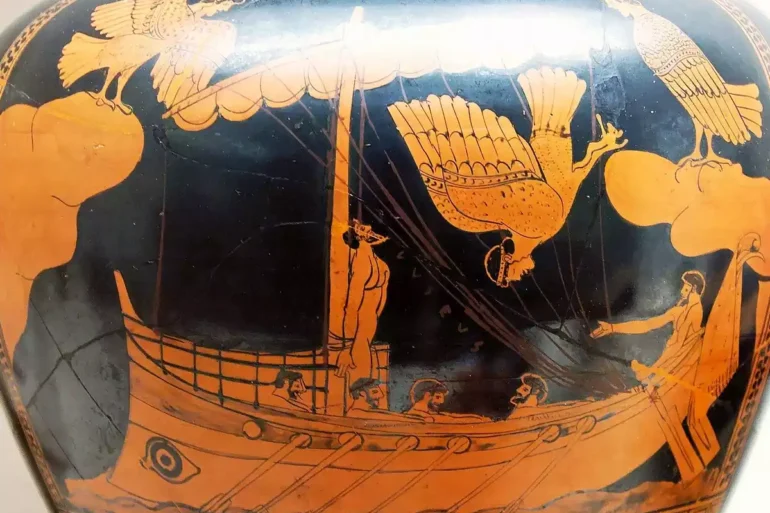
The long and eventful effort of Odysseus to return to Ithaca after the end of the Trojan War.
The story of Pan and his syrinx, one of the oldest musical instruments associated with Greek mythology.
Aeolus, the mythical keeper of the winds, is a multifaceted figure inextricably linked with natural forces.
Orestes is one of the most enigmatic and psychologically complex tragic figures in ancient Greek mythology and drama. Son of King Agamemnon and Clytemnestra, Orestes found himself at the center of a family tragedy that marked the house of Atreus. His story revolves around the revenge he undertakes for the murder of his father by his mother and her lover Aegisthus, leading to the tragic act of matricide. The figure of Orestes has been a source of inspiration for [...]
Ancient Greek mythology offers rich narratives that capture the genesis and evolution of the world through cosmogonic myths. Among these, the Overthrow of Uranus' Reign holds a prominent position as one of the fundamental episodes of the theogony. It is the narrative of the conflict between the first divine generations, where Cronus, the youngest of the Titans, overthrows his father Uranus from the power of the universe. This dramatic transition of power marks a defining point in Greek mythology and [...]
The Minotaur of Crete is one of the most iconic figures of ancient Greek mythology, embodying the complex interplay between the human and the monstrous element. This monstrous creature, with the body of a man and the head of a bull, was born from the union of Pasiphae, the wife of King Minos, with a sacred bull sent by Poseidon. Its existence is inextricably linked to the famous Labyrinth of Knossos, an architectural marvel constructed by Daedalus at the command of Minos to imprison [...]
Hercules, the most prominent hero of Greek mythology, faced twelve exceptionally demanding labors at the command of Eurystheus, king of Mycenae. The fifth of these labors, the cleaning of the Augean stables, is a characteristic example of the hero's ingenuity and cleverness. Augeas, king of Elis, possessed vast herds of cattle, whose stables had not been cleaned for thirty years. Eurystheus, aware of the magnitude of the challenge, set the condition that the cleaning be completed in just one day. [...]
The Muses, the nine daughters of Zeus and Mnemosyne, are fundamental figures of ancient Greek mythology who embody artistic inspiration and intellectual creation. Their presence in ancient Greek culture is decisive, as they served as protectors of the arts and sciences, inspiring poets, musicians, dancers, and philosophers. They resided on Olympus, where with their melodic voices they delighted the gods, and were often associated with places such as Helicon and Parnassus. Each Muse had her own distinct [...]
Atalanta is one of the most iconic figures of ancient Greek mythology, renowned for her exceptional prowess in hunting and athletics. Born in Arcadia or Boeotia, Atalanta was the daughter of King Iasus (or Schoeneus in the Boeotian version of the myth). According to tradition, her father, desiring a male heir, abandoned her as an infant on Mount Parthenius, where she was raised by a bear until hunters found her. As she grew up, Atalanta developed into an outstanding huntress, […]