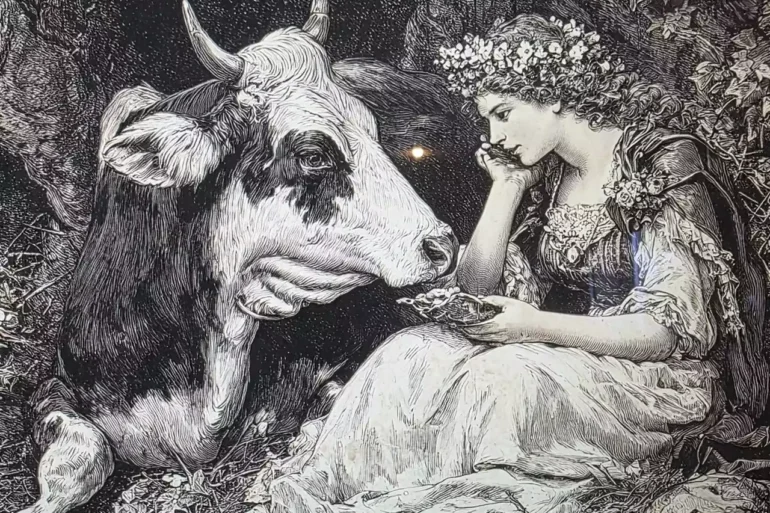
The Muses, the nine daughters of Zeus and Mnemosyne, are fundamental figures of ancient Greek mythology who embody artistic inspiration and intellectual creation. Their presence in ancient Greek culture is decisive, as they served as protectors of the arts and sciences, inspiring poets, musicians, dancers, and philosophers. They resided on Olympus, where with their melodic voices they delighted the gods, and were often associated with places such as Helicon and Parnassus. Each Muse had her own distinct [...]
GREEK MYTHOLOGY
Centaur mythology, deeply rooted in ancient Greece, presents us with some of the most compelling and mysterious figures of classical...
Discover the Orphic Mysteries: the beliefs, rituals, and Orpheus in Greek mythology.
The Amazons, the mythical warrior women of antiquity, hold a prominent place in Greek mythology. Despite the fact that their historical existence remains controversial, the legends and myths surrounding these iconic figures have fascinated generations of people over the centuries. Through ancient narratives, the Amazons are depicted as strong, independent, and fearless women who defied the social norms of their time. The mythology of the Amazons has its roots in ancient Greece, with numerous references in [...]
Meet the twelve gods of Olympus, their unique powers, and their indelible influence on ancient Greek culture and Greek mythology.
The Nemean Lion, a creature of frightful power and unyielding skin, was more than a mere figment of fancy. It...
In the misty, fairy-tale dawns of ancient Greek thought, where mythological imagination meets primal philosophical inquiry, the Pelasgian creation emerges as one of the most captivating cosmogonic narratives in human tradition. This cosmogonic tradition, attributed to the Pelasgians—the early inhabitants of the Greek region—represents a multi-layered myth that encompasses profound symbolism regarding the origin of the universe and human existence. This myth narrates the cosmic creation through the actions of the goddess Eurynome [...]
**Bibliography**
The Minotaur of Crete is one of the most iconic figures of ancient Greek mythology, embodying the complex interplay between the human and the monstrous element. This monstrous creature, with the body of a man and the head of a bull, was born from the union of Pasiphae, the wife of King Minos, with a sacred bull sent by Poseidon. Its existence is inextricably linked to the famous Labyrinth of Knossos, an architectural marvel constructed by Daedalus at the command of Minos to imprison [...]
The legendary friendship of Patroclus and Achilles: a story of devotion and tragedy at the heart of the Iliad. Greek mythology.
Atalanta is one of the most iconic figures of ancient Greek mythology, renowned for her exceptional prowess in hunting and athletics. Born in Arcadia or Boeotia, Atalanta was the daughter of King Iasus (or Schoeneus in the Boeotian version of the myth). According to tradition, her father, desiring a male heir, abandoned her as an infant on Mount Parthenius, where she was raised by a bear until hunters found her. As she grew up, Atalanta developed into an outstanding huntress, […]
The abduction of Persephone is a key myth for understanding the cyclicality of nature and human experience.
Depiction of the river Lethe flowing in the depths of the Underworld in Greek Mythology.