
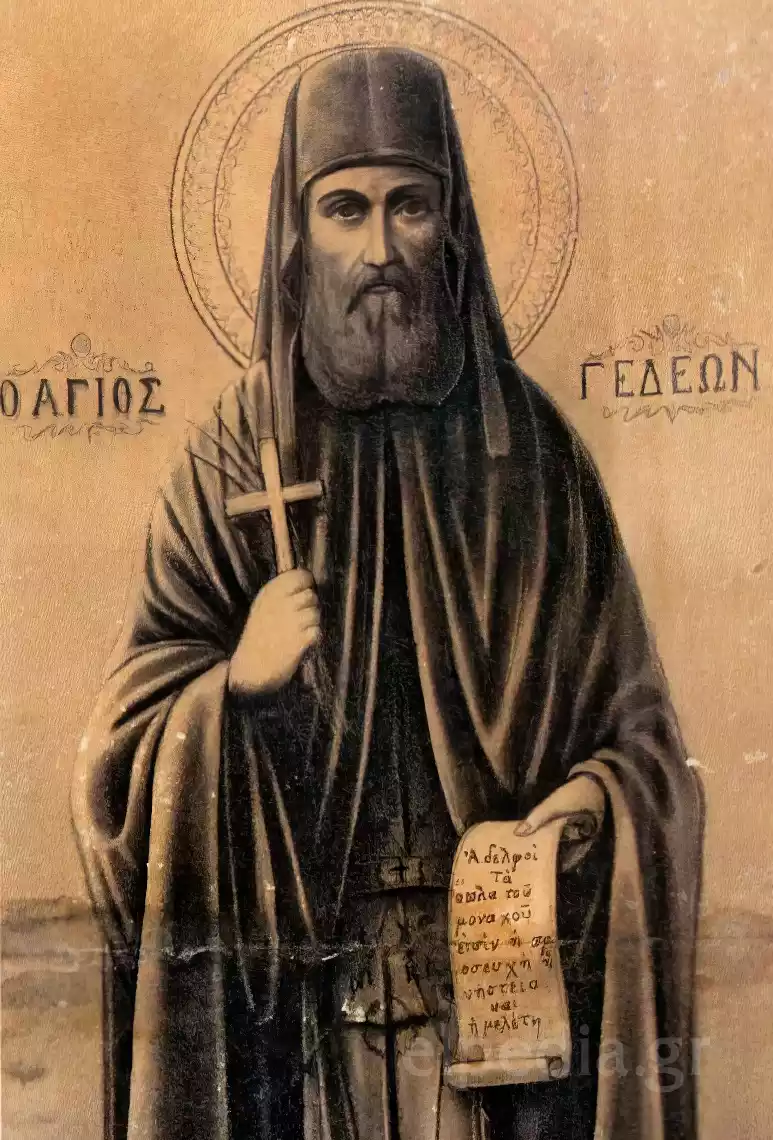
Saint Gedeon the New (New Martyr). Portable icon created in 1864. It is located in the Katholikon of the Holy Monastery of Karakallou, Mount Athos, Greece.
The history of the Orthodox faith is filled with figures who inspired and continue to inspire with their lives and their ends. One such remarkable figure is Saint Gedeon the Karakallian, a new martyr of the 18th-19th century, whose life constitutes a shocking journey from forced conversion to absolute devotion to Christ, sealed with martyrdom. Born as Nicholas around 1766 in the humble village of Kapourna (present-day Prodromos) in Magnesia, to poor parents, his life took an unexpected turn at a tender age. At just twelve years old, while he was in Velestino near an uncle, he fell victim to violent Islamization by a local Turk, who took him under his protection and renamed him Ibrahim. This act deeply marked the soul of the young Nicholas.
The realization of his act did not take long to come. Two months later, remorse overwhelmed him, leading him on a path of searching and atonement. Initially, he sought refuge in Crete, where he worked hard for three years, trying to find peace. However, his true purification would come in the Garden of the Virgin, Mount Athos. There, he found refuge in the historic Monastery of Karakallou, a place of asceticism and spiritual upliftment. During his monastic tonsure, he received the name Gedeon, marking his complete dedication to his new life. For thirty-five whole years, Gedeon lived exemplary as a monk, distinguished for his obedience, humility, and asceticism. However, the memory of his youthful denial remained a constant, painful flame within him, fueling a deep desire for the testimony of his faith.
The Path to Atonement: Life at Karakalou
The move to the monastic community of Mount Athos was the most significant life change for Nikolaos, an otherwise young man of the world. Withdrawing to this ancient enclave of Orthodox Christianity, he found the long-sought refuge and repentance that he desired.
Today, replicas of the 1990s era of Mount Athos exist. Then, as now, the Athonite peninsula was home to 20 monasteries. By the time Nikolaos arrived at Karakalou Monastery, a few years before the Great Jubilee of 2000, the Karakalou brethren had shrunk from a once-vibrant and sizable group to five to ten monks.
When Nikolaos took his monastic vows, he was bestowed with the name Gideon. This name change was not simply a matter of transferring a name from the secular world to the monastic realm. Rather, it was a rebirth: a shedding of the past and an entry into a new life devoted to a spiritual path. A life in which all choices are made with the utmost attention to their spiritual consequences—not just for the one making the choice, but also for the lives of others, especially those closely associated with the one making the choice. At least as far as the past is concerned, this is the story of a life well lived. For thirty-five years, the man who was once Nikolaos devoted himself to what monastics in the Greek Orthodox tradition understand to be the essentials of monastic life.
Even with the stellar behavior and the monastic life’s gift of spiritual serenity, Gideon was under severe pressure. He carried a dark, damaging secret from his past that nibbled away at his insides with a kind of perpetual motion that only secrets do. When he was twelve years old, Gideon was forced to convert to Islam. He hated doing it, and for years he didn’t tell anyone that he had done it. Even now, in the 1950s, 10 or 15 years later, his secret was not safe in the bag of time. It was pulsating and alive with shame and disgrace.
The Orthodox tradition, especially during times of foreign domination such as the Ottoman period, placed special emphasis on the way of martyrdom. It was viewed as the greatest kind of Christ-like sacrifice—the kind that one could safely assume would lead directly to sainthood.
Gideon’s spiritual life was deeply formed by reading the Synaxaria, the lives of the saints. He read and listened to sermons about the saints, and tirelessly paid heed to the examples they set. He idolized these figures, visionaries, and pathfinders, and not least for their capacity to bear witness to Christ. In particular, Gideon paid close attention to the lives of the Neomartyrs, who suffered unspeakable things at the hands of the Ottoman Turks. Their witness resonated so profoundly with his inner struggles that it gradually became his desire to emulate them. He began to see the path of martyrdom not only as a means of atonement for his many sins, but as the very highest, the most glorious expression of love that a poor sinner like him could ever hope to achieve.
Believing that his true purpose revolved around publicly embracing the faith he had once denounced, Gideon turned to his spiritual father, the Abbot of Karakalou. The Abbot, after some consideration, recognized in Gideon a genuine remorse for his past actions and saw a divine calling in what he was determined to do. He blessed Gideon in the presence of the monastic brotherhood. Soon thereafter, Gideon was to leave Mount Athos and return to Thessaly, where the life he had once known took a number of shocking twists.
Confronting the Past: Return to Velestino
Gideon’s path brought him back to Velestino, the town linked to his tormented childhood. This was not only a physical return to that place. It was a journey inward, a pilgrimage to the very center of his life, where he planned to confront and confess the things he’d wanted to hide even from himself.
When Gideon came to Velestino, he did not go directly to the Ottoman authorities. Instead, he performed several acts of piety and charity that made it possible for him to re-establish himself as a Christian in the not-so-pleasant to Christians community of Velestino.
His identity as a Christian was officially recognized once more, yet in such a way that it was, as was said, not sexually or socially attractive to those who live in that part of the world for the past 1,500 years.
Engaging in these acts made it possible for Gideon to wind up his presence in that community at the time.
The pivotal moment arrived when Gideon presented himself before the local Turkish officials. Boldly and unequivocally, he declared his unwavering faith in Jesus Christ and renounced Islam and its prophet, Muhammad, condemning the religion forced upon him decades earlier in that very town of Velestino (Paparounis). The officials were initially bewildered, perhaps dismissing him as mentally unstable, or having a “salos” (a term that means being mentally unstable). Such acts of open defiance were rare and dangerous. However, Gideon’s calm persistence and clear refusal to retract his statement soon turned their confusion into anger. He was brutally beaten, and for three months, he was bedridden with such serious injuries that he was nearly dead.
The Trials of Tyrnavos
His recovery was only temporary. Deemed a threat to public order and Islamic authority, Gideon was transferred under guard to Tyrnavos, a larger town in Thessaly known for its significant Muslim population and administrative importance. Here, his final ordeal would unfold.
Public Humiliation and Steadfast Faith
In Tyrnavos, the authorities subjected Gideon to public mockery and degradation. They shaved his monastic tonsure, a mark of his identity, and paraded him through the streets, encouraging insults and abuse from the crowd. Yet, throughout this humiliation, Gideon reportedly displayed remarkable serenity and even joy. His composure in the face of suffering baffled and enraged his tormentors, who saw his spiritual fortitude as defiance. His unwavering faith only seemed to fuel their cruelty.
The Ultimate Sacrifice: Enduring Torture
The final act of Gideon’s earthly life was marked by horrific brutality. On December 30, 1818, his tormentors, using an axe, systematically cut off his limbs – first his feet, then his hands. Hagiographical accounts emphasize his extraordinary endurance during this gruesome torture: “he showed no sign of pain or fear, nor did he let out a groan, nor did his countenance change, nor did he close his eyes.” This almost superhuman stoicism is a recurring theme in the narratives of Orthodox martyrs, signifying divine grace sustaining them. Still alive after the dismemberment, the mangled body of Saint Gideon was thrown into the town’s latrines (Akrivos). There, amidst unimaginable squalor and agony, he finally commended his soul to God, completing his martyrdom (Akrivos).
Legacy of a Neomartyr
The death of Saint Gideon did not signify an end but marked the beginning of his veneration as a holy martyr of the Orthodox Church.
Veneration and the Holy Relics
Despite the danger, the local Christians of Tyrnavos retrieved Saint Gideon’s mutilated body from the latrines and gave it an honorable burial in the Church of the Holy Apostles. Soon after, reports emerged that his relics emanated a sweet fragrance (a traditional sign of sanctity) and were associated with miracles. In 1837, a portion of these precious relics was solemnly transferred back to his monastery of repentance, Karakalou, where they are treasured and venerated to this day (Papastratos). The remaining relics are enshrined in the Church of the Panagia Faneromeni in Tyrnavos, serving as a focal point for devotion. His service (Akolouthia) was composed, preserving his memory liturgically.
Saint Gideon in Local Consciousness
The story of Saint Gideon resonates deeply within the local culture of Thessaly, particularly in Tyrnavos and the surrounding region, as well as on Mount Athos. He is remembered not just as a historical figure but as a powerful intercessor and a symbol of unwavering faith during the difficult centuries of Ottoman rule. His veneration is woven into the fabric of local Orthodox piety. The presence of his relics, both in the bustling town of Tyrnavos and the serene monastic environment of Karakalou, serves as a tangible link to his sacrifice and a continuous source of spiritual strength and regional identity for the faithful. His feast day on December 30th is celebrated with particular reverence in these areas.
Depiction of Saint Gedeon (1766-1818), patron of the Monastery of Karakallou. Drawing (20th century) preserved in the Holy Monastery of Karakallou, Mount Athos, Greece.
Epilogue
Saint Gedeon the Karakallian stands as a timeless symbol of the power of repentance and unwavering faith. His life, a journey from tragic fall to ultimate sacrifice, serves as a powerful testimony to the transformative power of God’s grace and the human capacity for spiritual resurrection. His martyrdom in Tyrnavos was not merely an end, but the sealing of a life dedicated to atonement and love for Christ. The reverence with which his memory is surrounded, both in the Monastery of Karakallou and in Tyrnavos and more broadly in Thessaly, demonstrates the profound impact he had and continues to have on the souls of the faithful. Saint Gedeon reminds us that even through the darkest moments, hope and return to God are always possible, and that true faith can overcome any fear and pain.
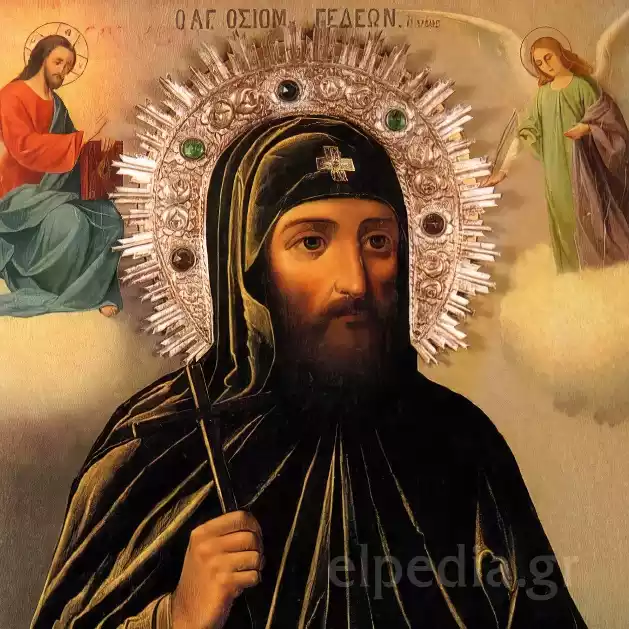
Saint Gedeon the Karakallian. Portable icon of the 20th century from the Holy Monastery of Karakallou, Mount Athos. It depicts the holy new martyr in monastic attire.
Frequently Asked Questions
Who was Saint Gedeon the Karakallian?
Saint Gedeon the Karakallian (born Nicholas, 1766-1818) was a Greek Orthodox monk from Kapourna, Magnesia. He was violently converted to Islam at a young age, but repented and lived as a monk for 35 years at the Monastery of Karakallou on Mount Athos. He returned to the place of his denial, confessed his faith, and was horrifically martyred in Tyrnavos.
Why is Saint Gedeon called a New Martyr?
Saint Gedeon is classified among the New Martyrs of the Orthodox Church because he was martyred for his faith in Christ during the period of Ottoman rule (specifically in 1818). The New Martyrs are saints who suffered torture and death from the Ottomans, refusing to renounce Christianity, often after previous (forced or voluntary) conversion.
Where did the martyrdom of Saint Gedeon take place?
The final martyrdom of Saint Gedeon took place in Tyrnavos, Thessaly. After confessing his faith in Velestino and initially suffering torture there, he was transferred to Tyrnavos where, after public humiliation, he suffered horrific tortures (dismemberment) and ultimately surrendered his spirit on December 30, 1818.
What happened to the relics of Saint Gedeon?
The precious relics of Saint Gedeon were initially buried with honors by the Christians of Tyrnavos in the Church of the Holy Apostles. In 1837, a portion of his relics, which are considered fragrant and miraculous, was transported to the Monastery of Karakallou on Mount Athos. The remaining relics of the saint remain in Tyrnavos, in the Church of Faneromeni.
When is the memory of Saint Gedeon the Karakallian celebrated?
The Orthodox Church honors the memory of our Holy and God-bearing Father Gedeon the New Martyr, the Karakallian, on December 30 of each year. On this day, festive services are held, particularly at the Monastery of Karakallou and in Tyrnavos, where his precious relics are kept.
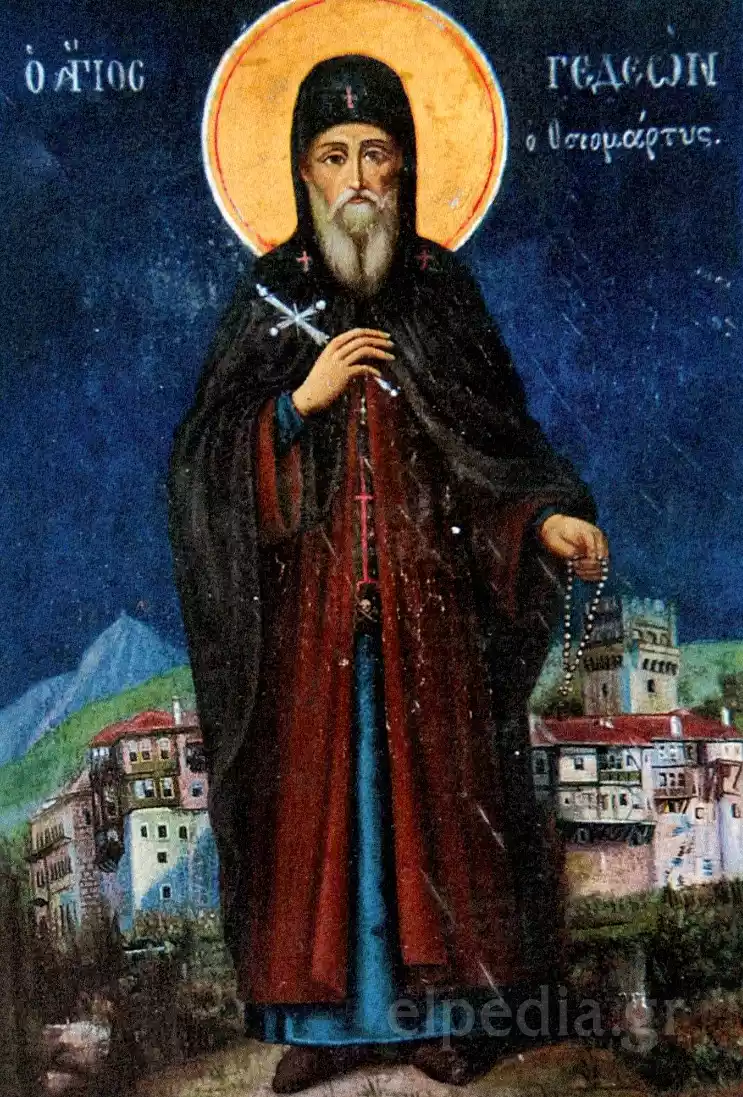
Saint Gedeon the Karakallian (1766-1818). Portable icon of the 19th century from the Holy Cell of Archangels – Averkaioi in Karyes, Mount Athos, Greece.
Bibliography
- Akrivos, Kostas. Pandemonium. Kedros, 2007.
- Conomos, Dimitri E., and Graham Speake. Mount Athos, the Sacred Bridge: The Spirituality of the Holy Mountain. Peter Lang, 2005.
- Gedeon, Manuel I. “The” Athos: memories, documents, notes. From the Printing House of the Brotherhood of Theologians “Life”, 1885.
- Loukas, Nikolaos. Mount Athos: the sacred polity. Edition of the Holy Community of Mount Athos, 2008.
- Paparoounis, Panagiotis N. Ottoman Rule: Fall, genocide, administration, justice, …. 1979.
- Papastratos, Dory. Paper Icons: Greek Orthodox Religious Engravings, 1665-1899. Recklinghausen; Papastratos, 1990.


