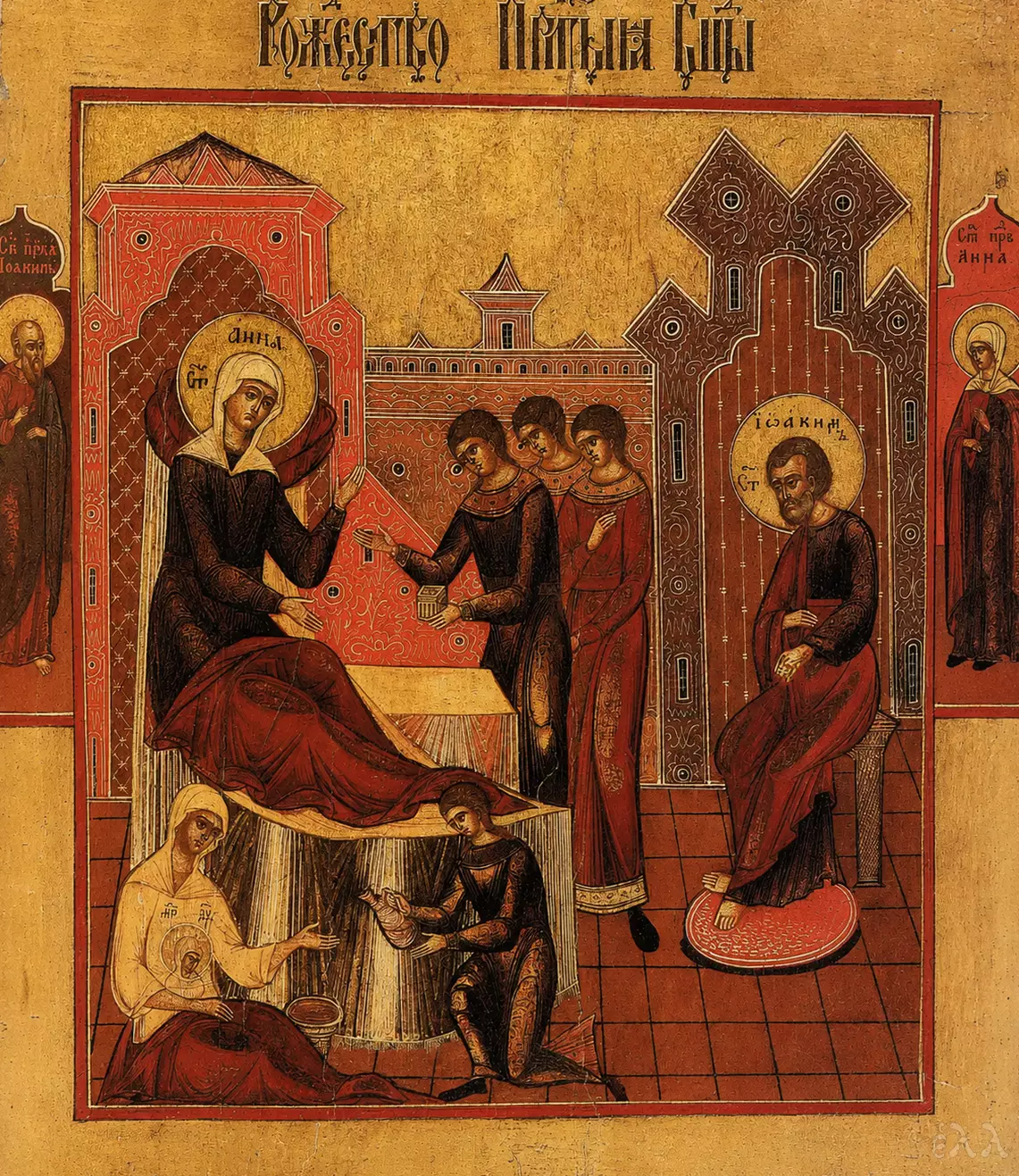
A nineteenth-century Russian icon of the Nativity of the Theotokos, painted by an unknown hand and now held in the Galleria Antiquaria in Rome, gathers into one field several episodes at once: Saint Anne’s confinement, the household attendants, Joachim set apart, the newborn being bathed. Not a single scene but a constellation of them. The composition rests on an iconographic scheme far older than the panel itself, one shaped in Byzantine workshops long before it reached Russian painters, who received it, adjusted it, and passed it on. A Church Slavonic inscription runs along the upper margin, naming the event for anyone who might otherwise mistake it.
Saint Anne dominates. She reclines on a high bed draped in deep red, turned almost frontally toward the viewer yet inclined slightly toward the women who approach. Behind her a red architectural mass rises — dense, ornamented, and pointedly unconcerned with the proportions of any real room. This is architecture that does not describe space so much as organize it: dividing, framing, enclosing. Gold ground shows through between the structures. Towers, patterned walls, sharply drawn roofs press the setting into a shallow field where nothing recedes.
None of this narrative comes from the canonical Gospels, which say nothing of Mary’s birth. It was the Protoevangelium of James, a second-century apocryphal text, that supplied the episodes — Anne’s confinement, the attendants, the ritual bathing of the infant — and these passed into Byzantine visual tradition, where they remained fixed for centuries within Orthodox art.
The Russian Nativity of the Theotokos icon and its Byzantine inheritance
Three attendants move toward the bed from the center of the panel, one carrying small vessels ahead of the others, their forms overlapping as they follow. There is no urgency in this movement. Rather, through the repeated curves of drapery and the inclination of heads, a slow and deliberate procession takes shape, drawing the eye toward Anne, who anchors it by sheer scale. Hierarchy here is not stated; it is built — through size, through placement, through the logic of enclosure.
Beneath the bed a smaller episode unfolds, almost on its own terms. A seated woman holds the newborn Theotokos, already marked by a halo, while a second attendant kneels at a vessel to bathe her. Small, domestic, compressed nearly out of view beneath the monumental bed above it — and yet indispensable, since no version of this iconographic formula omits it. Several moments of a single event thus occupy the same pictorial space without collapsing into one: birth above, infant care below, household ceremony at the center, and Joachim, apart from all of it.
That last separation is worth pausing on. Joachim sits alone on the right, before a tall architectural block, his body angled inward and his head bowed — a posture reinforced by the circular red footrest beneath him, which isolates him further still. Older Byzantine and Post-Byzantine images do this too, keeping the father at a remove from the birth chamber while the women occupy Anne’s space exclusively; in this Russian panel, though, the separation has hardened into something closer to architecture itself, with Anne and Joachim each confined to a distinct enclosed field.
Color does the rest of the dividing. Vermilion and darker reds govern the buildings, garments, and furnishings, set against black, brown, and muted passages elsewhere in the clothing. The gold ground, extensive and unbroken, supplies luminosity rather than depth — there is no atmosphere here, only surface. Fine white lines trace the architectural ornament and the folds of textiles, and although individual faces carry enough tonal modeling to avoid total flatness, the image as a whole stays linear, compressed, decorative.
The painter’s name is lost. He worked, evidently, within a culture where fidelity to an inherited model mattered more than any claim to individual invention — though fidelity did not mean identity. Russian workshops took the Byzantine compositional structure and reworked it each time through color, ornament, local habit, the particular handling of a given figure. What stands out in this nineteenth-century example is the sheer architectural excess: façades dense with linear ornament, roofs pitched sharply, windows narrow, borders elaborated almost past necessity. The buildings seem to participate directly in the story, separating one human action from the next even as the gold field binds them all together.
Standing haloed figures occupy the narrow lateral zones, set apart from the central episode but not disconnected from it, extending the icon’s sacred framework outward without loosening the narrative’s hold on its center. And at that center: a mother at rest, attendants in motion, an infant bathed, a father seated in silence — four separate actions, one birth. Painted in Russia some six centuries after the scheme first took shape in Byzantium, the icon keeps faith with that origin even as it reworks it into something distinctly its own.