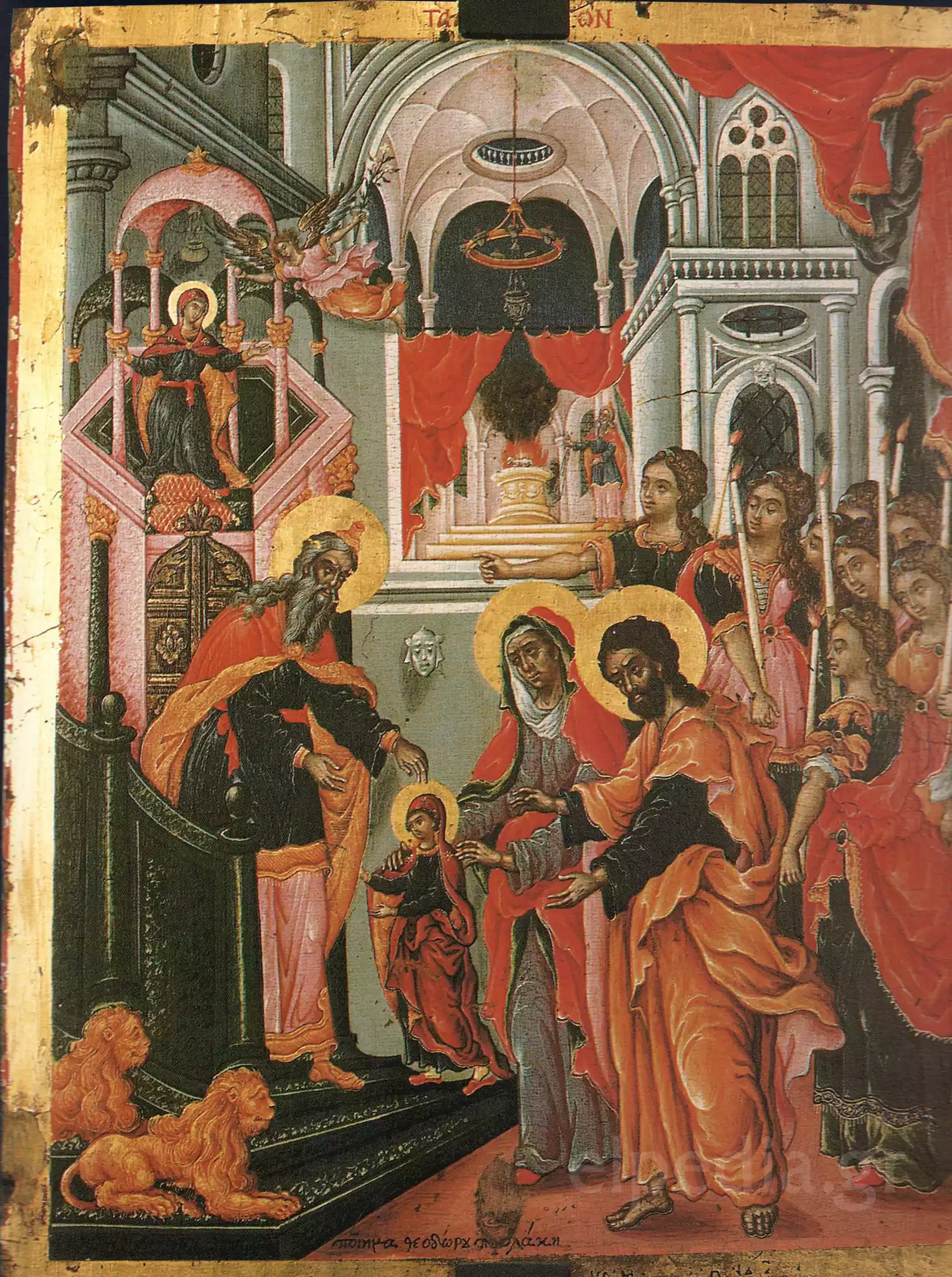
As the historical evidence of an era of deep, though often unseen, fermentations, the depicted composition opens its visual space to multiple, often conflicting readings. The end of the seventeenth century found the artistic production of the Ionian Islands absorbing the violent vibrations from the geopolitical realignments of the eastern Mediterranean and the subsequent fall of Candia. Within this fluid, suspended environment, Theodoros Poulakis (c. 1622–1692), a creator who moved from Crete to Venice, articulates his own distinct plastic proposal. Form, in his hands, does not remain inert. Utilising the traditional narration of the sacred text, the presentation of Mary in the temple moves gradually away from its narrow, exclusively liturgical use.
Indeed, the intention of a painter of that troubled period might not have been from the outset so clearly… in any case, the rupture of the traditional, absolute flatness cannot be hidden. He perceives the sacred event not as a timeless, undisturbed theophany, but as embodied action trapped within three-dimensional boundaries. This space — particularly charged with Venetian and Flemish inscriptions — refuses nevertheless to abandon its eastern root. It reconstructs it, it redefines it. Of the Palaiologan renaissance the echo, heavy still, is intersected by a post-Byzantine art which, vacillating, seeks new codes of description.
In contrast to the resplendent art of earlier centuries, here the medium demands speed, artistic skill, and steadiness, as the earthy colours attempt to capture human experience. The work, though of smaller dimensions in comparison with the monumental frescoes, retains the sense of scale through condensation.
The Architecture of Space: Attempts at Perspective
Dissolving the suffocation of the traditional compact gold, the depth retreats impetuously inwards. It retreats, creating in an almost aggressive manner positions for arched galleries and volumetric capitals that draw inspiration from classical models. A thick, red curtain dominates the right edge. Installed there as if to reveal an ongoing theatrical act in some Lombard palace, it transfers intact the vocabulary of western scenography onto the wood. Towards the left, the architectural organisation of the altar, where the small Mother of God stands upright, defines a secondary narrative centre, abolishing static frontality.
How exactly is the western, secular prototype translated into a strictly Orthodox, dogmatic environment? The method is located in the careful, perhaps even calculated, rupture of old conventions. After all, the foreign engravings that circulated widely in the workshops during those years… but perhaps we ought to focus primarily on the very management of the brushstroke and the light. In the West geometric, strict perspective; in the East the timeless, idealistic conceptual space. Poulakis attempts a perilous conjunction — old ideologies encapsulated in modern, Renaissance bodies — setting up practically an architectural screen.
Light, Dimensions, and the Mundane Scale
At the base of the grand staircase, two voluminous lions silently observe the scene. Seated passively, they register their own, almost sculptural, monumentality upon the marble floor of the temple. And the light strikes harshly upon the stone surfaces, and the shadows deepen in the folds of the garments, and the old hierarchies of dimensions are definitively abolished.
The draughtsmanlike rendering of the buildings around, though at times awkward in its strict perspective consistency, compels the eye to wander. It wanders across decorative details, across arches and galleries, which serve no theological necessity. They claim, simply, the autonomy of the painting act, released from the need to serve blindly the sacred dogma.
The Central Episode: Joachim, Anna, and Zacharias
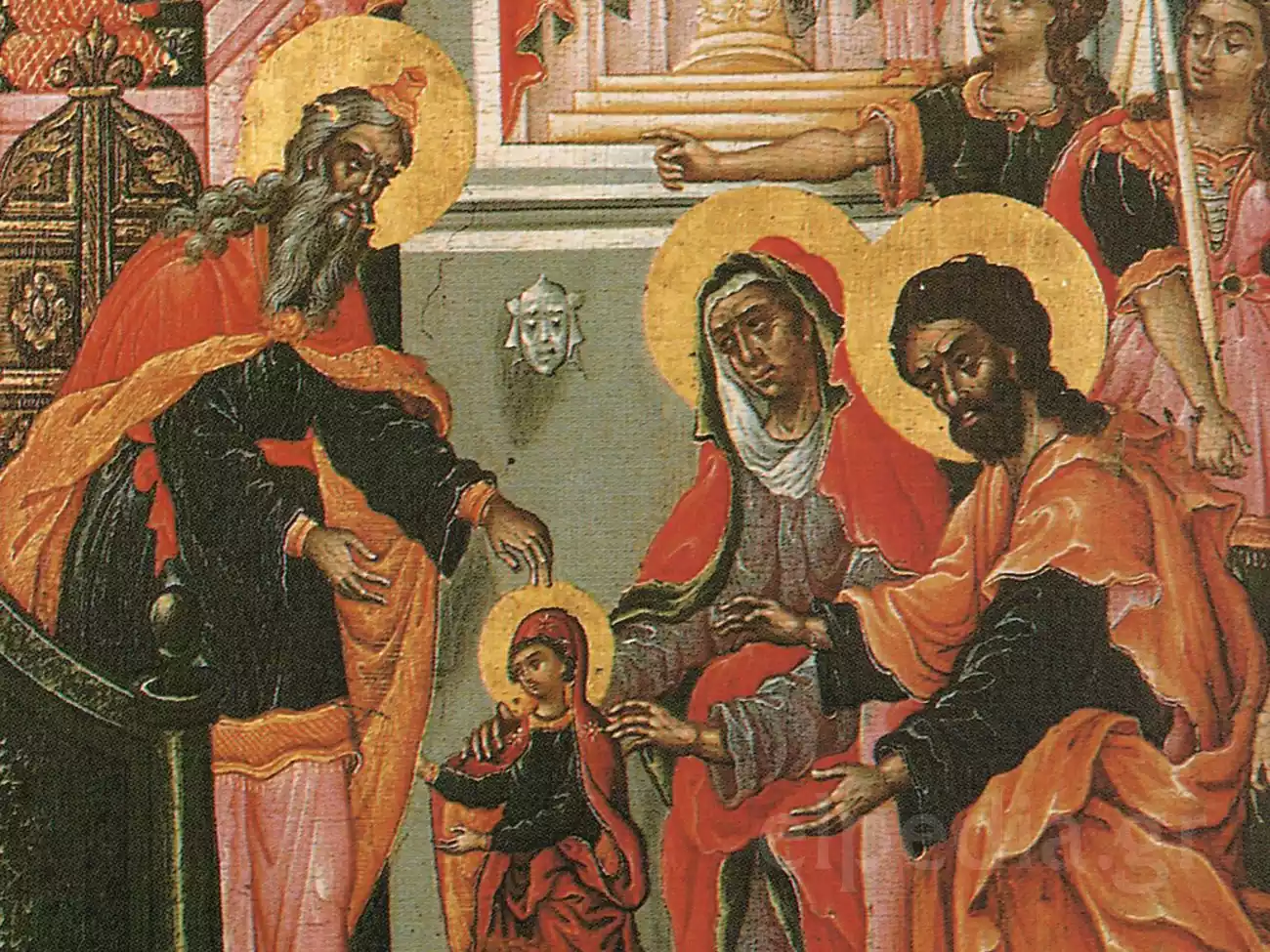
Shifting the visual attention to the narrative core, the gravity of the composition is located entirely in the gestures. The high priest Zacharias — the undeniable bearer of the Judaic, old law, austere and inflexible in appearance — extends his palms. He extends his palms to receive, perhaps even to bless, the dedicated infant. The small Mary arrests with her presence the impetuous movement. Darkly dressed, shrunken almost between the imposing bodies of the adults, she functions as the sole point of contact between the two worlds. That her transfer is realised with obvious, human hesitation removes the scene from the cold solemnity of the early Byzantine period.
Seeking Natural Volume
A harsh beard, fixed eyes, deep folds that strive, almost agonizingly, to create the sensation of a real, heavy natural body beneath the fabric. Conversely, the parents of Mary are depicted with an earthly, calm restraint. The brush — at times persistent in descriptive detail and at times slightly hurried — shapes their particular characteristics with continuous alternations of warm and cool tones. Of the elderly, weary figures the presence lacks the rigid idealisation which the older, mid-Byzantine canons unalterably demanded.
Not only the heavy garments, but also the very stance of the bodies reveals triumphantly the transition of art. Of Anna the fingers, slender, marginally touch the body of her child. An imperceptible, almost hidden resistance is located in this ultimate gesture. The intense orange of her hymation develops a pulsating chromatic surface, whilst her movement itself retreats, silently, backwards.
The Female Escort: Urban Borrowings
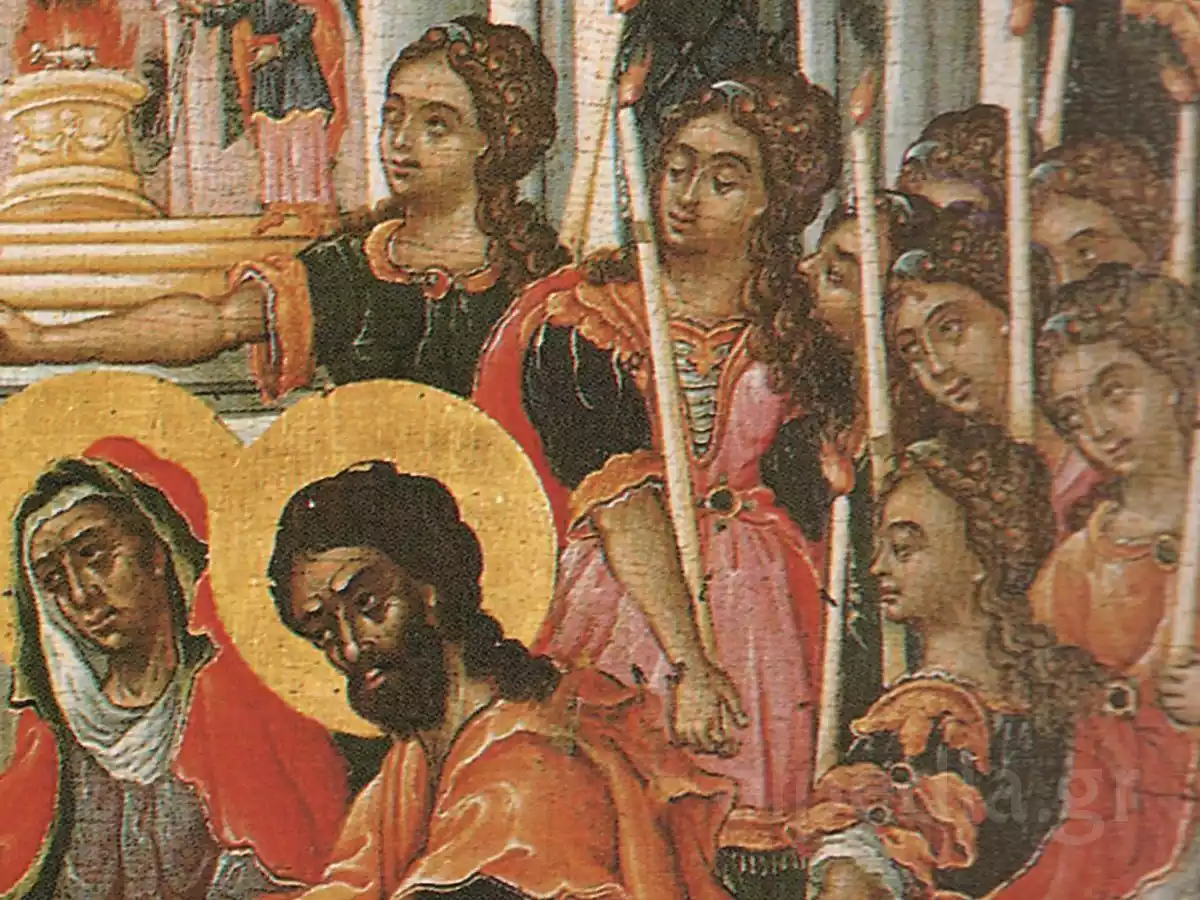
The scholar often wonders how exactly everyday life penetrates the strict, almost inaccessible boundaries of religious narrative. In the right part of the composition, the answer is set forth explicitly, without a trace of guilt or inhibition. The dense group of young girls completely rejects the abstract, levelling uniformity of the past. They hold high candles in their hands, yet their human substance is henceforth registered within a purely secularised framework, devoid of angelic attributes.
Garment as a Social Symbol of the Era
Flemish, intricate hairstyles, elaborate knots, heavy fabrics that outline the shoulders — these young faces bear indelible traces of Venetian urban life. I often think, observing their gleaming necklaces… possibly this kind of excessive decorativeness detracts something from the essence. But perhaps it is preferable to remain with the purely technical, visual rendering of the forms. The open décolletages and the precious, glittering gems witness to a society deeply familiar with European materiality, perfectly capable of integrating it into its devotional practice.
At times painting was blindly subordinated to the theological text, at times the text was used simply as a specious pretext for free painting. Here we see clearly ladies of the rising bourgeois class of the seventeenth century. They participate in the action not as transcendent, immaterial entities, but as living witnesses of a fluid era. An era, precisely, which pressingly demanded of the icon to reflect, even fragmentarily, its own historical reality.
The Material Trace and the Suspended Step
Of the wood the inherent limitations trap, and often frustrate, the broader spatial intentions of the creators. We observe the old, traditional gold ground retreating desperately. Retreating, almost suffocating beneath the voluminous architectural members and the heavy, luxurious scenic hangings of the Baroque. This specific material evidence, masterfully incorporating the deep contradictions of its era, records with chilling accuracy the existential anxiety of the art of those decades.
And whilst the general disposition of the central persons seems to declare an unshakable stability, the very texture of the applied colours betrays internal fluidity. The brush of the Cretan artist searches constantly for impossible balances between Byzantine memory and contemporary, Renaissance experience. It retains nevertheless, unintentionally, the decay which historical time ruthlessly imposes upon ideas.
The protagonists systematically avoid direct eye contact. They turn towards points, often indeterminate, outside the centre, completely surrendered to a silent internal process. A hand remains suspended slightly beside the fabric, casting a faint shadow on the marble floor of this history.

