The Supreme Expression of Palaeologan Art as a Historical Document
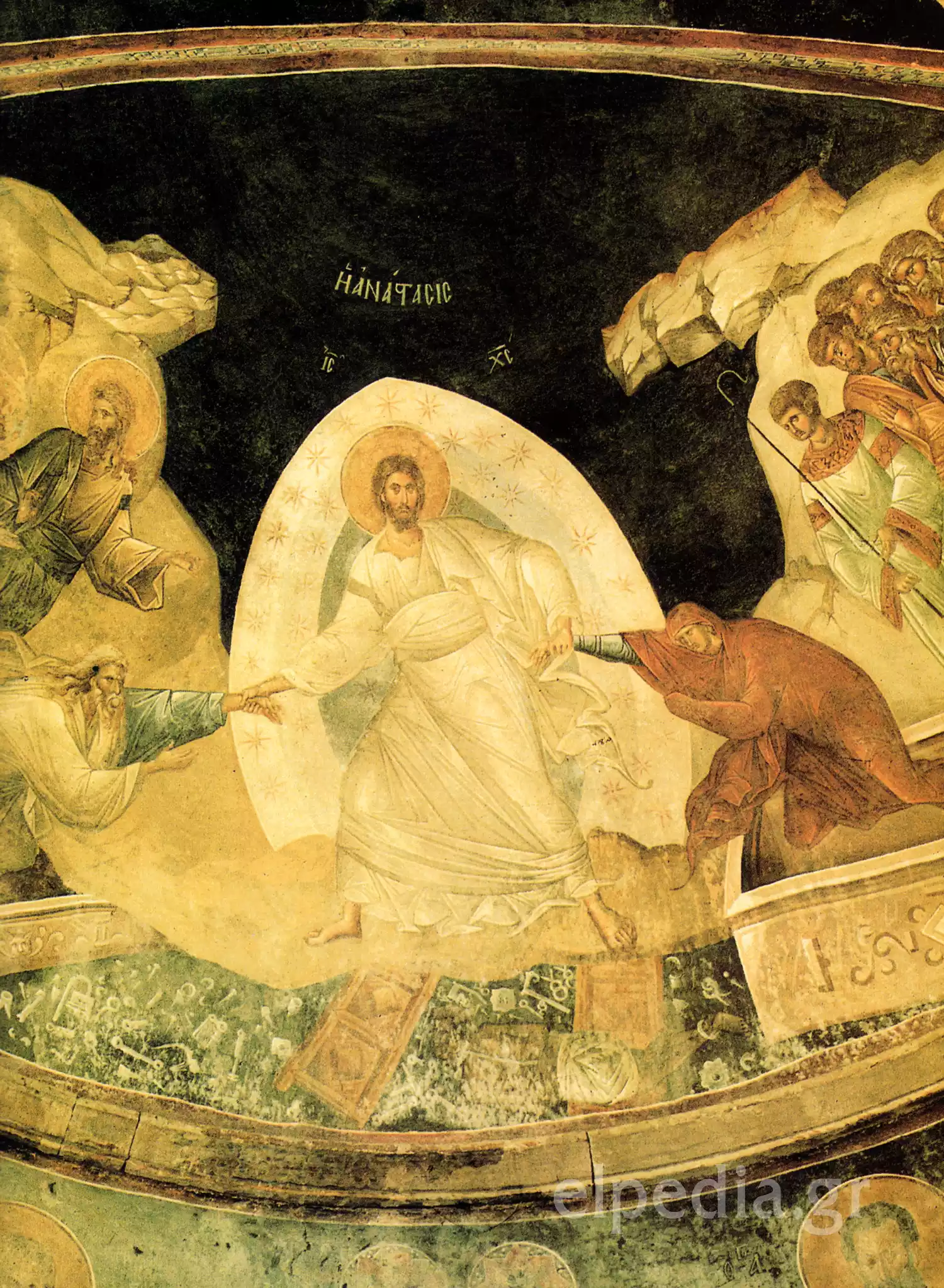
Offspring of the 14th century. A wall painting of the Descent into Hades, crafted by an unknown artist of the Palaeologan Renaissance, adorns the funerary chapel of the Monastery of the Chora —now known as Kariye Camii— in Constantinople. As a historical document, this work surpasses its strictly religious role, offering an invaluable lens for the study of the ideological, artistic, and cultural ferment of the late Byzantine period. We are not merely examining a dogmatic representation; we stand before a visual archive that encodes the spiritual agony of an entire empire shortly before its decline.
In this enclosed space, the materials —the precious pigments that were spread with rare mastery upon the damp plaster— have managed to withstand the decay of time. It was an epoch where in the Monastery of the Chora works were placed designed to provoke awe, incorporating the imperial patronage of Theodore Metochites in every trace of the brush. Then, the natural light, slipping through the narrow openings, would bathe the wall. It would emphasise the dramatic quality of the lines, the intensity of the blue, the blinding white. The specific depiction constitutes perhaps the most condensed visualisation of the victory over decay. The concept of death here is not bypassed — on the contrary, it is studied, it is analysed, and in the end it is abolished through a chromatic explosion.
The Dynamics of Liberation in Space
Centre of gravity. Exactly there the composition is focused. Christ dominates, not as a figure static or transcendentally remote, but as a bearer of invincible momentum. He moves. This movement is almost violent, a diagonal assault that intersects the space of the underworld, destroying the geometry of silence.
Beneath his feet —a complex of broken planks. They are the gates of Hades. Locks, bolts, nails, all scattered in the absolute darkness, rendered with a realistic roughness that comes into frontal collision with the idealisation of the divine persons. At this point, the artist functions as a chronicler of a metaphysical subversion, using architectural elements to denote the crushing of the human fate. The light, emanating from the very body of the central figure, swallows the gloom. Or does the gloom merely retreat, waiting, at the edges of the composition? The doubt concerning the finality of this dominion over hard matter remains, however clear the theological intention may be.
Of the rocks the sharpness follows the fluidity of the garments. A contrast permanent, visually noisy. The environment is not decorative. The precipitous volumes, almost abstract in their geometric schematisation, function as a sounding board; they multiply the intensity of the action, trapping the persons in a supramundane, claustrophobic landscape which only now begins to be ruptured.
The White Garment and the Corporeality of the Act
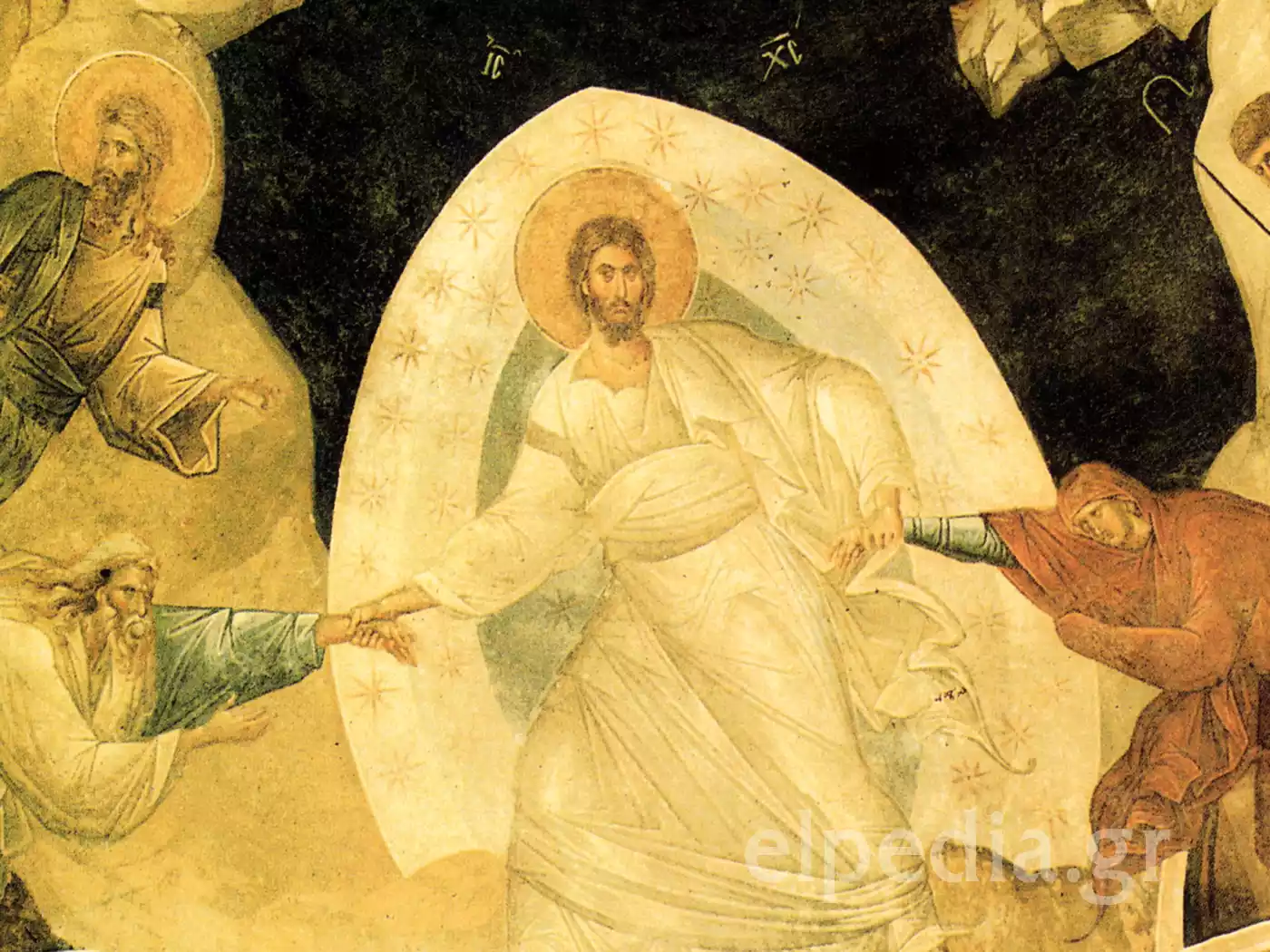
In the detail of the central figure, the observer comes face to face with the technical perfection of the Palaeologan epoch. The vesture —a mesh of white, nervous folds— radiates. It radiates not with the flatness of the older Byzantine art, but with the volume and the materiality of a fabric that is whipped by an invisible, fierce wind.
The gaze. Turned strictly downwards, fixed upon Adam. The expression does not have the slightest trace of softness. The act of salvation, as it is imprinted here, requires muscular strength. The hand of Christ closes around the wrist of the forefather, a grip almost violent, resolute. He draws him up from the sarcophagus with a physical exertion that grounds the metaphysical event. This tangible, corporeal dimension of redemption —the tightening of the wrist, the tension of the arm— reveals the renaissance, anthropocentric pulse that began to permeate the painting of the East before history arrested its course. The Redeemer here does not merely command life to return; he draws it up himself, by force, out of corruption.
The Expectation and the Memory of the Righteous
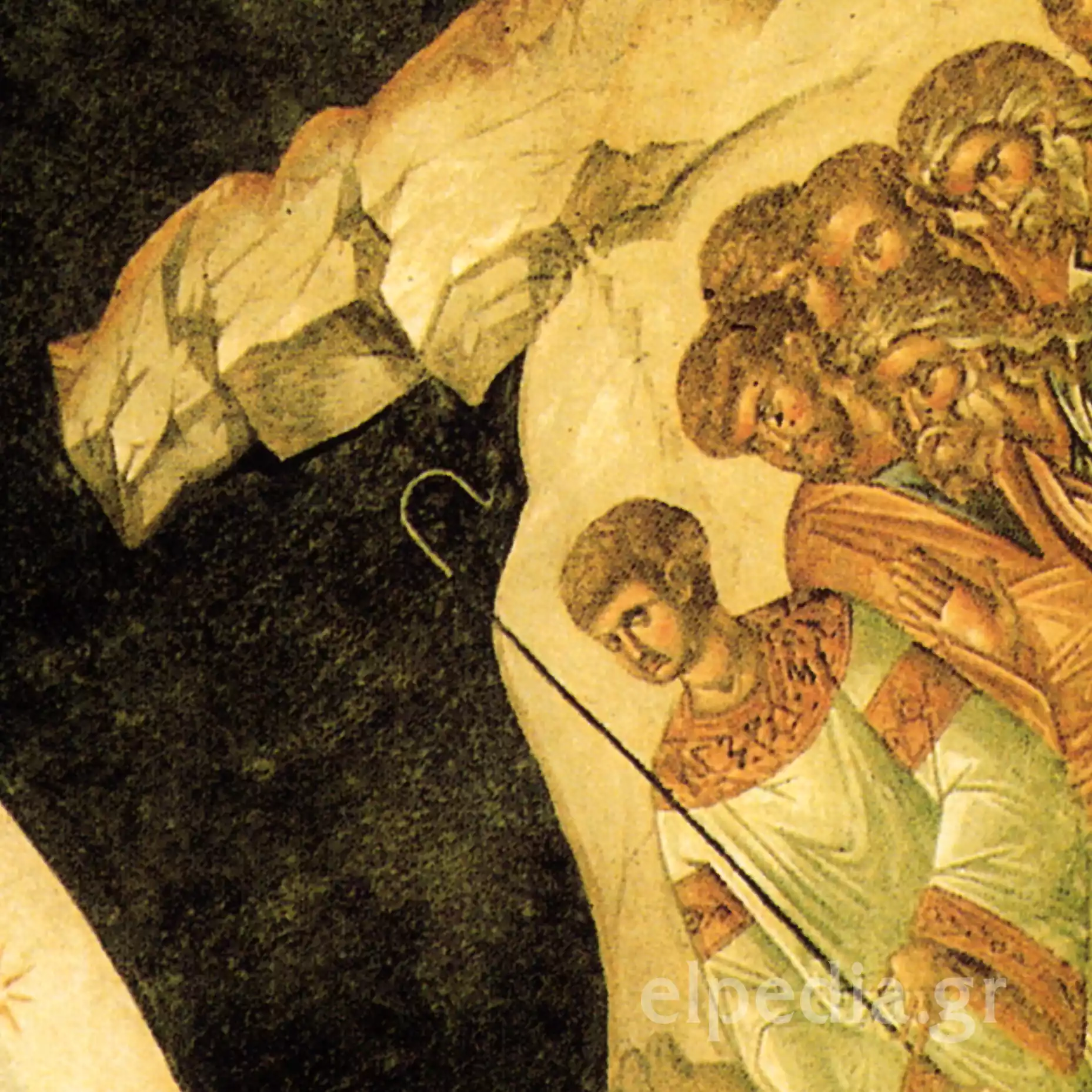
At the fringes of the central drama, the space is organised with strict hierarchy, permitting however the emotion to leak through, fissured. On the side of the resurrected proceeds humanity entire, condensed into historical and mythical archetypes.
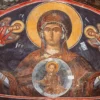
Aged, exhausted by time, Adam. His grey hair and the surprise on his face record the shock of the transition. Beside him, with garments in warm, earthy hues that emphasise her origin from the soil, Eve. Raising of the hands. Supplication. Her face, turned on high, bears the weight of centuries of guilt that is abruptly dissolved. The multitude of the righteous of the Old Testament that follows (kings with crowns, prophets with haloes) does not constitute merely an iconographic supplement. Western theology often classifies the scene as Höllenfahrt Christi, but here, in the East, it is a matter of something deeper than a simple “descent”. It is the simultaneous recall of the collective memory. These figures, pressing together at the opening of the rock, bear each one a distinct psychological character.
Observing the delicacy with which the gazes have been rendered —some full of hope, others frozen by the terror of the hell which they have just left behind— one wonders about the intentions of the creator. Did he wish, then, to transmit the certainty of rebirth, or perhaps to imprint the suspended second wherein man is unable to believe that the end was not final? The hands that are stretched out are hands that still tremble.
The composition closes, but the space dilates. The vertical intersections of the rocks, the centrifugal momentum of the garment, the falling of the doors, the darkness that is crushed — all these are organised into a wall painting that refuses to be complacent. The century that birthed this document was lost amidst the flames of changes. The colour, however, remains, trapping forever upon the wall the most violent and simultaneously fragile desire of man.
(This is a translation from the Greek text.)

