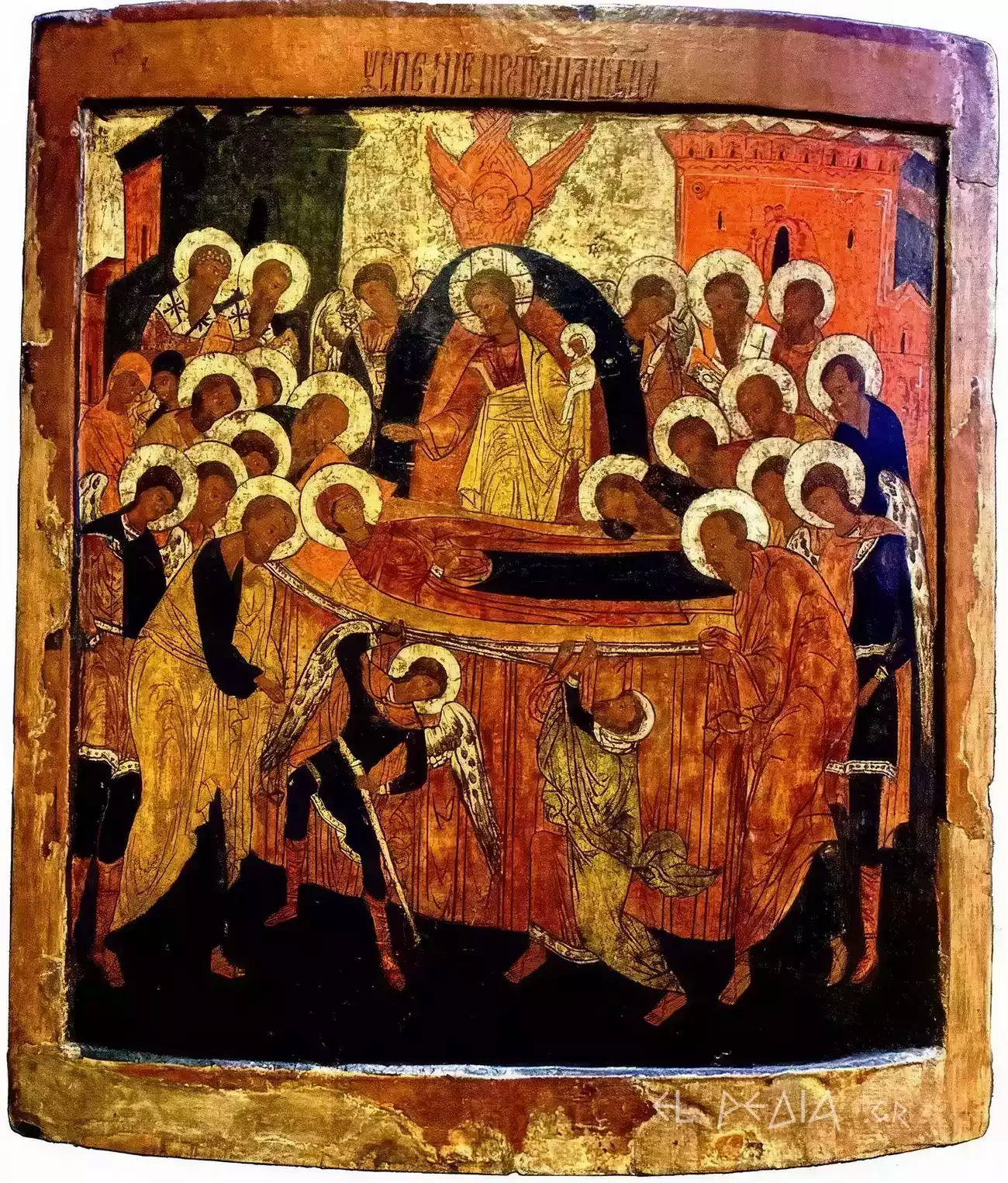
The art of the wooden surface, wrought with egg tempera and burnished gold, undertook in the Russian hinterland to salvage and reconstruct the heavy Orthodox legacy of Byzantium, harmonising it with local spiritual quests. On the threshold of the 17th century, circa 1650, a gifted but anonymous iconographer delivers his own visual interpretation to the supreme event of the Theotokos. This specific work, which is today kept at the Museum of Russian Icons in Clinton, Massachusetts, stands forth not merely as a typical devotional object; in a more penetrating, academic viewing, it functions primarily as an authentic historical document, a bearer of codified aesthetic, theological, and social fermentations of its time.
The representation of the Dormition traditionally dominates the firmament of the festal cycle of the Church. The portable icons of the period bear witness to the unbroken, though often subterranean, coherence of eschatological expectation with visual depiction. The artist here, drawing from the full waters of the renowned Novgorod School, structures a composition of a purely monumental breath. An impersonal, yet deeply noble melancholy permeates the depicted figures, as the pictorial matter is transfigured, attempting to transcend its own perishability.
Indeed, in a world constituted of strictly hierarchised symbols, the contemplation of the creation constitutes an initiation into the concept of metaphysical transition. Amidst the inviolable canon, the ascetic line and the rhetorical eloquence of colour, the creator grapples directly with the indescribable. And it is this conscious effort to contain the invisible within the strict rectangular frame that renders the work invaluable.
The Hierarchical Structure and the Style of the Main Composition
With extreme symmetry and geometricised stability, the total organisation of space is subordinated to the revelatory, almost hegemonic presence of Christ. Arrayed in the dark-coloured glory, which cleaves the gold ground like a rift in space-time, He stands exactly at the centre of the vertical axis. There He constitutes the indisputable culmination of the scene. Drawing from the rich arsenal of historical icon painting, the painter elaborates the drama with a rhythm-making mastery, consciously abolishing natural depth in favour of a reductive flatness.
Is, then, this stylised strictness of the line a dry limitation of visual imagination, as is often imputed to it? Or does precisely this absolute discipline constitute the necessary vehicle for the externalisation of the supersensory truth which Novgorod vehemently professed? The question remains in a way open, as our gaze slides continually upon the untroubled golden sky.
The gold background of the composition is not merely decorative. It functions as an active component of the narration, dissolving terrestrial perspective rules and imposing the timeless reality of the divine events. Against this imaginary, unassailable depth, the colours of matter are juxtaposed — the resonant, glorifying red and the heavy-hearted, contemplative blue. This chromatic system, remaining firmly attached to the broader theological art of the icons, is articulated with expressive audacity. The volumes acquire substance through the colour itself and the repetitiveness of the line, rejecting any suspicion of Western-style optical illusion.
In the upper section, angelic powers hover, organised in an arrangement that pulsates with restrained energy, while the two tall, slender architectural structures at the edges set the tone. They do not describe a historical city; they constitute the conceptual framework of the earthly setting. In this interweaving of the static (the bier, Christ) with the moving (the converging angels, the folds), the style of the school touches its maturity, preserving the measure.
Study in Expression: The Detail of the Central Scene
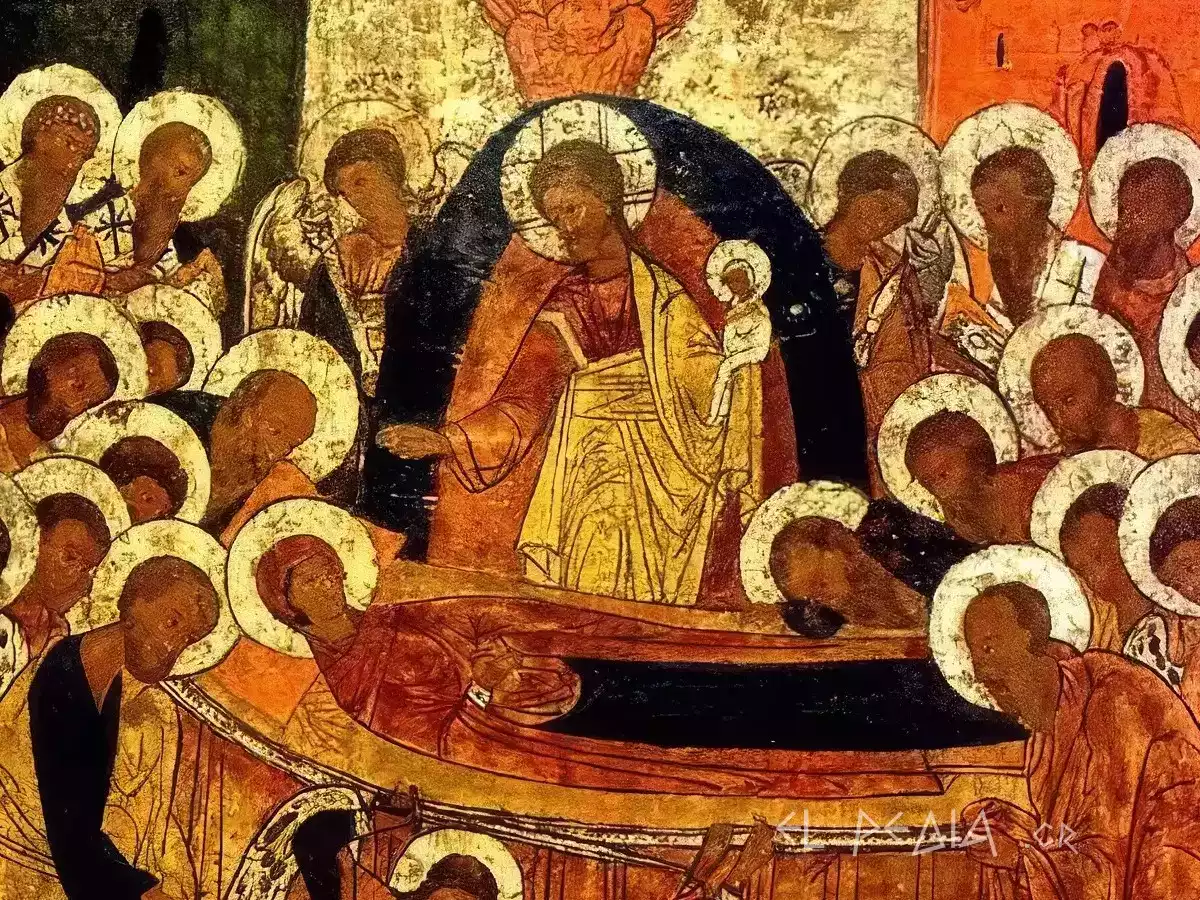
Bowed over the bier. Crushed, absorbed, reverent.
The closer focus on the central scene and on the figures surrounding the Theotokos reveals the rare plastic sensitivity of the artist to psychoanalyse without slipping into vacuous sentimentalism. The figure of the Virgin lies surrendered to absolute tranquility. The deep red maphorion that envelops her, shaped with straight, almost sharp folds, transforms her rigid, elongated body into a fundamental axis that holds the equilibrium of the entire representation. She is the pause around which the action swirls.
Entirely diametrically to the human element of loss experienced by the disciples, stands the frontal figure of the Saviour. His garments, wrought with golden highlights (assist), flash in the light, emitting ontological sovereignty. In His hands He carefully enfolds the soul of His Mother, which is visualised as a stark white, swaddled infant. This majestic, dogmatic inversion of biological roles, where the Son who was once borne in the womb now undertakes to bear the Mother into the eternal incorruptible life, is declared with a staggering naturalness.
The faces of the Apostles who are compressed on either side of the cenotaph, deserve special mention. Dark underpaintings of the flesh. Illuminations sparse, placed however with strategic precision so as to emphasise the cheekbones and the socket of the eyes. Their gazes cage the agony of a supreme separation, stripped however entirely of the theatrical lamentation that we encounter in the art of the late renaissance. Their mourning, deep-toned and internalised, is translated visually with the restrained curves on the shoulders and the contemplative inclination of the head, creating a unified, rhythmic undulation.
The Episode of Jephonias and the Narrative Momentum
Balancing between mysticism and popular narrative, the miniature-like unity at the lower extremity comes to agitate the unrippled sorrow. The presence of the Jewish priest Jephonias, who, in his attempt to desecrate and overturn the deathbed, is punished instantaneously by the angel with the severing of his hands, introduces violence within sacredness.
This acute, narrative digression is not bereft of significance. The armed archangel disrupts the soothing, horizontal motif of the scene with an aggressive, diagonal movement; his sword becomes a linear lightning bolt in the dark. The rendering of this secondary, yet theologically momentous absolute event, is connected directly with the defence of Orthodox dogma against any questioning. The artist, although obliged to incorporate the tension, does not rupture the cohesiveness of the whole. The unexpected incident acquires its own demarcated spatial imprint, enriching, instead of disrupting, the mystery of the Dormition.
Materials, Texture and the Vitality of Egg Tempera
Through the refraction of time, the very technical structure of the Russian work reveals its internal rhythms. Painting with egg tempera, rooted deeply in the visual grammar of Eastern art, imposes upon the hand of the painter the discipline of an unnegotiable precision.
Preparing the surface of the wood with successive, thin layers of warm gesso, he created a substrate that had to be absolutely clean and smooth. Upon this ridge, the colour, moulded from natural earths and rare minerals, was bound with the organic glue of the egg, solidifying into a durable, gleaming crust. If we observe the chromatic stratifications in the garments of the seated disciples, we ascertain that the tonal transitions do not arise from smooth blendings. On the contrary, they are built with successive, linear passages — from the dark underpainting towards the increasingly luminous layers — granting the garments a dynamic, almost crystalline geometry.
It is perhaps the inevitable ageing of the varnish (olifa), the gradual darkening from the smoke of the candles and the devotional use, that bestow upon the surface its current patina; the aspect of an object that has lived, breathing the historical air. The colour, although blurred locally, preserves its original vehemence. The lazurite in the garments of Christ, the restless cinnabar in the folds of the bier. Like a living organism, the work bears upon itself the marks of the past without betraying its pictorial truth.
Theological Symbolism and the Approach of the Invisible
If we delve into the eschatological meditations which the representation conceals, we are led to the core of the spiritual consciousness of the 17th century. In this late period of its flourishing, mural painting and the art of the portable panel of Russia were called upon to confess, often in the face of a hostile or tried environment, the hope of the future life.
The hierarchs who stand at the edges, with their geometrically adorned phelonia, represent the historical and liturgical continuity of the Church, referring back to the sources of tradition, Saints Dionysius the Areopagite and Hierotheus of Athens. With stances of absolute solemnity, they direct the souls heavenward and transpose the mind to the hidden liturgy of the universe. Around them, the architectural landscape traces closed, angular forms which, artfully prospectively distorted, thrust the eye to the epicentre. The dialectical relationship of the figures with the void of the upper part is bridged by the dynamic descent of Christ.
Nothing superfluous finds room in this cosmic synaxis. Every gesture — the extended palm of Peter, the lamenting flexion of Paul — acquires the weight of a dogmatic clause, confirming that the word of the Gospel took on here a tangible, didactic substance. The rebirth of the soul, freed from the fetters of earthly time, constitutes the sole certainty that the pictorial line brings.
Cleaving, in conclusion, the veil of mortality, this masterful version of the Dormition is proclaimed a visual manifesto of spiritual resilience. The paintbrush of Novgorod did not merely record an end; it orchestrated, with matchless expressive ethos and symmetrical safety, the violent transition from the pain of loss to the serenity of eternity. In this strict, silent yet also so resonant wooden microcosm, the past and the future are conflated, encapsulating in the gazes of the disciples the unquenchable agony of man before the inexplicable — conceding, however, generously the final word to the light.
(Translated from the Greek text)

