The Visual Silence and the Narrative of Colours on the Island of Ioannina
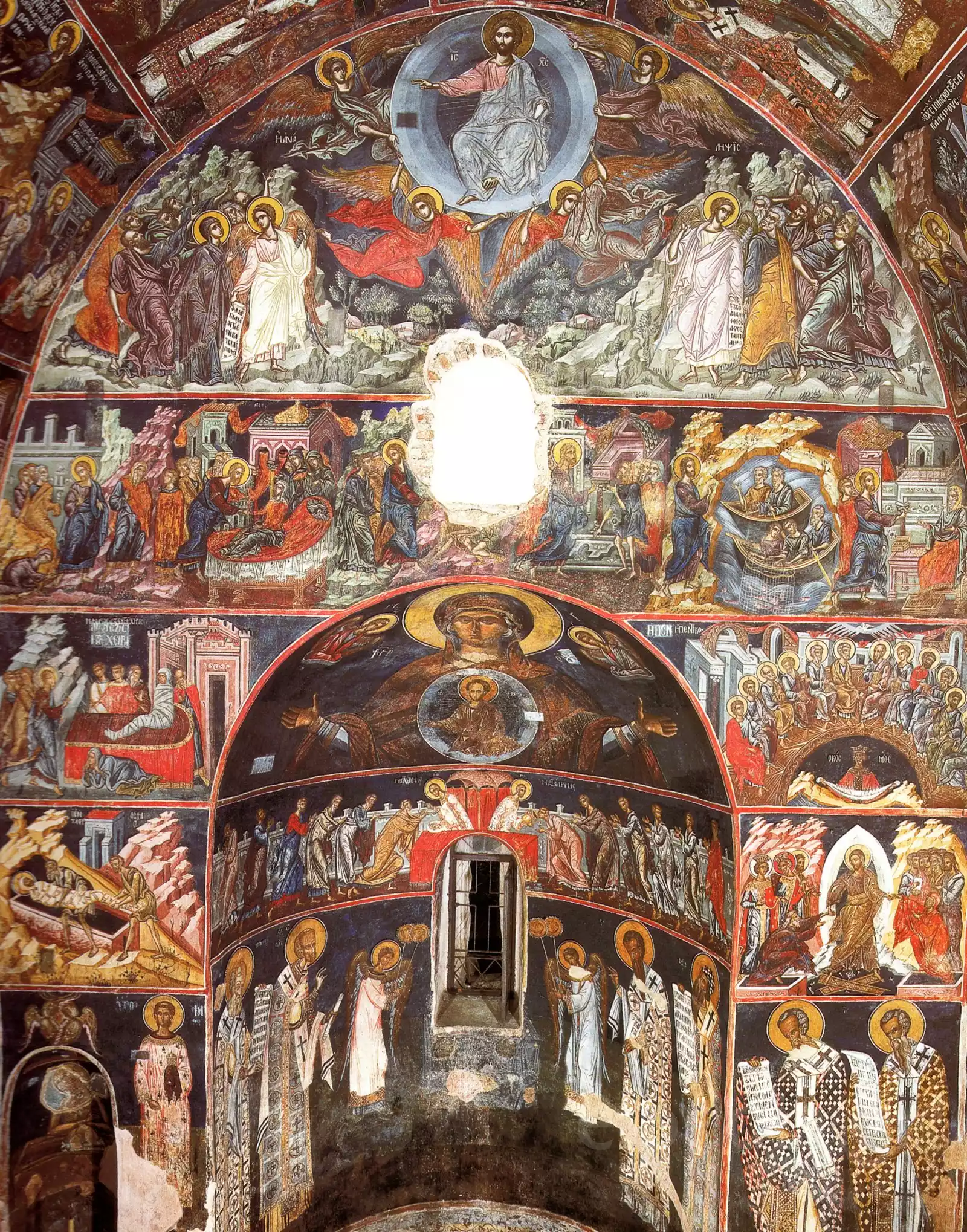
On the Island of Ioannina, the dampness of the lake seems to have passed deep into the stone, soaking the roots of the katholikon. Passing through the low door, that which welcomes you is not simply a historical space. It is a condensation of memory. The eye requires a little time to accustom itself to the shadow, to begin to disentangle the ochre from the blue within the half-light.
The monumental wall paintings that cover the walls bear the stamp of excellent craftsmen of the 16th century, a time when art was seeking ways to keep its voice alive under the weight of new conditions. A voice which here is not heard loudly, but persists. We know, moreover, that this space was not only a simple hermitage, but functioned also as a living Seat of Learning during that period.
Knowledge did not remain restricted to manuscripts; it was transferred onto the lime. Yet, observing the decoration… it is as if you understand that the craftsmen did not care only for theology. Perhaps… they simply allowed their hand to follow their internal tensions. Figures austere, lines that are interrupted abruptly, a painting that refuses smoothing. You stand in the centre of the temple and the air around these figures remains heavy.
The Ascent of the Gaze to the Central Apse
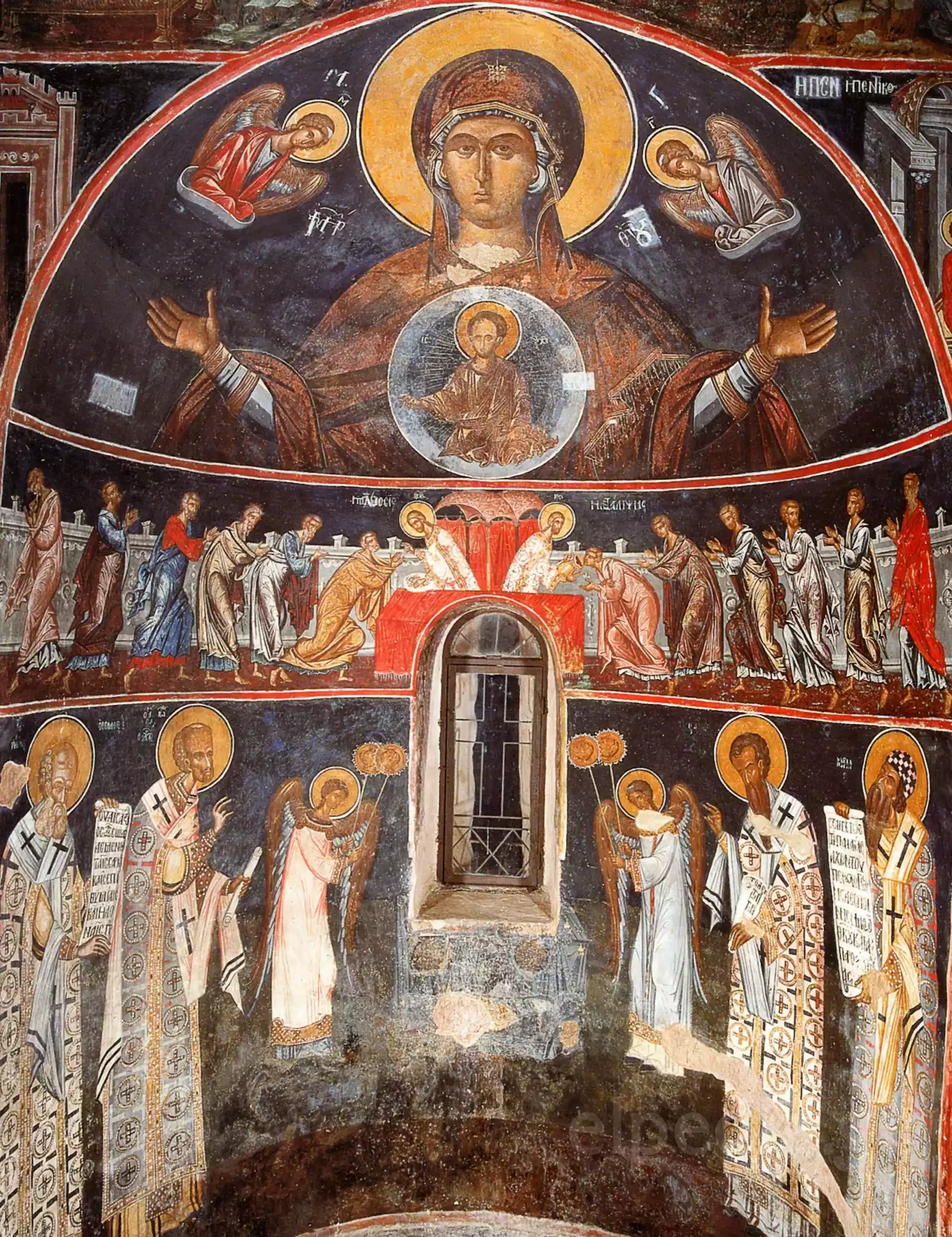
As much as you walk towards the holy bema, the attention is absorbed high above, there where the architectural curve meets the most dense meanings.
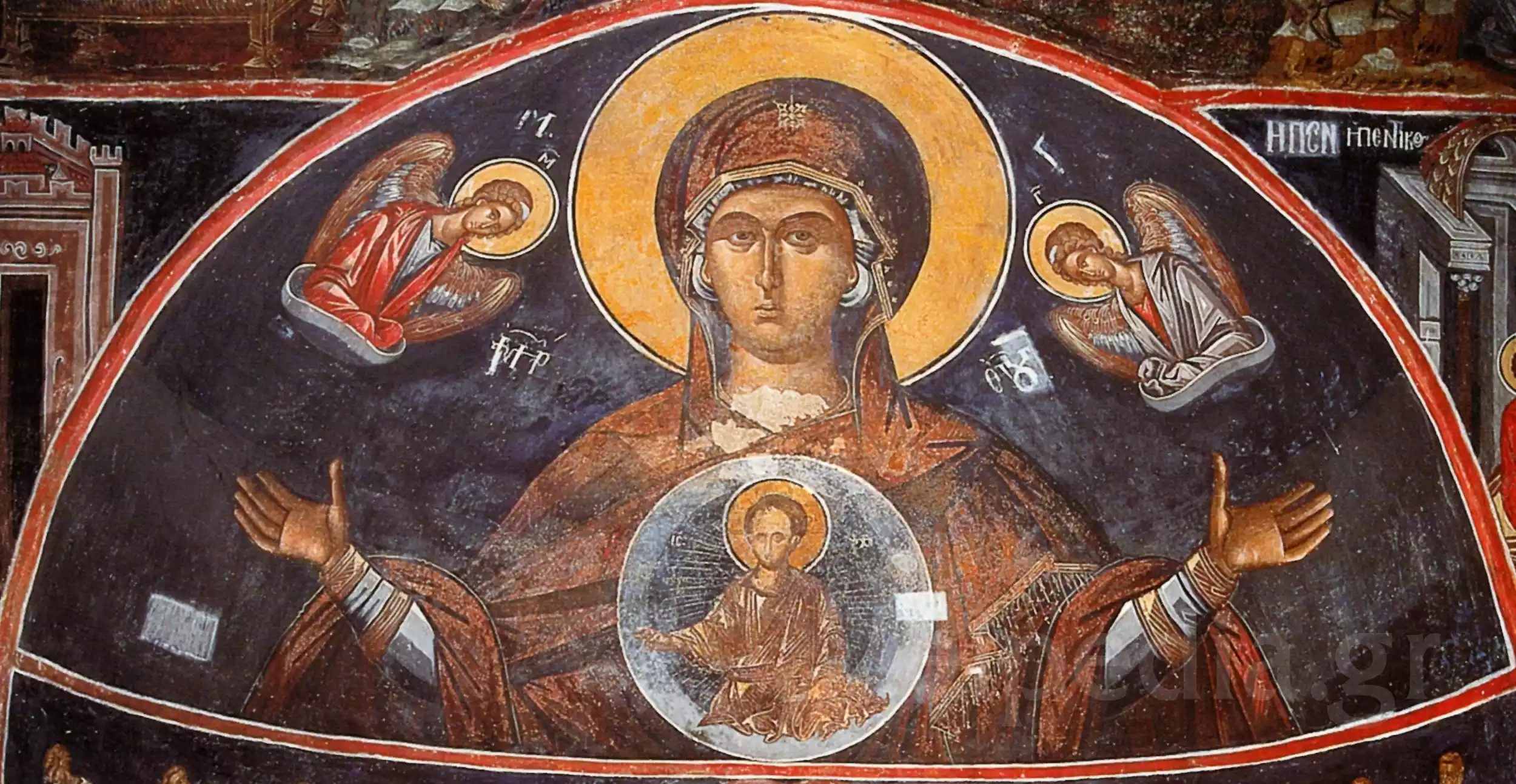
Dominant, in the conch, the Platytera of the Heavens imposes her presence through a compact, dark background. The type is the well-known Blachernitissa, with arms wide open. A movement purely supplicatory —as the bibliography would strictly note—, which, however, I perceive as a hovering embrace.
At the level of her chest, Christ emerges within a luminous medallion, bearing the characteristics of a mature, incarnate Word and not of an infant. To her right and left, the two Archangels bow slightly. Their bodies, though stationary, create an imperceptible oscillation. He who mixed the colours, —a man who probably rubbed his pigments with patience under the same cold of the lake— found the way to break the rigidity of the wall. Their gazes intersect somewhere in the void.
The Rhythm of the Communion
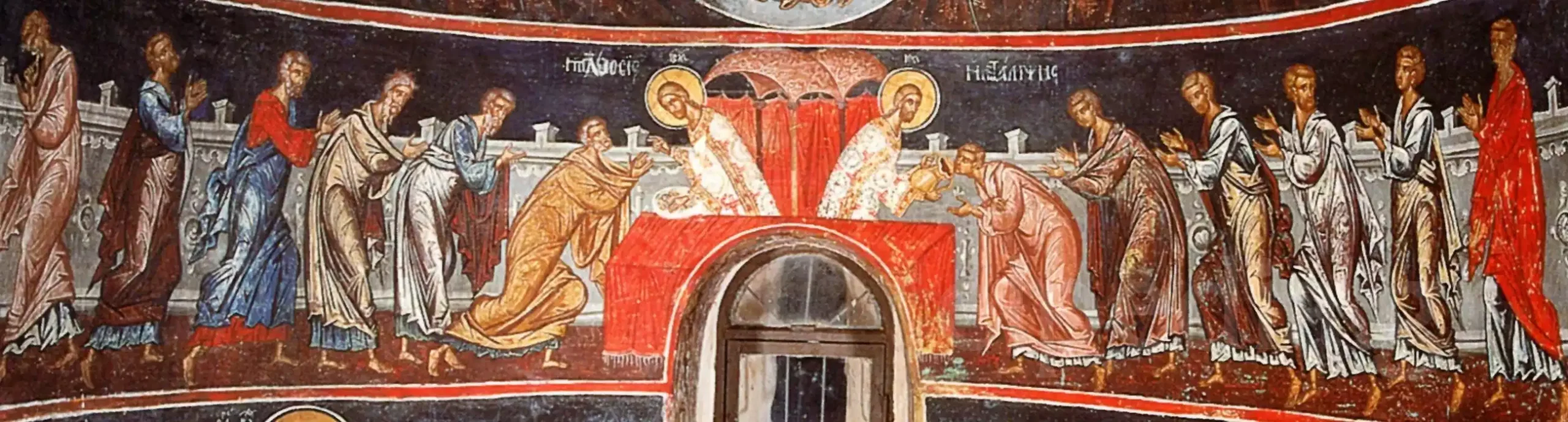
Exactly underneath, the serenity of the summit is shattered. In the zone of the Communion of the Apostles, the wall suddenly acquires speed.
Two groups of disciples, in an almost symmetrical arrangement, approach the doubly painted Christ. He wears pure white vestments, which function almost as a source of light within the earthly, rough tones of the rest of the composition. A ciborium in the background gives the necessary sense of space. Looking at the pacing of the Apostles, you notice that they do not move as a mass. Each one has a distinct, imperceptible differentiation in the inclination of the shoulder or in the extension of the hands.
And there, on the edge to the left, Judas. He turns his body towards the exit. His face half-hidden, his back turned to us — and… I do not know, it is as if all the doubt of human nature was condensed in this abrupt turn of the torso. He departs, transferring the tension outside the frame of byzantine painting.
The Gravity of the Fathers
Lowering the gaze to the level of the hierarchs, the momentum subsides abruptly. We return to staticity.
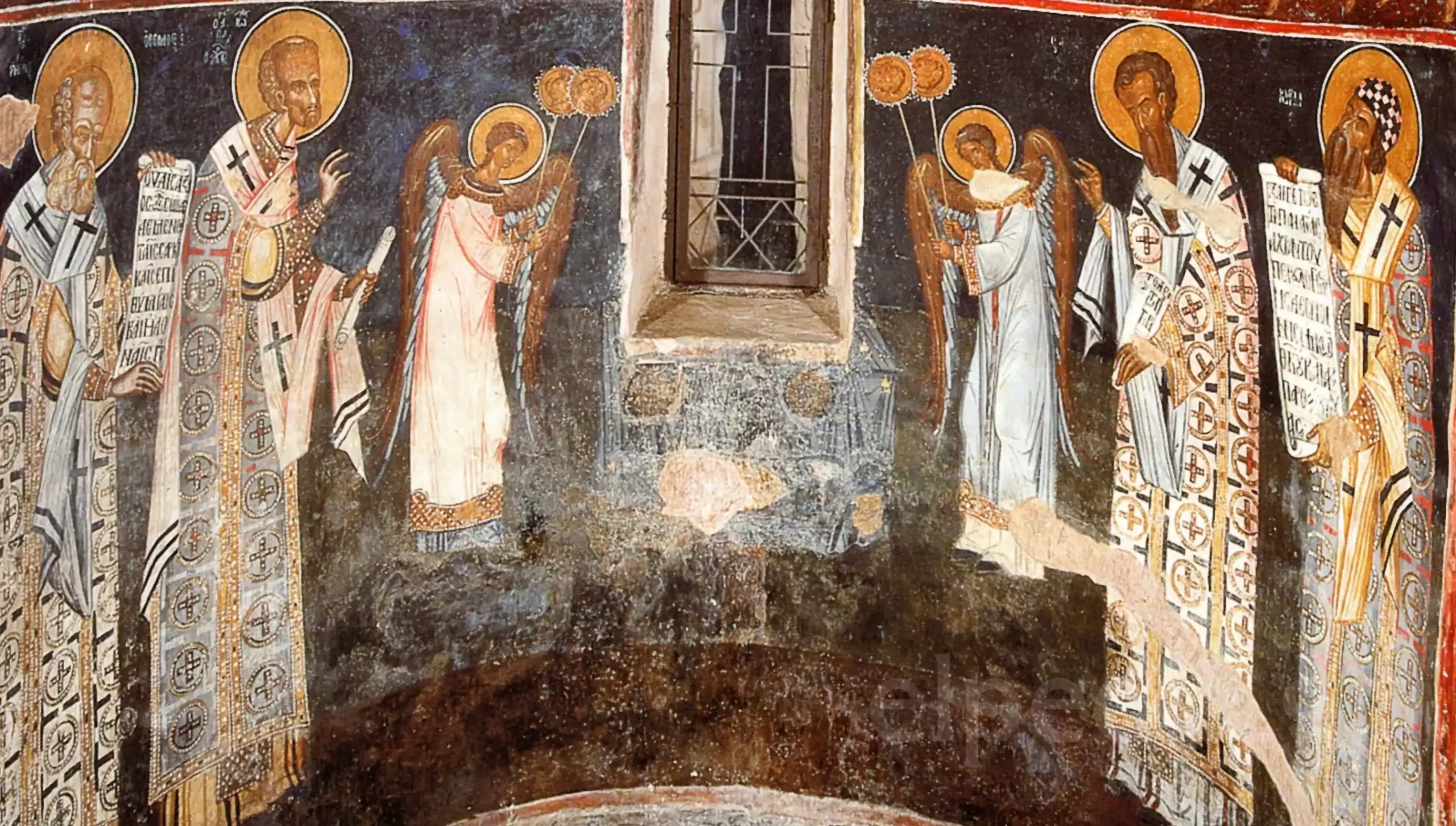
The representation of the Melismos unfolds with a robust, almost rough frontality. The Fathers of the Church converge towards the holy table, unfurling their scrolls. Their voluminous vestments, decorated with crosses, anchor them to the ground, imparting a sense of unmovable weight to the composition. In the midst, the angels hold rhipidia over the sacrificed Lamb. The decay of time has altered some of the outlines down here. The figures become one with the crust of the lime.