A rare sixteenth-century miniature reveals the art and faith of the Armenian tradition
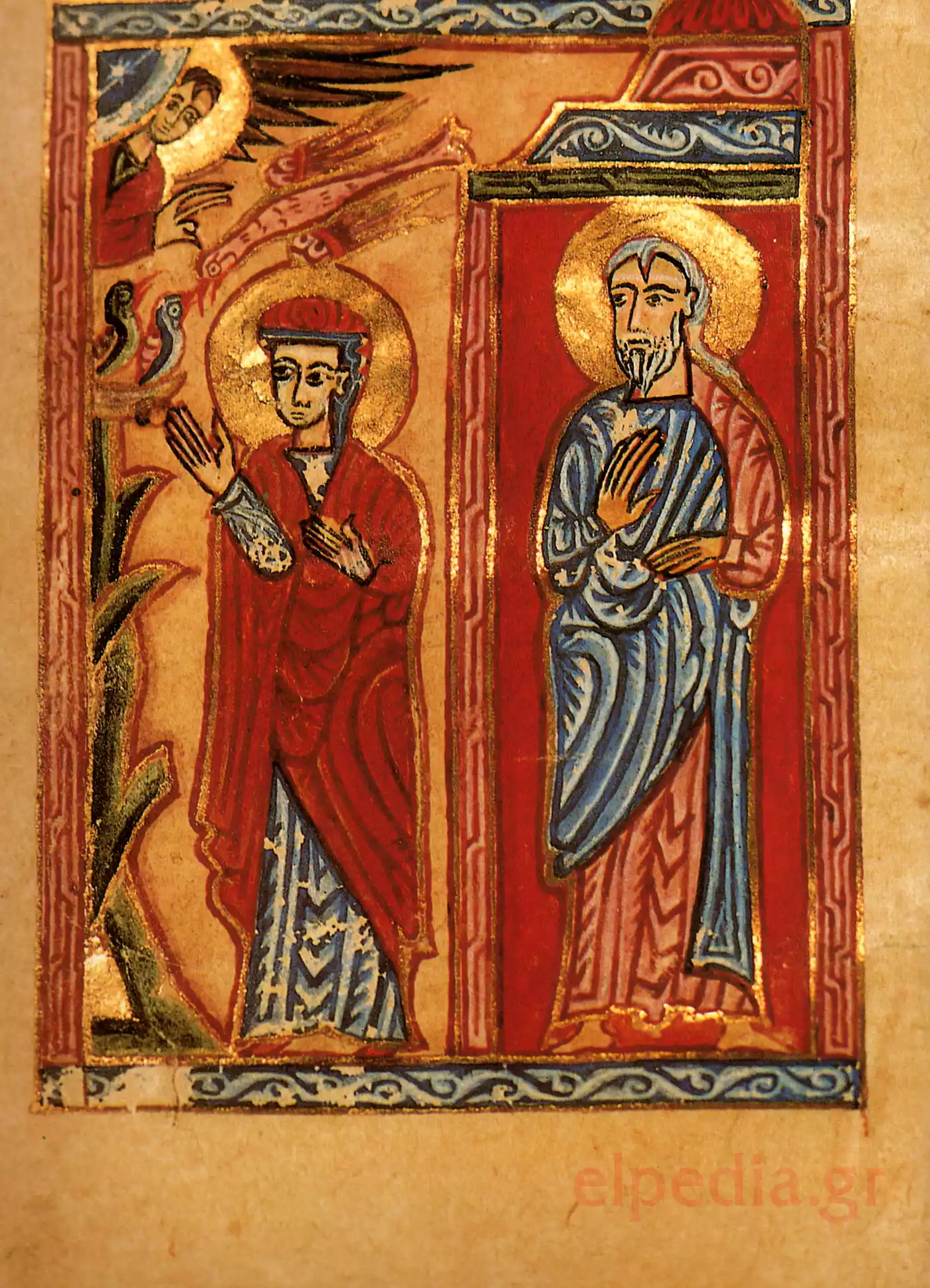
A sheet of parchment, painted in vivid red and gilded with gold leaf, has preserved since 1591 a scene that few have seen at close quarters. It is a miniature embedded within an Armenian hymnal, one of those liturgical books in which the hymns of the Armenian Church were recorded for every feast of the ecclesiastical year. It is preserved today at the Armenian Museum of France, in Paris, part of that movable heritage which the Armenian diaspora rescued after centuries of upheaval and displacement. The scene it depicts is called the Annunciation to Anna, and it narrates an episode from the apocryphal tradition surrounding the parents of the Theotokos, Ioakeim and Anna. It is not contained in the canonical Gospels, yet it spread widely through later texts and became a popular subject for illustration in many Eastern Christian traditions.
The artist remains anonymous, which was common for Armenian miniature painting of that period, yet his hand betrays a familiarity with models that had been formed in manuscript workshops centuries earlier. The study of such a work does not serve theology alone. It functions above all as historical testimony to the manner in which a community safeguarded its memory through the art of the book, a matter that has occupied research into Armenian art and its relation to the Byzantine world for decades.
The Composition, the Figures, and the Symbolic Landscape
Two arched compartments, framed by red columns and bounded above and below by vivid lattice-bands in blue, red, and gold, share the page. Within them spreads a ground of gold leaf, that technique which gave the manuscript an almost material radiance, as though light itself had been imprinted upon the parchment. In the upper left, within a small semicircle containing a star, a winged figure in red vestments emerges, its wings spread in sharp, almost flame-like lines that recall rays rather than an actual bird’s feathers.
Immediately below, a stylised plant with pointed leaves rises in the margin and shelters a small bird with pale blue plumage — a detail that lends the composition an almost horticultural tone, calm, in contrast to the dramatic quality of the divine intervention unfolding beside it.
The gaze of a viewer looking at this page today comes to rest, inevitably, upon the two central figures. Both bear a gold halo, a mark of sanctity. Both stand frontally, their bodies following that elongated, almost immaterial proportion which characterises the medieval iconography of the East, where the weight of the body yields before its spiritual charge.
The Pensive Ioakeim
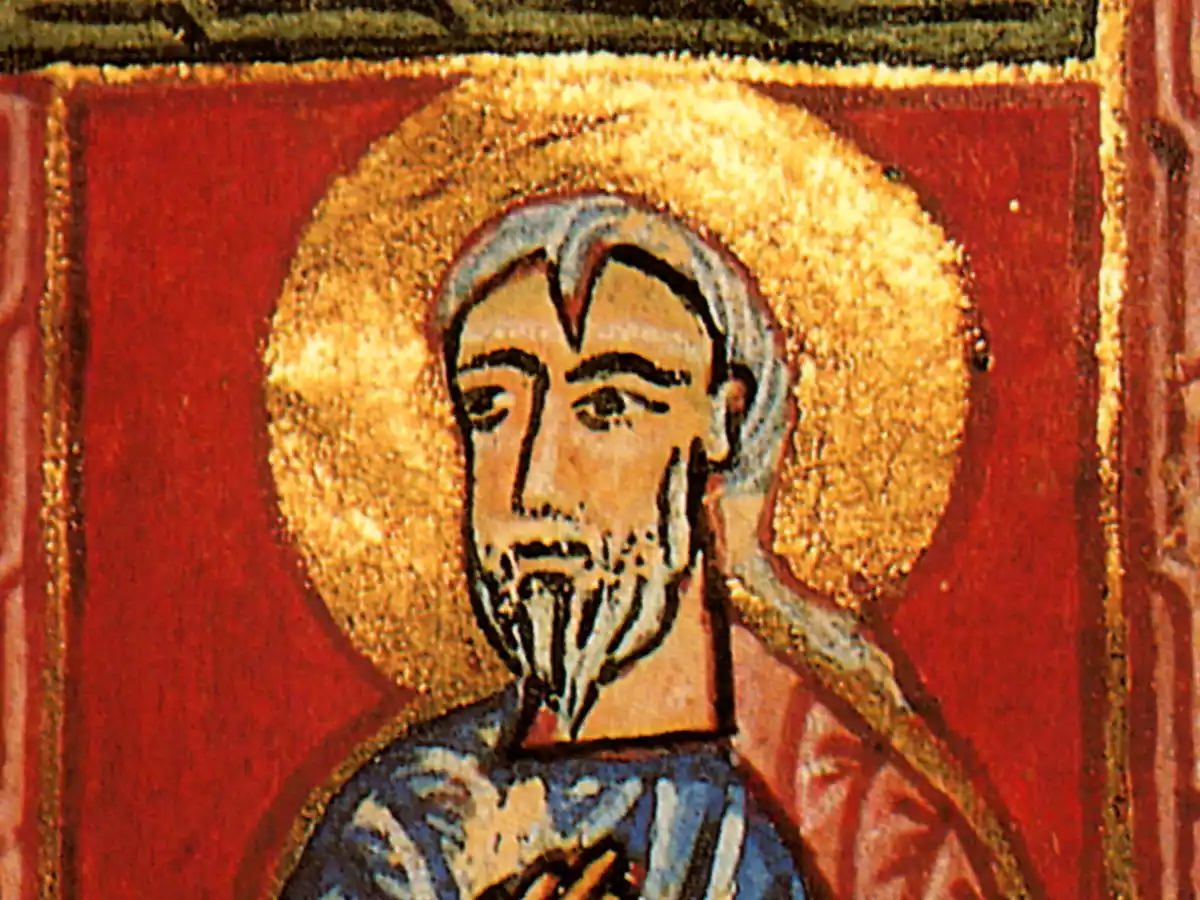
In the right-hand compartment, an elderly man with greying hair and beard holds his right hand extended upon his chest, in a posture of reverence, perhaps also of unease. The face, with its deeply etched brows and downcast gaze, expresses no surprise, but rather an inward gravity. It is Ioakeim, the father who, according to tradition, withdrew into the desert after the rejection of his offering at the temple, on account of his childlessness with Anna.
His blue garment, its dark folds indicated with loose, almost nervous lines, is set against the pink undergarment visible at the lower edge. There is none here of the dramatisation one might expect from a Western composition of the same period. The emotion passes through stillness, not through movement.
The Young Messenger beneath the Golden Ground
In the left-hand compartment, a younger figure in a red mantle and dark head-covering raises its hand in a gesture of speech. The face, small and almost childlike within the vast golden disc of the halo, bears large almond-shaped eyes with a pronounced outline, a characteristic feature of many Armenian manuscripts of that period. This gaze, fixed and almost expressionless, does not attempt to imitate human physiognomy with realism. It pursues something else — an inward presence.
The gold ground behind the head does not function merely as decoration; it functions as a spatial marker, isolating the figure from every earthly reference and placing it within a field beyond time. Who, though, is this messenger — an angel, or a prophet sent to assure Ioakeim that his prayer had been heard? The question remains open in the study of such scenes, since the iconographic tradition of the Annunciation to Anna is not always uniform across different workshops and periods.
Armenian miniature painting, from the earliest surviving examples of the sixth century to the manuscripts of the late Ottoman period, maintained certain constants without interruption: the preference for vivid red, the use of gold as a spiritual and not merely decorative element, the frontality of the figures. At the same time it absorbed influences from Byzantine art, particularly in the rendering of faces and in the arrangement of scenes within architectural frames, without, however, losing its own language. The hymnal of 1591 stands precisely at this point of intersection, between a local tradition of centuries and a broader Eastern koine, which renders it valuable not only for the history of art but also for the study of Armenian sacred music, since such manuscripts functioned simultaneously as objects of worship and as works of visual art.
The fact that so small a sheet of parchment preserved so much information — about the script, about the melody that accompanied it, about the colours and techniques of a sixteenth-century workshop — says a great deal about the endurance of the manuscript book as a vehicle of cultural memory. Today, within the display cases of the Armenian Museum of France, this page continues to speak to those who stand close enough to read, beyond the religious narrative, also the history of a community that persisted in recording its faith in gold and red.
(This is a translation from the original Greek text, translated by K. Pappas.)

