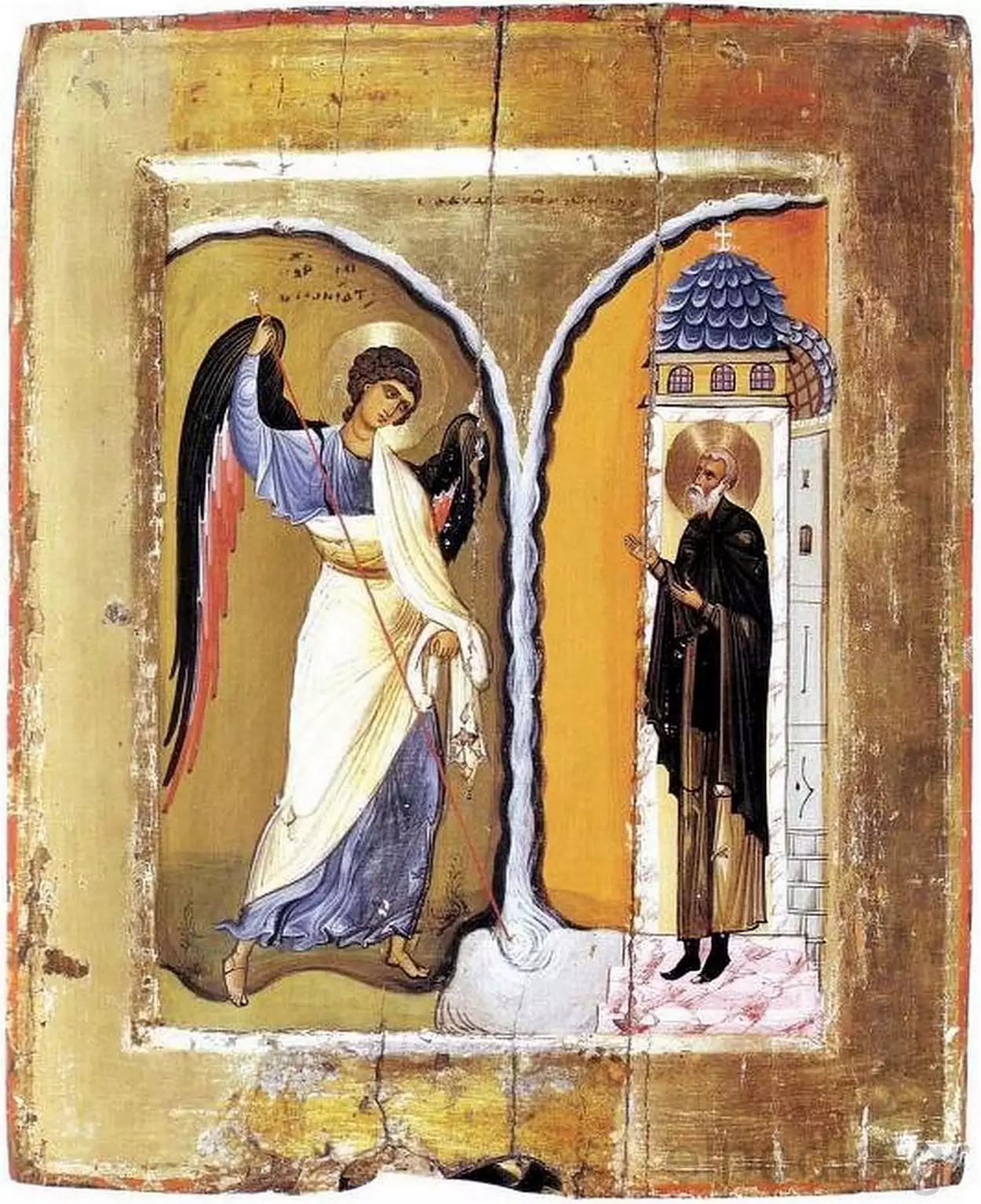
A few boards of wood, a mere 37.7 by 31.4 centimetres, suffice at times to contain nine centuries of silence. Upon this surface, somewhere between the second and third quarter of the twelfth century, an anonymous icon-painter set down one of the most dramatic moments of the Byzantine tradition: the miracle at Chonae. The Archangel Michael, winged and ready for action, appears to open the earth with a movement full of restrained tension; opposite him, motionless and almost voiceless, stands the ascetic Archippus, before the temple which he had undertaken to guard. Between them, a stream of water is traced vertically, like a fissure upon the golden field of the background.
This is not merely a matter of an icon with religious content. It is a document of the art of the Comnenian period, wherein the austerity of the composition coexists with an inner dramaturgy rare for its time. The black-red wings of the archangel, spread as if in flight, are set in contrast against the stillness of Archippus; from this contrast is born a tension which the viewer feels even today, nine centuries later.
The most interesting thing, perhaps, is the place where this work has been preserved ever since: the Monastery of Sinai, a rare example of a shared sacred space, where Christian worship and Muslim presence coexisted for centuries under successive regimes. There precisely, amid conflicting faiths and powers, survived this small panel that recounts a conflict.
The Miracle at Chonae: Narrative and Iconography
The Story Behind the Composition
At Chonae in Phrygia, according to tradition, the Archangel Michael intervened to save a temple dedicated to his name from destruction; hostile forces had attempted to flood it, diverting two rivers toward that spot. The ascetic Archippus, guardian of the sacred place, had no refuge other than prayer. And then, as the waters drew threateningly near, the Archangel appeared; with a single blow he opened the earth, carving out a ravine into which the raging torrents vanished, thus saving the temple from certain destruction.
This very moment, the moment of divine intervention, the icon-painter chose to depict. Not the battle, nor the triumph. The act itself.
The Language of Comnenian Painting
The composition is organised around two poles. On the left, the archangel moves with a dynamism recalling ancient reliefs, his garments fluttering in a moment of suspended balance. On the right, within an architectural space with a tower and a dome, Archippus raises his hands in a posture of supplication, his gaze turned toward the miracle unfolding before him. Between them, the water — white, spiralling, almost alive — functions as boundary and, at the same time, as link between the two figures.
Comnenian art, more generally, is characterised by a search for balance between Byzantine abstraction and a renewed, intriguing sense of volume; here, this search becomes evident in the movement of the archangel, who is not a static image of authority but a snapshot of action.
The Monastery of Sinai as Place of Safekeeping
The founding of the monastery goes back to the sixth century, when Justinian built it on the site of the Burning Bush, in a place that had already honoured the memory of Moses for two centuries. After the Arab conquest, the site attracted worship from Muslims as well, while a mosque was built within its walls — without this, however, endangering the monastery’s protection under the successive Islamic regimes. From the late twelfth century onward, western pilgrims began to visit it, recognising on the mountain the tomb of Saint Catherine; their devotion to this Saint, indeed, eventually overshadowed the biblical significance of the place in the West, while towards the end of the Middle Ages the Latin authorities were troubled by the monks’ reluctance to recognise papal authority, with the result that restrictions were imposed on the worship of Latins within the monastery.
Within this complex environment, then, was preserved the icon of the Miracle at Chonae — not in isolation, but as part of a long tradition of religious coexistence and tension.
A small panel, worn at the edges, its gold faded in many places. And yet, whoever stands before it feels the same tension that the unknown craftsman felt when he was designing the flight of the archangel. The icon of the Miracle at Chonae is not merely testimony to a miraculous tradition; it is a window onto an entire world, that of Comnenian Constantinople, where art sought new ways to express movement, passion, human smallness before the divine.
And perhaps that is why it survived. Not because someone considered it precious in today’s sense, but because it found refuge in a place made precisely to endure through time; the Monastery of Sinai, with its own walls, its own contradictions, its own persistence in remaining upright amid faiths that change. The miracle of the Archangel, there, found its own temple.
(This is a translation from the original Greek text, translated by K. Pappas.)

