Analysis of the mosaics in the Basilica of Saint Thérèse of Lisieux
In Normandy, France, there where the memory of a young Carmelite nun was gradually transformed into a site of mass pilgrimage, rises the Basilica of Saint Thérèse of Lisieux. It constitutes one of the most extensive religious edifices erected during the twentieth century, designed in a Romano-Byzantine style, with clear references to Art Deco. The canonisation of Thérèse in 1925 created the necessity for a church capable of receiving multitudes of pilgrims, and the answer to this necessity took the form of an impressive mosaic ensemble, crafted by Pierre Gaudin (1908 to 1973), in collaboration with the workshop of his father, Jean Gaudin.
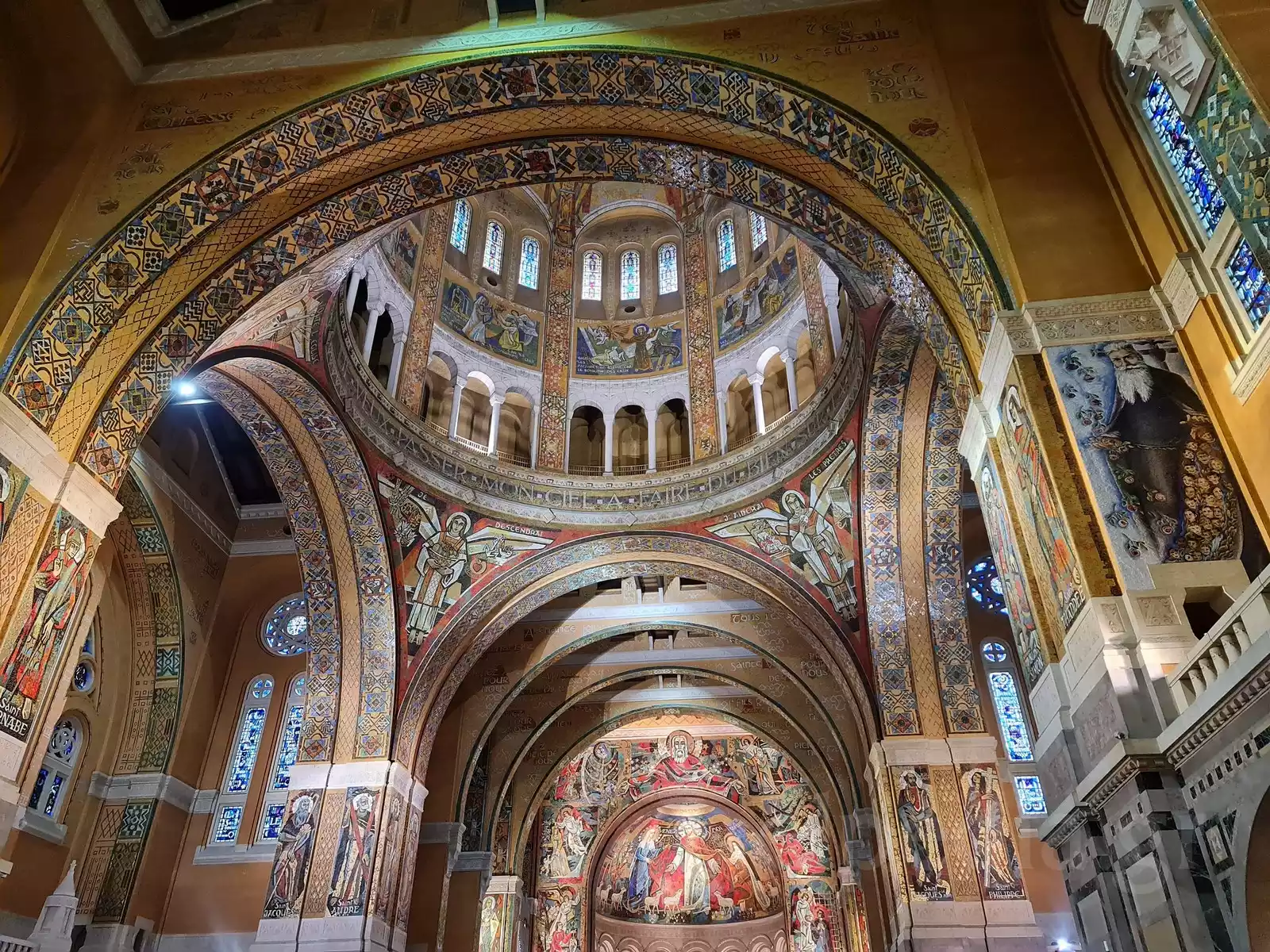
That which the visitor often perceives, at first glance, as a fresco, proves ultimately to be a work laboured tessera by tessera, monumental in its dimensions and unusually dense in its iconographic programme. It is not approached here as a place of worship, but as a historical document, as a sum of visual decisions that record the meeting of two different languages, of Byzantine hieraticism and of the geometric aesthetic of the interwar period. On the page presenting the Basilica, it is stated that the structure received hundreds of thousands of pilgrims already from the first decades of its operation, an element that explains in part the scale and the ambition of the decoration. Gaudin was called to translate into gold and colour a theology of simplicity, and the result is organised around two nodal points: the dome with the triumphal arch, and the conch of the sanctuary.
The mosaics of the Basilica: iconographic programme and style
The stylistic background: Byzantine tradition and Art Deco in the Lisieux mosaics
Very few works of religious art of the twentieth century negotiate so openly the relationship between tradition and modernity as does the mosaic ensemble of Lisieux. The architectural structure of the church, with its semicircular vaults, its twin piers and the dome that is elevated to fifty metres, follows models that trace back to the Romanesque and the Byzantine tradition. The rendering of the figures, however, the drawing, the distribution of colour, appear to distance themselves perceptibly from what one would expect in a purely Byzantine church.
Working upon cartoons that were subsequently translated into mosaic by the family workshop, Gaudin did not attempt to copy faithfully the Byzantine iconography. He retained the basic disposition of the subjects, the hierarchical placement of the figures, the use of the gold ground; he proceeded, however, to a rendering where the lines harden, the folds become geometric, the faces are simplified into a few clear contours, without this signifying that every choice of his has been interpreted adequately until today.
Gold ground, deep blue, red, white: the palette of a world that does not seek realism but intensity. These combinations recall as much the Byzantine mosaics of Ravenna as the palettes of French Art Deco of the 1930s, while the light that enters from the stained glass windows, in dominant blue tones, alters perceptibly the atmosphere of the space depending upon the hour of the day.
The dome and the triumphal arch: the central scene of the mosaics
At the point where the nave meets the sanctuary, a triumphal arch, framed by bands of geometric motifs in blue, red and gold, leads the gaze toward the dome. At its apex, a figure with a white beard and open arms, clothed in a red mantle dotted with stars, is depicted between two secondary representations. On the left, a young female figure with an infant, incorporated evidently in reference to the Tree of Jesse; on the right, a bearded figure with a staff, which refers to a prophetic or legislative presence.
On the vertical piers that frame the arch are developed smaller scenes, worked with the same economy of line. In one of these is distinguished an elderly man who embraces a large sphere covered with countless small faces, a composition that is not easy to be attributed with certainty to a specific episode. Perhaps it constitutes a reference to humanity in its entirety, perhaps an image of the forefather of all generations. The ambiguity does not appear accidental; it is integrated into the logic of a programme that prefers allusion to explicit narrative.
Elevated above the arch, the dome hosts the central scene: the crowning of Thérèse in Paradise, by Christ and the Virgin Mary. A zone of angels, eight in number, holds a garland of roses, a visual translation of her known promise that she would send a “shower of roses” after death. Lower down, between the windows of the drum, are depicted personifications of the Beatitudes, figures of saints who with their lives gave flesh to each of them; there is recognised, among them, Saint Francis of Assisi, with the characteristic garments of his order. The inscriptions that traverse the vaults, in gold letters upon a red ground, incorporate excerpts from the writings of Thérèse, such as the phrase regarding the heavenly good that she will do on earth, in a manner that recalls the inscriptions of Byzantine churches, where the word becomes equally image with the figure.
The conch of the sanctuary: the Good Shepherd in the Lisieux mosaic
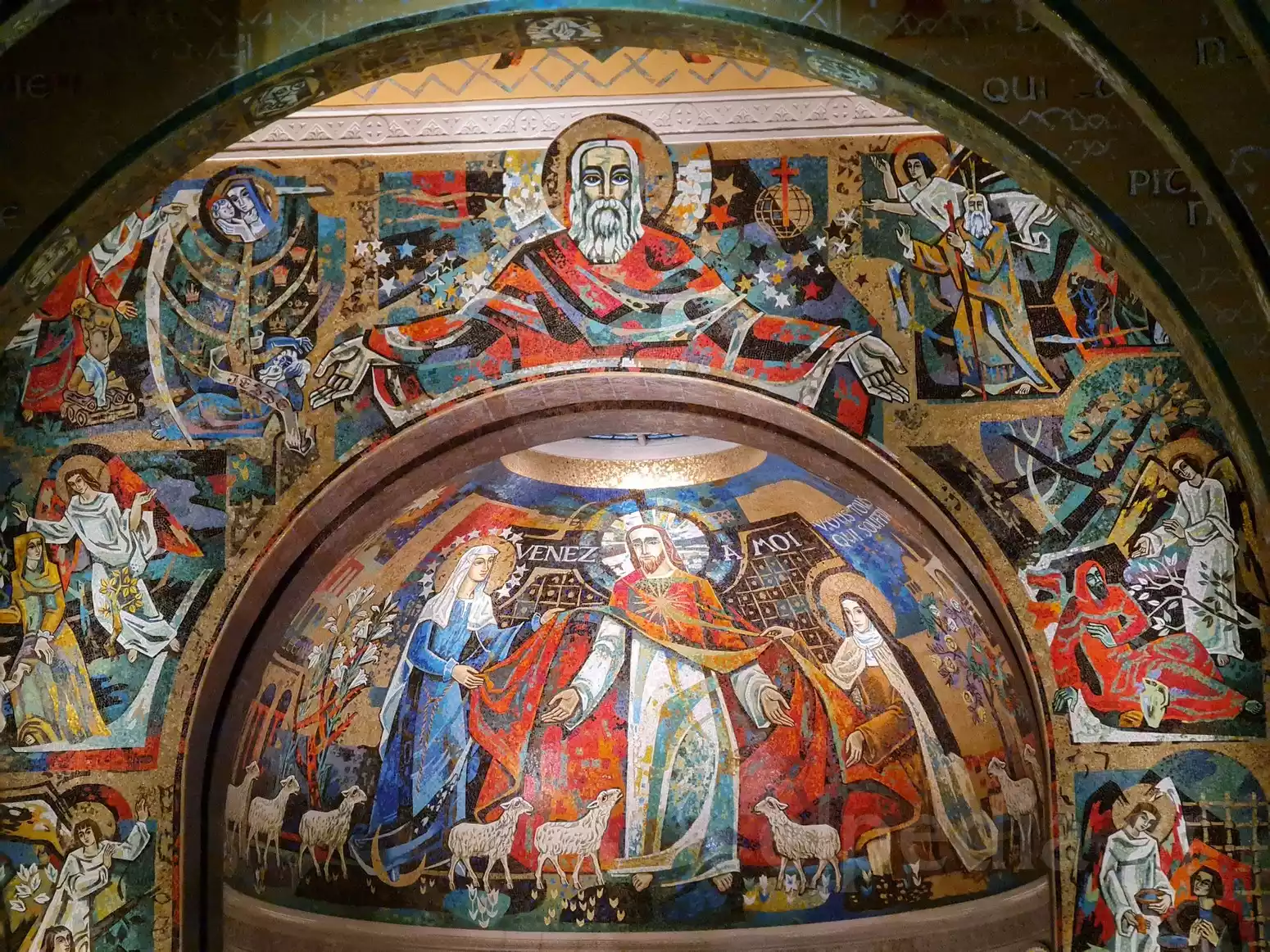
At a closer distance, there where one approaches the altar of the sanctuary, unfolds perhaps the most moving composition of the entire decoration. In the quarter-sphere of the conch, the same bearded figure that was located at the apex of the triumphal arch is repeated, this time on a larger scale, against a background of a sky dotted with stars upon a deep green-blue. Two angels frame it, the one holding a staff, the other with open hands; smaller scenes are arranged on either side, figures with garments in yellow and red on the left, an angel with white wings on the right.
Directly beneath unfolds the scene that gives to the ensemble its theological centre of gravity. Christ, standing, clothed in a white tunic and a red mantle, is framed by the Virgin Mary on the left and Thérèse on the right. Both female figures hold the folds of the red cloak, opening it wide as if creating a refuge, whilst beneath their feet sheep rendered with austere, almost geometric lines compose a flock.
Above the head of Christ, gold letters upon a black ground compose the phrase “venez à moi, vous tous qui souffrez”, that is “Come unto me, all ye that labour” (Matthew 11:28), an excerpt that refers directly to the evangelical text. The choice to render the phrase in French, and not in Latin as one would perhaps expect in so official an ensemble, manifests the intention for the work to speak directly to the pilgrim, without the mediation of the learned language. At the extremities of the composition, two small cities, the one with a star, the other with a cross, function as abbreviations, Bethlehem and Jerusalem, the beginning and the end of an earthly trajectory, recognisable without needing more detail.
The ensemble of the Lisieux mosaics is not read easily with a single glance; it presupposes time, movement within the space, a change of visual angle between the general view of the dome and the close viewing of the conch. The difference in scale, from the majesty of the triumphal arch to the almost personal scene of the Good Shepherd, corresponds to two different modes of approach to the religious experience, the collective and the individual.
Historically, the work of Pierre Gaudin is integrated into a broader current of French religious art of the interwar period, where artists sought ways to renew the iconographic tradition without renouncing it. It does not constitute an isolated phenomenon, nor an isolated experimental gesture, but a quest that is connected with parallel workshops of mosaic and stained glass of the same period, where the Byzantine heritage functioned as a point of reference for an art that wished to remain recognisably Christian.
There remains, certainly, open the question of to what extent a composition so dense in symbolisms can be read today with the terms that generated it. The contemporary visitor finds himself before a work that speaks to him primarily through colour, line, scale, without there having been given yet a fully satisfactory answer to why Lisieux continues, almost a century later, to occupy those who study the religious art of the twentieth century.
(This is a translation from the Greek text, translated by John Sakkouli.)

