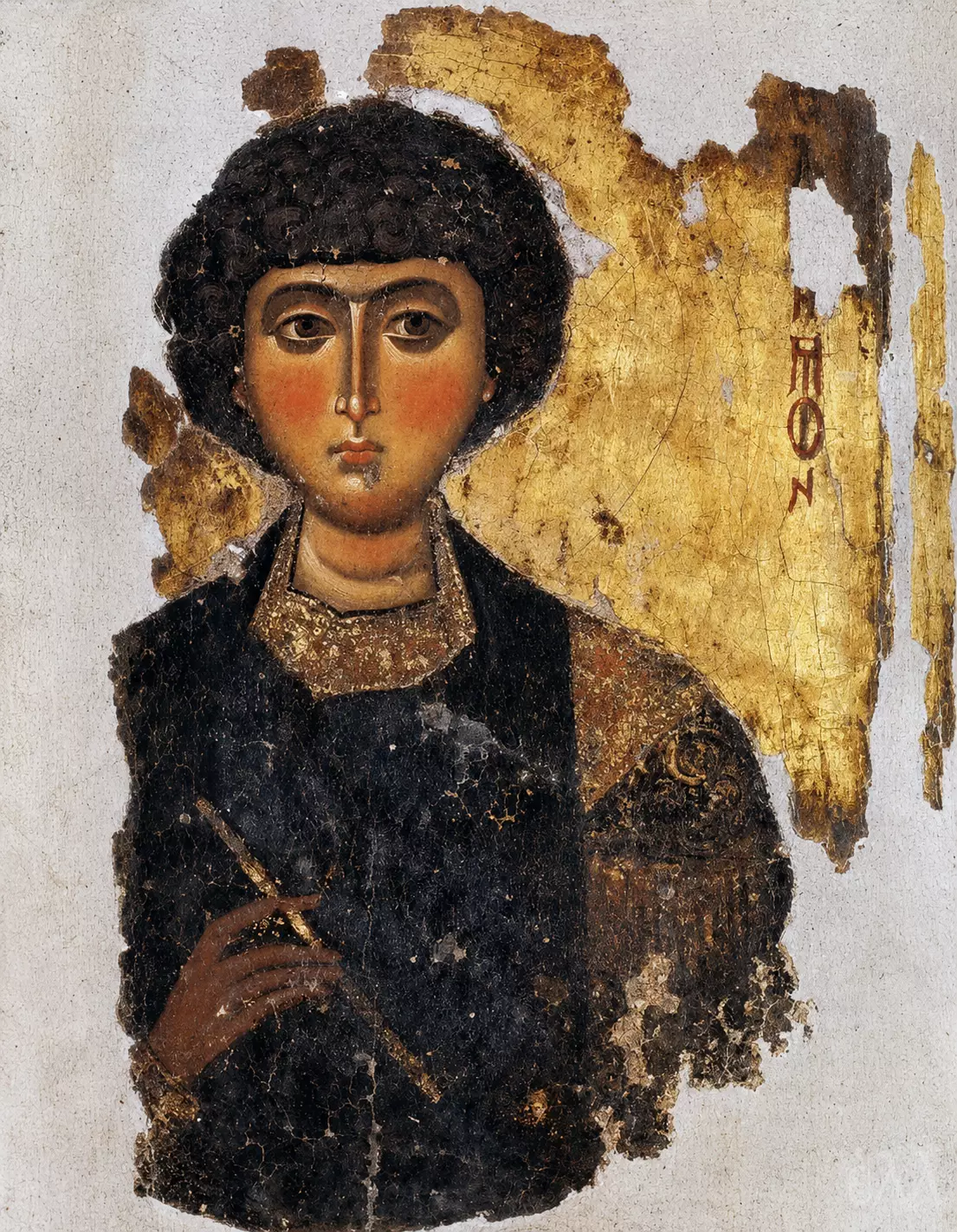
The Saint Panteleimon icon preserved at the Monastery of Great Lavra on Mount Athos is a small but exceptionally compelling survival of Middle Byzantine panel painting. Dated to the first half of the twelfth century and measuring 41.5 × 33.3 cm, it presents the holy physician as a youthful, almost boyish figure, frontal and self-contained, his dense mass of dark curling hair enclosing a face of remarkable delicacy. The gold ground is now interrupted by extensive losses; so too the body has survived only incompletely. Yet the head, the right hand with its attribute, and substantial areas of the upper garment retain enough of the original painting to disclose the quality of the work.
Its present fragmentary state is not simply the consequence of deterioration. The physical history of the image is unusually complicated. Manolis Chatzidakis, before an earlier conservation intervention was undertaken, observed that the surviving painted figure had already been separated from an original support, cut according to its contour and transferred to another wooden panel. During a later treatment, the surviving section was transferred again, this time onto a textile support. Such interventions make the icon an important document not only for Komnenian painting, but also for the history of the preservation and reuse of sacred images. Comparable Byzantine practices of retaining older painted material within new supports have received particular attention in scholarship on transferred and composite icons, including the discussion reproduced in the academic journal Modus. Modus article
Saint Panteleimon Icon: Physiognomy, Medical Attribute and Komnenian Style
Panteleimon is represented according to the youthful physiognomic type appropriate to the holy physician. Nothing in the face suggests age or physical severity. A rounded chin, small closed mouth, long narrow nose and large almond-shaped eyes produce an image whose authority is established through stillness. Above them, the eyebrows follow broad, controlled arcs. The gaze meets the spectator directly, though without the intense abstraction encountered in some earlier Middle Byzantine icons. It possesses an unusual quietness.
Around this face the hair creates a powerful dark frame. Thick, tightly packed curls broaden the silhouette of the head and make the comparatively slender facial oval appear still more refined. The contrast is pronounced: dark hair, luminous flesh, gold behind. Across the cheeks, subdued areas of red warm the complexion without disturbing the controlled tonal modelling. Shadows remain soft, concentrated particularly around the eyes, along the sides of the nose and beneath the lower lip. Through restrained tonal gradations passes the light, giving the features substance while preserving the smoothness of the painted surface.
The saint holds a slender gilded medical instrument in his right hand. Rising diagonally across the lower part of the composition, the implement provides one of the few pronounced directional movements within an otherwise frontal design. It is an identifying attribute connected with Panteleimon’s established representation as a healer saint, translating his medical identity into a concise visual sign. The fingers themselves are elongated and carefully ordered around the instrument. Face, attribute, costume: together they establish the saint’s visual identity.
The garment introduces another register of visual richness. A dark field covers much of the torso, relieved at the neck by an elaborately ornamented band composed of small light and gold-toned forms. Further decorative work survives over the shoulder. Despite the considerable paint losses, these remnants suggest that the painter originally balanced the plain expanses of the dark costume against concentrated passages of ornament, avoiding an evenly distributed surface pattern. Considerably more sumptuous must the original effect have been against an uninterrupted gold ground, although the present state prevents a complete reconstruction of its decorative scheme.
Part of an identifying inscription survives beside the saint’s head, reduced by damage to isolated letters. It is precisely the incomplete character of such elements that gives the icon its present visual tension. Large areas of gold remain; others expose losses, fissures, interruptions. The figure itself emerges from this damaged surface with surprising coherence. Its frontality is unbroken, the head remains firmly centred, and the vertical axis of nose, mouth and chin steadies the composition, while the diagonal medical instrument introduces a minor counter-movement.
Stylistically, the most revealing feature is the face. Its fine oval, almond-shaped eyes, discreet cheek colour, narrow nose and closely controlled modelling have long encouraged comparison with refined Constantinopolitan painting of the early twelfth century. Particularly significant is the affinity noted with the celebrated Virgin of Vladimir, generally associated with Constantinople and dated to the first decades of the century. The comparison depends less upon iconographic resemblance—the subjects, naturally, are entirely different—than upon artistic language: delicate transitions between light and shadow, highly finished flesh modelling, an almost courtly refinement of physiognomy, and the capacity to give an immobile face psychological presence without conspicuous dramatic expression.
Such qualities belong comfortably within the artistic climate of the Komnenian period. Twelfth-century Byzantine painting could sustain monumentality and emotional intensity, yet it also cultivated attenuated forms, elegant physiognomies and increasingly subtle forms of human expression. The Saint Panteleimon of Great Lavra occupies the quieter end of that spectrum. Emotion remains internalised. The mouth scarcely moves; the eyes carry most of the expressive burden, while the flushed cheeks preserve a sense of youth that distinguishes the saint sharply from the ascetic and episcopal types common in Byzantine icon painting.
This refinement has sometimes encouraged associations with Constantinopolitan models, although the surviving evidence does not justify assigning the icon to a named workshop. Its significance lies partly in precisely that uncertainty. Great Lavra possessed important icons of the late eleventh and twelfth centuries, some of them themselves marked by complex histories of repair, transfer and preservation. The Saint Panteleimon belongs to this unusually valuable Athonite group, its present condition reflecting repeated efforts to preserve the painted image as its physical supports failed. Scholarship on Byzantine sacred space and the placement of images has also emphasised how panel icons existed within carefully articulated ecclesiastical settings rather than as isolated easel paintings; Jelena Bogdanović’s Oxford study provides a wider architectural context for such relationships between image, framing and church space.
Damage has, paradoxically, made certain pictorial decisions more conspicuous. Against broken stretches of gold, the dark rounded hair appears almost architectural; beneath it, the illuminated face becomes the absolute centre of attention. The decorative neckline, the surviving shoulder ornament, the slender medical implement: secondary accents, each controlled. Dominant throughout is the youthful physiognomy, softly modelled yet sharply memorable, preserving within a fragment measuring little more than forty centimetres the cultivated visual language of early Komnenian icon painting.
(The translation was edited by E. Wilson.)